 And the record rotates full circle: when 2009 was fresh, I posted "Number Nine, Number Nine" on The Dancing Image in response to a meme (remember those?) about nine New Years resolutions. Now I'm ready to take a deep gulp and a look back, to see where I succeeded and where I fell short.
...enin rebmun, enin rebmuN
And the record rotates full circle: when 2009 was fresh, I posted "Number Nine, Number Nine" on The Dancing Image in response to a meme (remember those?) about nine New Years resolutions. Now I'm ready to take a deep gulp and a look back, to see where I succeeded and where I fell short.

Annie Hall
 (Another day, another delay. But not to fear, there's more where yesterday's Manhattan came from: here's a passage on Annie Hall from that same essay. Hopefully tomorrow, or the day after, I'll discuss a film mentioned by characters in both movies.
Incidentally, I don't think I can stand by the claim that Annie Hall, Interiors, Manhattan, and Stardust Memories represented the "high point" of the Woodster's career, except perhaps on the strength of the two most popular films. However, I do still think this period may have been the most interesting point in Allen's development as an artist and entertainer.)
Manhattan
 I promised some new posts for this blog, but I was just stuck on the T for about 40 minutes longer than necessary, I already have a bit to write tonight and I'm not quite feeling up to it. So here's a compromise, on my end at least: a piece new to you, but not to me. It's a selection from an unpublished essay I wrote on Woody Allen years ago (when I was 19), revived in honor of seeing Manhattan on the big screen recently, with Gordon Willis in attendance. Even with the cinematographer on hand to speak after the show, it was hard to focus exclusively on the photography: the image, the performances, the story all blend seamlessly together in one of Woody's finest pictures. Here, then, in a moment of frustration with my own city let me turn my gaze towards Allen's idealized metropolis...
(P.S. The time it took me to actually dig up this old piece made this not so economical after all, but at least it didn't take much mental energy...)
The Girlfriend Experience
 Steven Soderbergh's The Girlfriend Experience was shot quickly and cheaply in the fall of 2008, as a historic election loomed and the entire economy collapsed. The film, which leaves a bitter aftertaste, is a perfect statement of the Bush era zeitgeist right at the moment it all came undone. References to current events (which already feel a little dated, like yesterday's front page) pop up perpetually throughout the film, but in a way they are unnecessary. Soderbergh captures the time and place just as well through the hideousness of his characters and his setting - New York in the throes of a yuppiedom so impeccable yet inert, it makes one long for the tackiness of the 1980s. No tackiness here - porn star Sacha Grey is cool as an Apple-designed cucumber in her "straight" debut as high-class call girl Chelsea. Just as the title suggests, Chelsea is there to look good on her john's arm, to discuss movies intelligently (or rather, superficially but with a veneer of intelligence), to eat at the finest restaurants and listen to her "dates" whine about how they're only going to make a few million this year. And to sleep with them, of course, but the sex is almost an afterthought, and sometimes - in peeved tones - she complains in her meticulously recorded bookkeeping about the lack of intercourse. She's a pro, then, in every sense of the word, and what she sells is not so much her body as her image. What the men are buying is the faux "experience" of having her as a girlfriend; she's just one more accessory in the age of the iPod.
Catching up

As the end of the year approaches, I've a number of things on my plate. Among others, I'd like to finally put up some fresh material on this site, in addition to the usual links to the Examiner. So I'll be writing some short, in some cases very short, pieces on films I've seen over the past month. Back in the summer, I compiled a short list of movies I wanted to see before making my own top 150. Most of these movies were great director's movies I'd missed out on (including four Godards). Some were iconic popular hits like Saturday Night Fever, others were the movies I most wanted to see from Allan Fish's countdown, and still others were just acclaimed movies I had an inclination to rent (Open Your Eyes). I'm on target to finish these movies by Christmastime, and I already wrote about three of their number - When a Woman Ascends the Stairs, Accattone, and The Exterminating Angel - on this blog. Now I'm going to catch up with all the ones I've seen since then with a variety of capsules, brief reactions, short reviews and other forms of tribute. I'll also write a bit about other movies I saw but did not write about in November or December. And, of course, I'll continue to post Examiner updates (I've started linking to my "Best of the 21st Century?" pieces on Wonders in the Dark; visit there if you're looking for more discussion on the posts).
There should also be one or two big pieces - one essay, one round-up (knock on wood) - presented on The Dancing Image before year, and decade, are out.
This post was originally published on The Sun's Not Yellow; for years after it was cross-posted here, I deleted the text and just left the image - because I liked it - and a quick explanation of the original post's irrelevance (I didn't even get to a lot of the reviews I was planning). In 2017 I restored it for archival purposes.
The Tracey Fragments
 The title is quite literal, as this film - the story of a sullen girl in love with the cool new outsider boy, and guilty over the disappearance of her brother, for which her parents blame her - is told in fragments. Not just fragments of narrative, but fragments of the screen, with multiple views popping up and down, left and right, all over our monitor (and this seems a film much more suited for the small screen than the big one, lest its cacophony become overwhelming). This is a risky formal gambit, but surprisingly both story and action remain easy enough to follow, however mixed up the chronology and mise en scene. What's more, the style - while not exactly as expressive of adolescent confusion and mental exhaustion as the authors may hope - does indeed complement the subject and add to the delivery. Unfortunately, none of this can compensate for a perfunctory screenplay; in comparison to its potential, The Tracey Fragments adds up to less than the sum of said fragments.
Grizzly Man
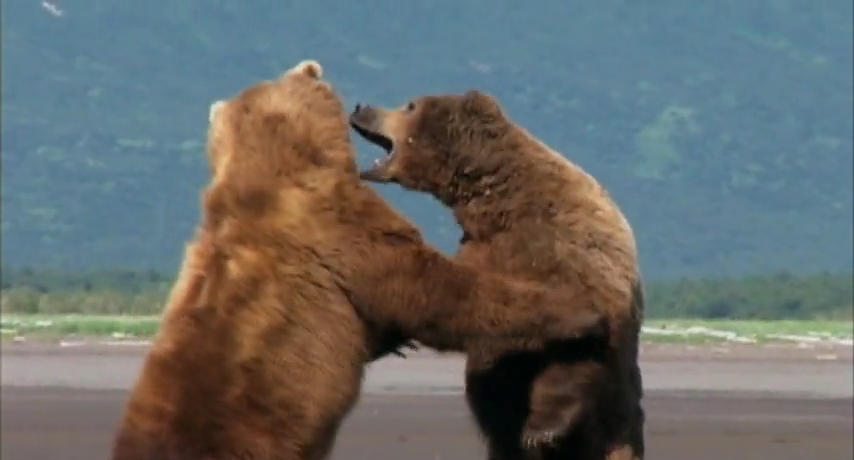
Over and over again, we are told that Timothy Treadwell wanted to be a bear. That he felt closer to bears than to other people and that in nature he sought his salvation. We’re informed, by commentators and by the narrator (filmmaker Werner Herzog himself) that Treadwell would drop on all fours and growl at those who stumbled across him in Katmai National Park and Reserve in Alaska, where he spent summers living amongst the creatures, just him and his camera. Or rather, him, his camera, and his girlfriend Amie Huguenard, whom he never mentioned or acknowledged in any of the footage, but who died alongside him in 2003. Herzog, who mixes Treadwell’s own footage with latter-day interviews and his own commentary, at one point listens to Treadwell’s death tape (the camera was running, with the cap on, so audio but no visuals remain of Treadwell’s butchering by a Grizzly in his tent). After a few seconds, Herzog rips off the headphones and tells Treadwell’s ex-girlfriend never, never to listen to the tape (which she acquired through a coroner) – in fact, she must throw it away. In his last moments, it appears, Treadwell was all too human and his death cries are too grisly for any member of his species to experience.
Antichrist

Antichrist is a film which surrounds itself with an intangible, yet undeniable, aura of Olympian, or perhaps Styxian, grandeur. First there is the title with its connotations of the apocalyptic and the blasphemous. Then there’s the reputation of the director himself – though already an accomplished filmmaker in the 1990s, Lars von Trier has made himself the cinematic bete noir of this young century, a veritable lightning rod for controversy. His psychologically brutal methods with actors have earned criticism (it’s said that Bjork vowed never to appear in a film again after enduring Dancer in the Dark), while his storylines garner accusations of misogyny and anti-Americanism. With his devilishly grinning visage and intellectually refined sadism, he himself strikes a cutting figure in public appearances and even in his own movies: the 2003 documentary The Five Obstructions saw him torture one of his idols, the older director Jorgen Leth. Von Trier forced Lethe to remake a classic short film over and over under various conditions, all of them set, with perverse pleasure, by von Trier himself (on one occasion, he rather obscenely forced Lethe to hold a banquet in front of starving Calcuttans; on another, von Trier himself takes over directorial duties, violating his own rules and holding Lethe responsible for the violation).
Yet undergirding – perhaps even motivating – all this diabolical cruelty, nastiness, and alienating misanthropy is the suggestion of a moral vision. Is this morality merely a front, a charade, as von Trier’s most vociferous critics seem to suggest? Or does von Trier, engaging in the very evil he claims to condemn, only strengthen his moral outrage by including himself in its aim? All these questions are liable to spin around in a viewer’s head while watching one of the Dane’s films, but to be fair, such questions are usually overtly suggested onscreen as well. Not so much this time. While Dogville, The Five Obstructions, and Dancer in the Dark (I’ve seen neither Manderlay nor The Boss of It All) are all evasive and tricky, their purposes are not as obscure as that of Antichrist. This new film, starring Willem Dafoe and Charlotte Gainsbourg, is narratively straightforward and stylistically far more conventional than much of von Trier’s recent work. By the ending its themes are clear enough: violence towards women, masochism masked as sadism, the collapse of smug rationalism. The story is always rather easy to follow, with some scenes consisting of nearly undisguised exposition, and the remarkably uncluttered cast certainly make the characters easy to keep track of (there are no speaking parts except for Dafoe’s and Gainsbourg’s; and all the extras have their faces blurred out). Even much of the initially obscure symbolism – the deformed animals who haunt the film, the wife’s obsessive thesis paper, the strange chapter headings (“Grief,” “Despair,” “Pain”) – is clarified by the climax. Yes, the “what” is not so hard to ascertain. What’s more elusive is the “why.”
This is England
 It's 1983. Arch-conservative Prime Minister Margaret Thatcher is at 10 Downing Street. The UK has just recently emerged victorious from the brief Falklands War, in which a few hundred British troops died. And in the poorer and more working-class districts of England, gangs of skinheads roam the streets, albeit not with the connotations that term carries now...not yet anyway. Director Shane Meadows firmly places his story within this historical context, in an opening montage which combines images of 80s pop culture with documentary footage of political occasions and social unrest. Then he segues into the main narrative, a coming-of-age tale centered around Shaun (Thomas Turgoose), a 12-year-old whose father has died in the Falklands War. The boy misses his dad, is mercilessly teased, and seems vaguely lost until he is adopted into a good-natured gang of older skinheads.
Coming up this week
 Originally this provided a link to a preview of my upcoming work at the Examiner. Here are links to the new homes of the pieces written that week: This is England, Antichrist, Grizzly Man, The Tracey Fragments.
This post was originally published on The Sun's Not Yellow.
Capturing the Friedmans

Putting aside the fact that much of Capturing the Friedmans is in video – certainly the family home movies provide its elusive emotional core – this 2003 documentary calls to mind those competing definitions of cinema: “truth 24 frames a second,” “lies 24 frames a second.” While nonfiction films would seem to sway the pendulum in the former direction, they actually make the issue even more complex. On the one hand, what we are seeing, especially in a documentary like this which utilizes primary source material (home movies compete with interviews for screen time, and there are no re-enactments – thankfully) is an undeniably direct representation of external, physical reality. On the other hand, what lies behind that exterior – what is the shell of the image concealing? And more importantly, why this particular footage, and why shown in this particular way? If the truth is in what we see on screen, then the lies – or at least the mysteries – are what we don’t see, what’s hidden behind and littered around the frame.
In Bruges
 Martin McDonagh apparently never received (or else discarded) the memo that Tarantino-style hip thrillers are out of fashion. Good thing too, because In Bruges is amusing fun, even if its conceptual hook is no longer fresh and the first and second halves of the black comic plot sit uneasily next to one another. The film ultimately displays a deft command of dialogue and character: its protagonists may seem stereotypical but, as embodied by Colin Farrell and Brendan Gleeson, they live and breathe relaxed charm - even in the more hyperkinetic moments. (Incidentally, minor spoilers ahead...) Ken (Gleeson) and his younger protege Ray (Farrell) have been exiled to Bruges following their latest hit (in what has become the default occupation of characters in need of a job, they are professional killers). Ken enjoys the prettily medieval scenery while Ray gripes, drinks, gay-baits, makes fun of midgets (er, dwarfs), punches out Americans, and woos a sexy drug dealer (Clémence Poésy). Finally their boss, Harry (Ralph Fiennes, sounding remarkably like Michael Caine over the phone, at least to this ignorant Yank's ears), calls Ken to deliver his troubling assignment: kill Ray.
Subscribe to:
Posts (Atom)