Lost in the Movies

Wonders of the Past and Present: Conversation w/ Wonders in the Dark's Sam Juliano, author of Paradise Atop the Hudson & Irish Jesus of Fairview (podcast)


The history of Sam Juliano's film (and wider arts) website Wonders in the Dark dovetails almost perfectly with my own. I launched The Dancing Image (the original incarnation of Lost in the Movies) in July 2008 while Wonders kicked off two months later in September. But Sam's appreciation of and engagement with the cinema began much earlier. In this conversation, we begin by discussing Sam's seventies and eighties cinephilia as well as his connection with his British complementary opposite Allan Fish whose decades countdowns launched a fruitful collaboration. (Sadly, an extended chat about Allan's persona and approach got lost in the midst of Zoom technical difficulties.) From there, we explore Sam's new novels Paradise Atop the Hudson and Irish Jesus of Fairview, which mix slice-of-life memoiristic details, melodramatic explorations of violent bullying, and eccentric navigations of cultural dynamics and gender presentations. Finally, we wrap up with a look at this current year and the recent era anchored by Sam's recent viewings and Oscar predictions. As I conclude my public film discussions on this site, this conversation provided a great opportunity to bring things full circle.


LINKS


(future polls appear under weekly Monday Morning Diaries)

(& list of "Fish Obscuros")

Reaching the Finish Line for Public Film Writing/Podcasts


Early next week, I will share three or four new public pieces - an essay, a podcast, a conversation, perhaps a video montage - alongside some other announcements or teasers. These will serve as a farewell to the era of non-Twin Peaks (and perhaps non-Citizen Kane) public film/TV commentary on this website...

For over three years, I've been following a very particular schedule on this site, presenting written film analyses on Wednesdays, weekly or monthly public podcasts on Thursdays, status updates or other random posts on Fridays, Lost in Twin Peaks illustrated companions on Saturdays, Patreon cross-posts on Sundays, TV viewing diaries on Mondays, and video essays on Tuesdays. Out of necessity, I am abandoning this approach in the final days of October because the posts I hoped would be up this past Wednesday and Thursday didn't make it in time and I don't want to drag this process into November. I believe I can have the major holdouts - a conversation with blogger/author Sam Juliano, a written review of the documentary 63 Up, and my final Sight & Sound miniseries podcast episode on Andrei Tarkovsky's Stalker - ready by October 31. I also want to record a YouTube message about the Journey videos and other work (essentially reiterating what I'm laying out here but for the platform where the most people find and follow me).

For a long time, I've seen my November 1 birthday as a threshold for my online work, a deadline to wrap things up and shift toward a new approach. Initially I thought this would include concluding my three major Twin Peaks projects: the public presentation of my Lost in Twin Peaks podcast; the last thirty entries of my TWIN PEAKS Character Series; and of course Part 6 of my video series Journey Through Twin Peaks. I finally realized a few months ago that even if I devoted every possible hour to them I wouldn't come anywhere close to finishing them in October. So my goal narrowed to ending my public film commentary after fifteen years (future reviews and most other reflections will be reserved for patrons) so that from November onward, I could focus on finishing those Peaks projects before moving on to other ambitions. However, even this more limited goal may be slightly compromised since the remaining chapters of the Mirrors of Kane video series should be shared with the public too, fulfilling the promise I made back in 2016; like those Peaks projects, Mirrors has been years in the works.

By the end of October, I would also love to tackle a long-brewing avant-garde video montage idea involving Watership Down and Brideshead Revisited or, if that doesn't gel, maybe another Mirrors of Kane chapter involving Bernstein; wouldn't his wistful ferry speech provide a wonderful note on which to end this period? Unfortunately, this goal seems unlikely to be reached given my busy on- and offline schedule this weekend and early next week, especially, and unexpectedly if beneficially in other ways, the offline schedule. Meanwhile on Patreon, the Episode 100 finale of my patron podcast (composed of a dozen films in focus which have already been previewed for a higher tier) has long been completed but I've been waiting to release it until everything else has been published for the month. Additionally, I'd like to offer a couple more rewards just for patrons: a character study for the $1/month tier and an exclusive film review for the $5/month tier. Going forward, those will probably be the regular monthly rewards for those tiers (with back halves of bonus Twin Peaks Conversations sometimes replacing the film review for $5/month patrons) and I'll record a new Patreon welcome video reflecting this as well.

So far nothing has really worked out as expected, but maybe I can finally hit the target with these last offerings. Thanks for hanging in there and I hope you enjoy the end of October with me.


Sight & Sound #11 Sunrise (LOST IN THE MOVIES podcast #59)


Following my coverage of Jeanne Dielman, Beau Travail, and Close-Up, Sunrise is the first film in my Sight & Sound podcast miniseries that I saw before this particular project; however, in all these years of online work I've never discussed it in depth. The F.W. Murnau-directed silent film is famous as, among other things, arguably the first real Best Picture winner at the Oscars (it won a one-time-only "Unique and Artistic Picture" award alongside Wings' canonized victory for "Outstanding Picture"). It's been a mainstay on the Sight & Sound list for decades although 2022 saw it slip slightly from its 2012 peak at #5. The story of a husband (George O'Brien) considering the murder of his wife (Janet Gaynor) because he's under the sway of a diabolical "Woman from the City" (Margaret Livingston), Sunrise makes several unexpected and enthralling swerves in narrative, tone, and character. How in the world does a brooding melodrama set in a rural village find time for a drunken pig on the floor of an urban Jazz Age nightclub dance floor?! I love the film - and Murnau's work generally - for its willingness to wander, but of course Sunrise's appeal goes far beyond the narrative: this is just an absolutely gorgeous film to look at. Re-visiting this movie takes me back to the early days of this site, when I covered silent cinema with much more frequency than in recent years. While the film hails from an era that's now a century past, it's fascinating to consider how close it is to the present - as I point out on the podcast, the three central actors lived into the mid-eighties, all dying within a year of one another and (just barely) within my own lifetime.


Subscribe, rate, and review on Apple Podcasts
You can also listen on Pinecast and Spotify
(and most places podcasts are found)


The Curious Case of Benjamin Button (The Unseen 2008)


"The Unseen" is a series in which I watch popular films for the first time (spoilers are discussed, including for Twin Peaks and Forrest Gump). The list, which moves backwards in time, is based on the highest-ranked film I've never seen each year on Letterboxd (as of April 2018). The Curious Case of Benjamin Button was #5 for 2008.

The Story: "So we beat on, boats against the current, borne back ceaselessly into the past." The famous conclusion of F. Scott Fitzgerald's The Great Gatsby was literalized by the same author three years in the past (how appropriate) with his 1922 short story The Curious Case of Benjamin Button. And David Fincher's cinematic adaptation, based on a screenplay by Forrest Gump's Eric Roth (a connection hard to miss), literalizes this concept even further with actual floodwaters threatening the hospital deathbed of Daisy Fuller (Cate Blanchett) in 2005 New Orleans. As Hurricane Katrina bears down on the city where she spent much of her life, the eighty-two-year-old Daisy shares an anecdote, and then a diary/scrapbook, with her thirty-seven-year-old daughter Caroline (Julia Ormond). The anecdote relates the sad tale of Mr. Gateau (Elias Koteas), a clockmaker who was commissioned to create a grand timepiece for New Orleans' train station; grieving the recent loss of his son in World War I, Gateau's installation runs backwards, symbolically wishing for the return of those dead young men. The diary reveals that, around the same time - the night of Armistice Day to be exact - button manufacturer Thomas Button (Jason Flemyng) raced home through the jubilant end-of-war celebrations to find his wife (Joeanna Sayler) dying in childbirth. Horrified by the infant's appearance - the boy is a shriveled creature covered by wrinkles and wracked with arthritis, cataracts, and other ailments - Thomas flees his home with the baby in his arms, nearly tossing the child into the river before hiding him on the steps of a nursing home.

Adopted by caretaker Queenie (Taraji P. Henson) and dubbed Benjamin (eventually played by Brad Pitt whose features are fused with other actors' bodies early on), the child is not expected to live very long. Every day of existence seems a miracle, and all the more miraculous is his slow recovery from all those birth defects. Though small in stature, well into adolescence his face and body resemble the elderly residents surrounding him; he needs braces after finally standing from his wheelchair inside a revival tent (the preacher played by Lance P. Nichols collapses in death even as he summons Benjamin to rise). Drawn to the outside world but unable to travel far - physically because he's old and mentally because he's still a dependent child - Benjamin falls in love Daisy (Elle Fanning and Madisen Beaty before Blanchett steps in), a girl visiting her grandmother at the home. Just a few years younger than him in reality, they appear to be separated by an almost unbridgeable gap of generations. Eventually Benjamin becomes self-reliant enough to begin work on a tugboat, where the salty, tattooed Captain Mike Clark (Jared Harris) introduces the naive youngster to the pleasures of booze and women. Departing for a series of international engagement during the Great Depression, Benjamin - now looking like a seasoned but far more upright sixtysomething - meets the refined British expat Elizabeth Abbot (Tilda Swinton) while docked in the Soviet Union, already at war with Germany although the U.S. is not. The sailor and the diplomat's wife begin an affair with ends without explanation on the eve of Pearl Harbor; from there Benjamin joins his captain in a war effort where they serve mainly to assist bigger and sturdier cargo conveys and battleships.

After a relatively quiet period at sea, the tugboat battles a U-boat and Benjamin is one of few survivors. He returns to New Orleans looking middle-aged while his mother appears noticeably older. When he is reunited with Daisy, she is at the peak of youthful beauty and vivaciousness - a trained dancer, she lives in New York City and provides a stark contrast with Benjamin's reserved Southern gentleman demeanor. He declines her sexual overtures and then attempts to visit Manhattan and sweep her off his feet a few years later, by which time she has another lover. They remain emotionally too far apart to kindle their chemistry into something deeper and more fulfilling. Meanwhile, Benjamin's father reaches out to reconcile with him, explaining the young man's history for the first time and eventually passing the booming button business onto the younger Button when Thomas dies. Another decade, another phase of life for Benjamin, who is now spry enough to race his motorcycle from one romantic encounter to another while also encountering another missed connection with Daisy in the fifties. The handsome bachelor discovers that the talented performer's career has been cut short by a devastating car accident; when he shows up in Paris to visit, she rejects even his overtures of friendship. Only in the sixties, when they are both chronologically and physically around forty, do the couple finally come together. Traveling in style and living off the Button family earnings (they move in together only after Benjamin's non-Button mother passes away), they embrace the vitality of rock and roll and the sensuality of the era. A daughter - Caroline, it turns out - is born in the late sixties and Benjamin decides he must depart to wander the world and prepare for an old age in which he will transform into a child.

Benjamin and Daisy reunite one other time to make love, she now aged into her fifties (with a new husband to raise Caroline) and he a beautiful youth of twenty or so, before their final years together. A seeming adolescent whose confusion has more to do with senility than puberty, Benjamin returns to the nursing home and is looked after by his former lover now playing the role of mother; he dies in her arms as a fresh-faced infant just a couple years before her own end. Caroline is shocked to learn all of this history in her mother's final moments, just as it becomes clear that the hurricane is about to consume the city. Nearby, Gateau's ornate clock - recently replaced by an impersonal digital display - rests forgotten in a basement and drowns in the deluge.

The Context:

Harry Potter and the Half-Blood Prince (The Unseen 2009)


"The Unseen" is a series in which I watch popular films for the first time (spoilers are discussed). The list, which moves backwards in time, is based on the highest-ranked film I've never seen each year on Letterboxd (as of April 2018). Harry Potter and the Half-Blood Prince was #8 for 2009 - the next entry will be published later today.

The Story: Far from the gothic fairy-tale setting of Hogwarts School of Witchcraft and Wizardry in the Scottish Highlands, wicked creatures are attacking ultramodern twenty-first century London. The fanatical Death-Eater cult - who use black magic in a campaign against sorcerers born to Muggles (non-wizard humans) - destroy the Millennium Bridge; no wonder the salty old Hogwarts headmaster Dumbledore (Michael Gambon) yanks his star pupil, Harry Potter (Daniel Radcliffe), away from a date with a waitress (Elarica Johnson) whom he's just worked up the nerve to ask out. Harry is needed to help save the world; romantic rites of passage can wait. And yet despite these apocalyptic stakes, Harry will spend the next days and/or weeks far from the metropolis calling out for his protection, instead helping Dumbledore recruit (and then spy upon) a former professor (Jim Broadbent), studying an old spell book altered by the mysterious "half-blood prince" in his remote academy, and - after all - navigating romances between and around himself, his friends Hermione Granger (Emma Watson) and Ron Weasley (Rupert Grint), and Ron's sister Ginny Weasley (Bonnie Wright). Distrustful of rival student Draco Malfoy (Tom Felton) and the imperious teacher Severus Snape (Alan Rickman), Harry eventually discovers that their perniciousness runs even deeper than suspected; collaborating to bring down Harry's mentor, they end up killing Dumbledore (with Snape revealing that he himself was the half-blood prince who wrote the spells Harry has been using). Harry concludes that he must hunt down the evil Voldemort - once upon a time the brilliant but resentful Hogwarts student Tom Riddle (Frank Dillane and Hero Fiennes-Tiffin), whom Dumbledore rescued from an orphanage. And Harry's friends insist on accompanying him on this quest.

The Context:

Sight & Sound #9 Close-Up (LOST IN THE MOVIES podcast #58)


For the third week in a row (and the last time, although two more entries remain) I'm covering a film I'd never seen before as part of my Sight & Sound podcast miniseries. Abbas Kiarostami's Close-Up (1990) mixes fly-on-the-wall documentary, manipulative "reality" filmmaking, and re-creation in its depiction of the humble Hossain Sabzian, a cinephile who ingratiates himself with the affluent, cultured Ahankhah family by posing as famed film director Mahmoud Makhmalbaf. Arrested and put on trial for this con, he offers unusual defenses - some perhaps suggested by Kiarostami (who shows up to film the court proceedings and becomes part of the process himself). And amazingly, both the defendant and the family pushing for his prosecution agree to play themselves for Kiarostami's camera, re-imagining their own fateful encounters. Like the two films I discussed previously - Jeanne Dielman, 23 quai du Commerce, 1080 Bruxelles (with guest Ashley Brandt) and Beau Travail - this is a highly unusual art film pushing the boundaries of cinematic storytelling. No wonder Close-Up placed slightly higher on the directors' list than the critics'; in narrative, theme, and self-conscious approach, this is a filmmaker's film.


Subscribe, rate, and review on Apple Podcasts
You can also listen on Pinecast and Spotify
(and most places podcasts are found)


October status update: what's left for public film/TV commentary


A month ago, I observed that I could either continue to try and finish my big Twin Peaks projects as soon as possible (alongside a grab bag of non-Twin Peaks pieces) - understanding that none of it would be done before my original October 31 deadline - or I could just put all my eggs in the film commentary basket and try to wrap that up that work before November (letting the Twin Peaks projects end whenever they end, hopefully at some point in 2024). Obviously at this point I've chosen the latter path although I do hope to get a few TWIN PEAKS Character Series patron advances and one Lost in Twin Peaks week of episodes up this month, concluding my coverage of season three. Those aside, October will be the month of concluding my original and longstanding focus for this website: written, audio, and (hopefully) video pieces on particular movies. In the future, I plan to reserve that type of work for Patreon, using my public platform to conclude the Peaks podcast and character studies as well as the Journey Through Twin Peaks video series before shifting my focus to less cinema- or television-specific video projects, and maybe even embarking on some filmmaking endeavors.

Sight & Sound #7 Beau Travail (LOST IN THE MOVIES podcast #57)


A week after this Sight & Sound podcast miniseries covered the #1 film Jeanne Dielman, 23 quai du Commerce, 1080 Bruxelles with guest Ashley Brandt, I'm back for a solo discussion of another film I just watched for the first time: Claire Denis' 1999 Beau Travail. Placing high on both the critics' and directors' lists - and shooting way up the ranking since 2012 - the film is a fascinating, deeply unusual exploration of desire, discipline, and repression. Chronicling the idiosyncratic French Legion in former colony Djibouti with dreamlike choreography and elliptical plot machinations inspired by Herman Melville, Denis depicts a tense but indirect conflict between soldiers Galoup (Denis Lavant) and Sentain (Gregoire Colin). Gorgeous visuals and stirring music (ranging from modern opera to nineties Europop) make this film at least as much a sensory experience as a cerebral one, yet I found a lot to talk about with its themes and characterizations. In fact, the vivid viewing experience inspired me to go back and explore Billy Budd, teasing out what Denis changed from the century-old novella she used as inspiration as well as the significance of those changes: shifts in perspective, emphasis on certain characters rather than others, and how the historical context affects what we take away from the central struggles.


Subscribe, rate, and review on Apple Podcasts
You can also listen on Pinecast and Spotify
(and most places podcasts are found)


September 2023 Patreon round-up: EXCLUSIVE - More thoughts on "Barbenheimer" & Podcast Episode 100 Feedback + ADVANCE - TWIN PEAKS Character Series entry


With summer officially coming to an end, it was finally time to wrap up my "Barbenheimer" reflections which began with a public double review of Barbie and Oppenheimer in the week after their July 21 release. I announced back then, and am now delivering, a lengthy, in-depth follow-up essay exclusive to the $5/month tier with no plans to share it any further. If you enjoyed the first piece, you'll definitely want to check this one out; in twenty-one paragraphs and over six thousand words, I explore the recent films of both Christopher Nolan and Greta Gerwig and how they lead into their latest work, the political ramifications of Oppenheimer, why the meme/trend of combining the two movies took off, the millennial resonance of both but especially Barbie, and many other related subjects. Given the way it builds off what I've written about both Nolan and Gerwig for the full fifteen years of this site, and how it echoes a piece I wrote almost a decade ago (another dual review providing a springboard for cultural reflections), this essay feels like the perfect punctuation for this moment in my own online activity. I didn't think it would take this long for this sequel to be ready, but I'm quite pleased with the results and hope you consider them worth the wait.

Between my "Barbenheimer" analysis and the many podcasts previewed in August and still unreleased to other tiers or the public, this is a great time to make the jump to the top tier if you've ever considered joining. However, there are also rewards for $1/month patrons to enjoy, including the first taste since March of the main patron podcast's Episode 100 - in this case, a final round-up of listener feedback. And as always, I'm sharing a TWIN PEAKS Character Series entry (albeit one that I still need to revise a bit) at least a month ahead of schedule - in this case well in advance, since I probably won't resume the public series again until 2024.

Farewell to Netflix DVD: the end of an era...


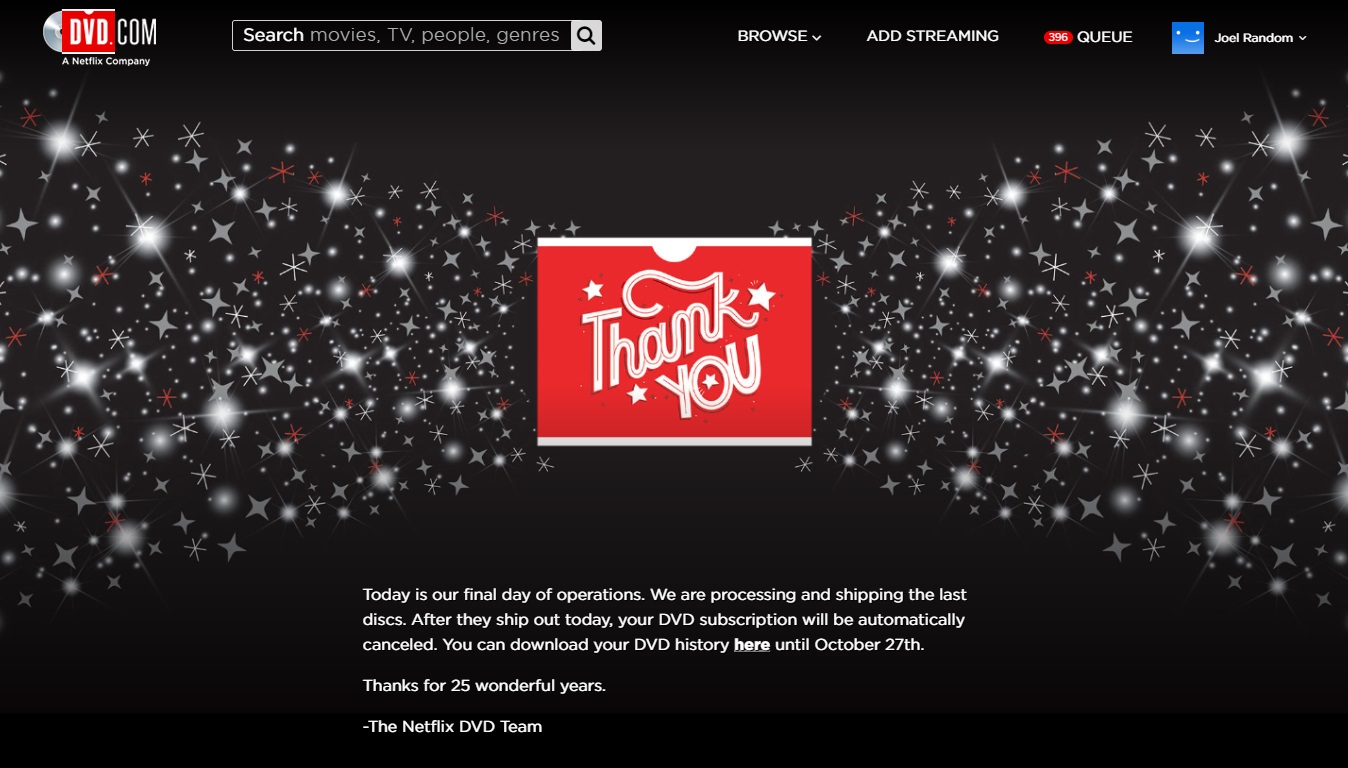
Netflix's DVD mailing service ends today, and my last disc (Carmen Jones) was sent a few days ago. Although the closure received buzz in the past few months since it was announced, the vast majority of Netflix users - streaming subscribers, if it even needs to be said - likely have no idea that the postal service was still delivering those once-famous red envelopes at this late date (and technically, still will be as the last stray scarlet survivors reach their now-permanent homes early next week). As with so many of these mercurial changes, it's hard to say exactly when "Netflix" came to mean streaming from a number of quite limited titles rather than choosing a rental from a vast library of physical media and receiving that object from the company. Some time around the middle of the last decade, while I stubbornly persisted with this practice, most of my friends and family would appear surprised when they spotted the envelope, or heard me reference "getting a Netflix"...as if this could mean anything besides picking up a remote control and pressing a button. Much of my own work for the past fifteen years of this site - a period that parallels Netflix's own gradual shift away from its original model - would have been far more difficult and even impossible without access to a catalog far more vast than anything offered by a single streaming service (or even a collective sampling of many individual subscriptions).

This quiet termination, long expected among those of us aware it hadn't already happened, is indicative of much broader cultural trends. Sam Adams has already written a piece that articulates most of what I'd want to observe: "The Death of Netflix DVD Marks the Loss of Something Even Bigger". (The piece was either promoted or originally titled, before an all-too-revealing namechange to something catchier and more recognizable, "Remember the long tail?" Apparently not.) Adams references an article and book from the early zeroes (in the spirit of the general intransigence that led me to keep skirting streaming in favor of renting physical discs, I still won't call that era the aughts): "...on-demand manufacturing and digital distribution would disrupt the winner-take-all logic of monopoly capitalism and allow businesses to profit by making a nigh-infinite variety of products available to any audience, however small." The cultural trajectory of my own youth was in many ways the peaking and waning of this phenomenon - so in addition to the more generalized obituaries of Adams and others, I'd like to offer a few of my own personal reflections at the graveside.

My Netflix DVD history not only parallels but precedes my online work, stretching back between June 28 and 29 in 2005 when three discs were shipped to myself and my two roommates: Blazing Saddles (which I'm pretty sure was someone else's pick), Hotel Rwanda (which was definitely another roommate's, since I still haven't seen it), and Rebecca (that would be my own selection). I was living in Brooklyn, awaiting my senior year of college, and had moved into my first apartment just weeks earlier. Up to this point, my main source for rentals in New York was the legendary Kim's Video at St. Mark's Place, which would go out of business a few years later - part of a general trend of rental store closures initially spurred and eventually joined by Netflix's mail service - and experience a strange afterlife when its VHS/DVD library wound up in Sicily, enmeshed with the Mafia (a recent documentary relays this bizarre story). Truthfully, however, I hadn't been renting many films at all for the past year or so: music had completely captured my attention and eclipsed my cinephilia, and for a while Netflix was just another arm of that obsession. My rental history shows multiple chapters of the Beatles' Anthology documentary (alongside curios like the Pete Best doc Best of the Beatles) as well as Tommy, Live from the Isle of Wight, and so on.

A new phase of cinephilia was sparked a year later when I began renting more classic and contemporary art house films - as well as a little something called Twin Peaks. Prior to even the Gold Box collection, I rented "Season 1: Disc 1" of the David Lynch series on July 11, 2006, returning it a long fifteen days later with a resolution to wait until the pilot was available: this disc actually began with the first "regular" episode of the series rather than the one establishing the story. I'd finally come back to Peaks exactly two years later, by complete coincidence. On July 11, 2008 - after a six-month break from the service - I rented three discs simultaneously: Twin Peaks disc 1 (this time a version with the pilot), Be Kind Rewind, and Landmarks of Early Film. Five days later, the latter two would become the first films I'd ever review for this site. I'd always thought, for some reason, that I rented one of the titles - the more recent one, ironically - from a brick-and-mortar store, but no, apparently Netflix came in clutch from the beginning. From this point, my rental history (which parted ways with my roommates when they stopped the service and I took over their queues around 2006 or 2007, long before moving out) looks like an archive of my early blogging. Aside from some cinema attendance, and dips into my own collection, Netflix (which back then still just meant Netflix DVD) was my main dealer and perhaps occasionally my pusher, though I had enough endless requests that I didn't really need to ask for help finding more.

My queues - the list of discs Netflix would send me as soon as one was returned - grew to five and were organized thematically. In fact even that first trio had a rationale: Peaks topped the TV queue, Landmarks the chronological classic queue, and Rewind the new release queue. The first two topics remained until (literally) this very day, while new releases were phased out in favor of a random queue, a queue based on the Wonders in the Dark canonical countdowns, and a Criterion Collection queue which eventually became a home for acclaimed twenty-first century films instead. Each queue included hundreds of titles but I never got very far into most of these backlogs. My last disc is from my not-all-that-crowded chronological classics list which means in the fifteen years since Lumiere and Melies, with years passing between dips into this particular pool, I'd only reached the fifties. Now they all stand, Ozymandias-like, as relics of a time when the possibilities seemed endless.

As I plan to draw my own public film and (non-Twin Peaks) TV commentary to a close in just over a month, the closure of Netflix DVD feels like an intimate part of a long goodbye. Thanks for joining me in the neverending (until it ended) queue.

Sight & Sound #1 Jeanne Dielman, 23 quai du Commerce, 1080 Bruxelles w/ guest Ashley Brandt (LOST IN THE MOVIES podcast #56)


My Sight & Sound podcast miniseries, covering the top five films I'd never covered before from the 2022 critics' and directors' lists of "greatest films of all time", starts at the very top. (Last week I offered a rundown of lower entries with links to my previous work.) The #1 movie I'd never written, podcasted, created a video essay, or even composed a visual tribute about was also the #1 movie on the entire list: Chantal Akerman's 1975 Belgian three-hour minimalist quasi-melodrama Jeanne Dielman, 23 quai du Commerce, 1080 Bruxelles, the story of a middle-aged widow (Delphine Seyrig) going about mundane tasks - and some unexpected, even shocking, activities - in her Brussels apartment, told in a series of long takes and static shots, released when the filmmaker was just twenty-five. The critics' choice (it placed fourth on the directors' list) caused quite a stir when it was chosen nearly a year ago, displacing 2012's choice Vertigo - which itself knocked Citizen Kane off its perch for the first time in forty years - and placing a female filmmaker atop a list where only men had cracked the top thirty.

Joining me for this discussion is Ashley Brandt (host of the podcast Twin Peaks Peeks, among other outposts), whose enthusiasm for Jeanne Dielman encouraged me to move forward with my planned Sight & Sound series despite a crowded schedule. In this case, it turns out, she was not just a conversation companion but a guide into this legendary work of art. Much to my surprise, when I finally popped the DVD of Jeanne Dielman into my player this summer, I discovered that the memories of my presumed first viewing from a decade ago were foggy for a very good reason: presumptions aside, I'd never actually seen the film before! And so I was able to watch this classic with completely fresh eyes. Here is my initial response to Jeanne Dielman, recorded eight months after the international poll canonized its high placement and fifteen years after I proclaimed this a "holy grail" film I hoped to seek out.


Subscribe, rate, and review on Apple Podcasts
You can also listen on Pinecast and Spotify
(and most places podcasts are found)


The Sight & Sound Top 100 Films: which have I discussed? Announcing a new miniseries... (LOST IN THE MOVIES podcast #55)


Late last year, Sight & Sound Magazine released the results of its eighth decennial critics' and directors' poll to determine "the greatest film of all times." I think it's fair to say that, due to the massive expansion of the voter pool and the consequent shake-up in results, this was the most provocative, exciting, and controversial list in the poll's history. Citizen Kane, which landed at #1 five times in a row until it was unseated by Vertigo in 2012, has now been dropped to #3. Vertigo has been pushed back as well, with a film previously ranked #36 rocketing all the way to the top spot. Chantal Akerman's Jeanne Dielman, 23 quai du Commerce, 1080 Bruxelles - its mouthful of a name announcing its challenge to film conventions at the outset - presents a radical detour in many ways: lengthy runtime, pared-down approach, and a female filmmaker as a stark departure from seventy years in which only men cracked the top ten (or, once longer lists began to go public in 2012, even the top thirty). Debate raged; did this - and other notable elevations of the work of female, queer, and/or people of color - represent a courageous revolution or superficial tokenism? And what of the unabashed inclusion of more recent works, following decades of midcentury emphasis with barely any forays into the eras millennials or zoomers grew up in?

Amidst all the discourse, I realized I didn't have much to say - either in the past or the present - on the top film or other major movement within these rankings (aside from breakthroughs for personal favorites like Meshes of the Afternoon). Several of the highest-ranked films had never been discussed by me on my site; some I'd never even seen. And my memories of the cinematic centerpiece were surprisingly fuzzy, although I was certain I must have seen Jeanne Dielman at some point following its Criterion release, probably between 2010 and 2012 (after all, I'd proclaimed my interest back in the blog's early days when the now-greatest-film-of-all-time was still quite hard to see). I'll save the details of that (re-?)discovery for next week's episode on Jeanne Dielman, because I ultimately decided to record podcasts on the top five films (on the combined critics' and directors' lists) about which I hadn't previously written, recorded, focused on in a video essay, or otherwise covered. Here is this week's episode announcing the miniseries:


Back in June, when I released what seemed like an epic guest conversation on Southland Tales (wait until you see the length of the Jeanne Dielman one), I thought I was concluding this Lost in the Movies podcast feed...but here we are again. I do plan to wrap up my public film/TV work in late October but I couldn't resist this opportunity, especially once a prior Twin Peaks Conversations guest (Ashley Brandt, of Twin Peaks Peeks) expressed her interest in talking about Jeanne Dielman. Even just setting up this introductory episode, I initially found myself going on way too long - the initial recording was thirty-eight minutes! - so I tried to keep it simple and pare it down. This kickoff alludes to past work on many other Sight & Sound picks; if you want to actually visit these links, scroll down and gorge to your heart's content. Aside from that, see you in a week, and then every week after that until we reach the fifth film (all five revealed in this episode as well as the line-up below)...


Subscribe, rate, and review on Apple Podcasts
You can also listen on Pinecast and Spotify
(and most places podcasts are found)


Search This Blog