Lost in the Movies: disordered stories
Showing posts with label disordered stories. Show all posts

Rashomon as Twin Peaks Cinema #20 - Disordered Stories (podcast)


When focusing on "disordered stories" - the theme of the Twin Peaks Cinema season/miniseries that closes this month after episodes on Back to the Future Part II and The Vanishing - it's hard to avoid the granddaddy of them all, Akira Kurosawa's gleaming prism Rashomon (1950). The investigation of a woodland rape/murder from the perspective of the three participants (even the one who diad) is capped by a surprise fourth point of view which throws all of the others into relief. Who is telling the truth? The bandit (Toshiro Mifune) who presents a boastful, fairly one-dimensional portrait of conflict? The dead husband (Masayuki Mori), conveyed through a medium in contact with the other side, who focuses almost entirely on his wife's "betrayal"? The wife (Machiko Kyō) whose version of events both condemns and exculpates herself by the standards of the day? Or the woodsmen (Takashi Shimura) who drags all of the self-mythologizing figures down to earth? Is even he implicated in the surrounding crimes? The first part of this podcast reads an older essay on the film to establish its narrative and themes before I offer newer reflections emphasizing the way this story, and particularly its telling, relate to Twin Peaks. There are certainly similarities within the world of the two works: setting, character, and particularly the way that this fragmented reality is rooted in the trauma of a woman victimized by powerful men (and determined to assert her presence despite their power). But the most striking connections may be how the storytelling elements *within* Rashomon are mirrored by meta elements *around* Twin Peaks. Just as the characters themselves in the Japanese film adjust, loop back on, and transform the story they're telling, so the creators of the American TV show would shift, reverse, and expand their perspectives over the course of years.


Subscribe, rate, and review on Apple Podcasts
You can also listen on Pinecast and Spotify
(and most places podcasts are found)


LINKS FOR EPISODE 20

The Vanishing as Twin Peaks Cinema #19 - Disordered Stories (podcast)


To my surprise, this is one of the longest episodes of Twin Peaks Cinema: a study of the chilling, riveting Dutch thriller The Vanishing from the late eighties (right around the time Twin Peaks itself was first conceived and produced). Like the other three subjects of fifty-plus-minute episodes - Vertigo, The Sweet Hereafter, and Mysterious Skin - this is one of the darkest Peaks-connected films, with a rich sense of character psychology. Unlike them, and unlike Fire Walk With Me, The Vanishing does not really explore the victim's side of the coin to the same extent as the detective's. The perspectives it offers are more akin to Cooper's and Leland's (and maybe even Windom Earle's!) than Laura's. That is not to say the story doesn't have a Laura Palmer-like character of course; Saskia is played by Johanna ter Steege, a luminous presence and lively performer whose curious mind and warm charisma anchor the opening passage of the movie before her disappearance haunts the rest. Once she casually enters a gas station and is never seen again, her brooding lover Rex (Gene Bervoets) spends years obsessed with her image on TV screens and missing posters, tracing and re-tracing their steps together and giving interviews which disturb the kidnapper Raymond (Bernard Pierre Donnadieu). That's not a spoiler, by the way, since he's introduced even before the kidnapping itself! This early reveal is embedded in a narrative jumbled with flashbacks and re-tellings (hence its inclusion as part of the "disordered stories" season alongside last month's timey-wimey Back to the Future Part II and next month's classically fractured Rashomon). Not identity, but motivation and outcome are the mysteries here along with the question of whether Rex will - or could - ever get satisfaction in his quest. In a way, Fire Walk With Me - or rather the process that led to Fire Walk With Me - is present in The Vanishing, because Rex's determined pursuit of Saskia, consequences be damned, resembles David Lynch behind the camera as much as anyone onscreen. Unable to give up on someone who appears to just be gone, he forces his way back into the past at great personal cost.


Subscribe, rate, and review on Apple Podcasts
You can also listen on Pinecast and Spotify
(and most places podcasts are found)


LINKS FOR EPISODE 19

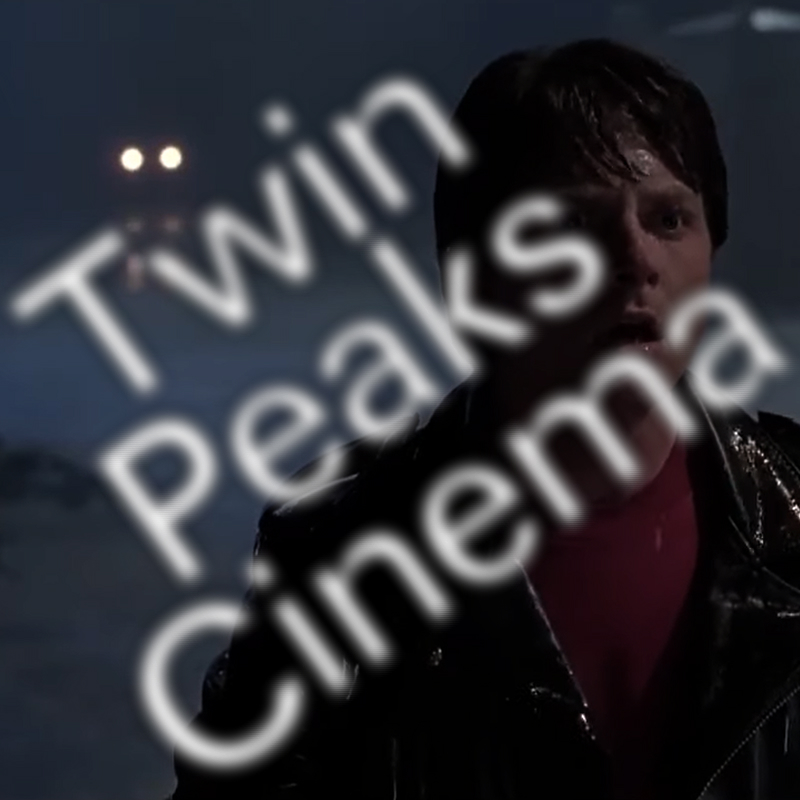
Back to the Future Part II as Twin Peaks Cinema #18 - Disordered Stories (podcast) + Back to the Future capsule


Tomorrow is the sixth anniversary of the future - the day that Marty McFly stepped into the 2015 version of Hill Valley as envisioned by the creators of Back to the Future Part II in 1989. The same year that Lynch/Frost Productions descended upon the Seattle area to establish Twin Peaks, Robert Zemeckis released the ambitious sequel to his 1985 hit Back to the Future. After spending all of his time travel in 1955 for the original film, Marty zips back and forth across the space/time continuum in this follow-up. He rescues his own son from catastrophe, returns to an alternate version of '85 run by a distinctly Trumpian Biff Tanner and finally winds up returning to the site of the first movie: spying on past events while trying to retrieve an item from the future which could threaten his own present. Got that? If Peaks can be perplexing and maddening due to its ambiguity and surrealism, Part II poses the opposite challenge. Its intricate interplay of meta-narratives and sci-fi concepts may make you either giddy or dizzy depending on your mood. While Marty initially travels to the year that David Lynch would film The Return, and his return to the Potterville-like alt-'85 resonates with Cooper's and Carrie's nocturnal sojourn in the season three finale, it's the third part of Back to the Future Part II that connects with Twin Peaks most strongly: a hero attempts to both alter and maintain the past and a filmmaker returns to his own earlier work, incorporating new and old footage into a new context, presenting the familiar from a skewed perspective.

After exploring the film in its own right as well as its Peaks connections, this podcast also incorporates some bonus material from my Patreon archives: a two-minute quickie capsule review of the original Back to the Future, a clip from my video essay comparing different eras in the town, an early tease for this eventual recording, and some memorable listener feedback which, unusually, scorns rather than praises the subject matter. This episode kicks off a new themed mini-season: "Disordered Stories", in which chronologically skewed films echo, amplify, and contrast with Twin Peaks' own narrative games.


Subscribe, rate, and review on Apple Podcasts
You can also listen on Pinecast and Spotify
(and most places podcasts are found)


LINKS FOR EPISODE 18

Search This Blog