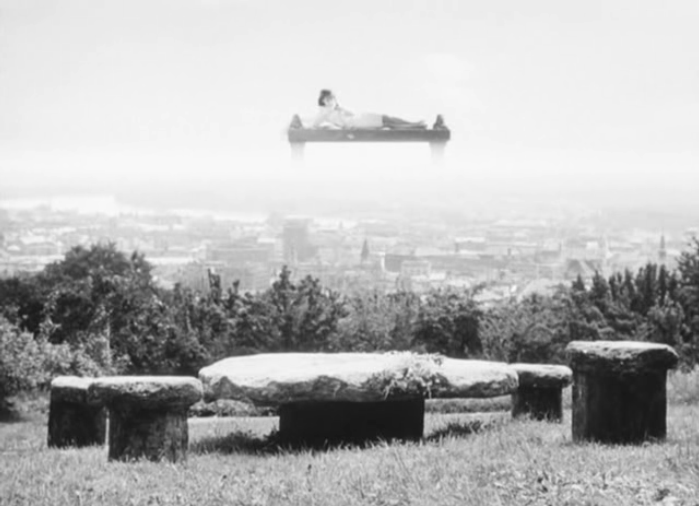
This is an entry in The Sunday Matinee series.
Miraculous Virgin, Czechoslovakia, 1967, dir. Stefan Uher, starring Jolanta Umecka, Ladislav Mrkvicka, Otakar Janda
Story: As bombs fall from the sky, a beautiful young woman wanders into the lives of several young artists and a melancholy middle-aged sculptor. They treat her as their muse. Yet before long, she is overwhelmed by their aggressive attention, and they are frustrated by her aloof resistance to their overtures.
An interesting element of the various European New Waves is their relationship with the recent past - namely World War II. I've often felt that the sixties were imbued with the displaced spirit of the forties, and that the cultural explosion and political upheaval of the era may have been impossible without the misery, death, and displacement of two decades before. This is not to say that the war played a huge role in cultural artifacts of the time; in some ways, the influence was indirect, in others displaced. In certain countries, for example the United States or Britain, the war was considered property of the older squares, and youthful revelers, rebels, or activists either satirized or ignored the earlier era's sensibility. Elsewhere, the war haunted the cinema without necessarily being foregrounded: in France, it popped up in the films of Alain Resnais (about ten years older than most of the other New Wavers); in Italy and Japan, a sense of collective guilt fed into the bitterness with which young filmmakers scorned the societies of the past. Whatever the country, New Wavers tended to be born around the same time period, from the late twenties to the mid-thirties (some a bit younger in Italy, some a bit older in Britain), making them teenagers at the time of the war. This meant that most did not serve as soldiers, and would only have experienced the turmoil of the time to the extent that war came to them.
Czechoslovakia, in some ways, was spared the most brutal aspects of the war. Unlike Britain, Poland, Germany, or Japan it was not subjected to substantial aerial bombardment, one reason that Prague still remains the glistening city of the past, architectural jewels from earlier centuries still dominating its skyline. Yet this was precisely because the Germans didn't
need to bomb the Czechs - the country had already been handed over to Hitler by allies eager to appease, and Czechoslovakia was given the dubious honor of enduring Nazi occupation from months before World War II even began. Following the war, unlike the French, Italian, or British, the nation was not able to stumble towards a new sense of independence or democracy; it was occupied by the Soviets, democratic officials were killed, and a Stalinist dictatorship was installed within several years of the "victory." In some ways, for Czechoslovakia, the war never ended. No wonder then, that World War II features so prominently in the Czechoslovakian New Wave (and here it makes sense to use the country's full name, as
Miraculous Virgin was directed by a Slovakian, not a Czech). Some of its most famous films - including the Oscar-winning
Closely Watched Trains and
The Shop on Main Street - take place during the war. The best of these (and the least well-known) is the phenomenal
Miraculous Virgin - while the setting is ambiguous, the film is tormented by a sense of occupation, persecution, death, and collaboration. Its themes are universal, but the historical experience of this beleaguered nation is the context out of which
Miraculous Virgin was born.