Lost in the Movies: avant-garde month
Showing posts with label avant-garde month. Show all posts

Avant-Garde: WHAT'S IN A NAME?


We began avant-garde month by defying language - with silent films whose currency was visual, whose ideograms were images. Today we openly confront, pull apart, and reassemble language, on a kind of a cracked-looking-glass Sesame Street, numbers and words thrown in the air, land where they may, brought to you by the letter X - as in crossed-out, mysterious value, or X marks the spot. Two short entries are followed by a longer one (covering A Walk Through H, a fantastic film that seems to aptly round out all our themes). Bring your map, but don't expect it to help any.

Avant-Garde: FILM AS A SUBVERSIVE ART


Check out this list for the hundreds of films included in "Film as a Subversive Art."

Many years ago, while living in New York, I found myself reading Rousseau on a park bench, studying for a course on Political Theory. In this case homework led to something more long-lasting (however short the actual meeting) than an A on the test. An elderly man, about eighty, was sitting nearby with a female companion and, noticing my book, began talking to me. He had been educated by his parents according to the precepts of Rousseau's Emile, and this early education had given him a lifelong openness to all sorts of experiences, a fondness for the offbeat and unconventional, and a unique way of seeing the world. We talked for a while, and I discovered his life story was fascinating. He had fled Hitler's Austria, and in New York, just after the war, he had founded (with his wife) one of the first major film societies in the U.S., Cinema 16 - which would grow to become the most successful membership-based film society in American history.

Cinema 16 screened everything from political documentaries to foreign films to scientific movies to the occasional Hollywood picture (Hitchcock appeared at the theater to introduce The Man Who Knew Too Much). But its bread-and-butter was avant-garde cinema, a form (in all its different forms) that its administrator adored with the passion many reserve for their favorite genre or movie star. Frustrated by the inability of many friends and proteges to get onboard with experimental cinema, and eventually drawn into a rivalry with Jonas Mekas, whose Anthology Film Archives was founded in the early sixties in part as an alternative to Cinema 16's operation, this man eventually decided to write a book, exploring and celebrating not just the avant-garde, but all forms of subversive cinema from the political to the aesthetic to the topical to the completely personal. When Cinema 16 folded in the early seventies (never having received funds from government or corporation, it was reliant on the support of its members, which eventually dwindled), this book would remain as his enduring legacy.

The man was Amos Vogel, and the book was Film as a Subversive Art. At the end of our pleasant conversation, Vogel gave me his business card and I still have it - a playful sketch of an absent-minded bearded man trotting off with a reel of film unspooling from under his arm. He did not mention his book at the time and only years later would I purchase it, but it's become one of my cinematic treasures. While focusing on the offbeat and provocative, it is in fact a manifesto for a wide-ranging cinematic love with a keen eye for how subversion is ingrained in the very substance of the material itself - its ability to freeze, preserve, repeat and upend the physical world around us. Today I cover three films introduced to me by this book, and my entries include Vogel's capsule on the film in question and an embedded video of each movie.

But that's not all - such a brief sample could hardly convey the vast riches contained in this great book. I've tracked down several of the selected shorts on You Tube and so a dozen videos follow the post. Some of these selections are narrative, some purely abstract, some are animated, some live-action, some documentary while others are fiction, and still others defy any description. They demonstrate Vogel's broad taste, and his talent for spotting cinematic treasures in every corner. The avant-garde is, in many ways, not the far wing or the margin of cinema, but its very heart and soul, the - if you will - main stream of the medium. I would suggest watching all of these films when you get the chance, perhaps one each day after finishing the main entry. You won't be sorry; if some of these are new to you, as they were to me, then you'll be as thankful as I am for that warm spring day in New York.

Avant-Garde: THE LEGENDS


In the middle of the twentieth century, particularly in the United States, there was a very clear divide between the mainstream and the avant-garde in cinema. While the modernist obsession with abstraction and experimentation swept the other arts, making celebrities out of artists who defied or reinvented conventions, when it came to movies, you either told a story - with a budget and release schedule provided by the Hollywood system - or you disappeared into the margins. Yet talent thrived on those margins and the postwar era saw the growth of a vital underground cinema, fostered and facilitated by institutions like Amos Vogel's Cinema 16, an inexpensive film society in New York (Vogel and his views of cinema will be the subject of the next installment in this series, going up Sunday evening).

Three figures - Maya Deren, Kenneth Anger, and Stan Brakhage - probably had a bigger impact and wider reach than any others, and so here I will focus on three of their early works: Deren's At Land (1944), Anger's Scorpio Rising (1964), and Brakhage's Cat's Cradle (1959).


Avant-Garde: The Silents ("Fixing a Hole")
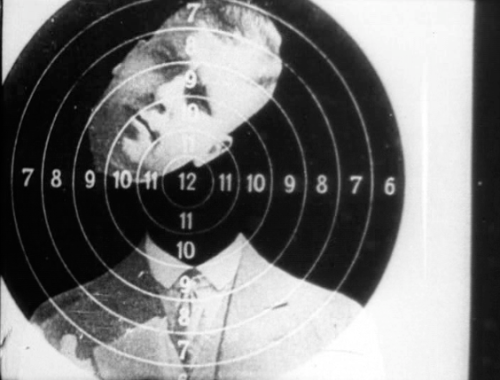

A new month, a new theme for "Fixing a Hole". The year ends with the avant-garde, and today I've tapped Maurizio Roca, whose noir countdown was one of the highlights of 2011, to address three of his favorite avant-garde films of the 1920s. I added the pictures and videos. Maurizio writes about Entr'acte, Emak-Bakia, and Ghosts Before Breakfast here:


"Opening with a startling close-up of a man looking through a movie camera, we are quickly led to a barrage of abstract and animated images (some taken from the earlier Le Retour a la Raison) that instantly plunge us into a world of bewilderment. A similar tact was taken by Clair’s Entr’acte, when after a relatively docile opening, the filmmaker quickly pulled out the rug from under us with a swift journey into abstraction. Emak Bakia (at least in the Kino version) is greatly aided by the mournful string-heavy score that accompanies it. Early on, the visual focus, like Entr’acte, is centered primarily on slow-motion movement. We are given the various traits that make up film art and watch as they are applied in nonlinear and unconventional ways. The concentration always seems to be simply about reveling in this new medium’s impressionistic possibilities above all else. Where the dancer was the underlying image of movement that Clair returned to early in his short, Ray instead decides to devote his time with distorted depictions of artifacts we cannot make out clearly. They come and go with no established delineation other than to reveal the ability to gracefully move before our eyes."

Search This Blog