

Showing posts with label fixing a hole. Show all posts
Showing posts with label fixing a hole. Show all posts
Avant-Garde: WHAT'S IN A NAME?


Avant-Garde: FILM AS A SUBVERSIVE ART

Check out this list for the hundreds of films included in "Film as a Subversive Art."
Avant-Garde: THE LEGENDS

In the middle of the twentieth century, particularly in the United States, there was a very clear divide between the mainstream and the avant-garde in cinema. While the modernist obsession with abstraction and experimentation swept the other arts, making celebrities out of artists who defied or reinvented conventions, when it came to movies, you either told a story - with a budget and release schedule provided by the Hollywood system - or you disappeared into the margins. Yet talent thrived on those margins and the postwar era saw the growth of a vital underground cinema, fostered and facilitated by institutions like Amos Vogel's Cinema 16, an inexpensive film society in New York (Vogel and his views of cinema will be the subject of the next installment in this series, going up Sunday evening).
Three figures - Maya Deren, Kenneth Anger, and Stan Brakhage - probably had a bigger impact and wider reach than any others, and so here I will focus on three of their early works: Deren's At Land (1944), Anger's Scorpio Rising (1964), and Brakhage's Cat's Cradle (1959).

Avant-Garde: The Silents ("Fixing a Hole")
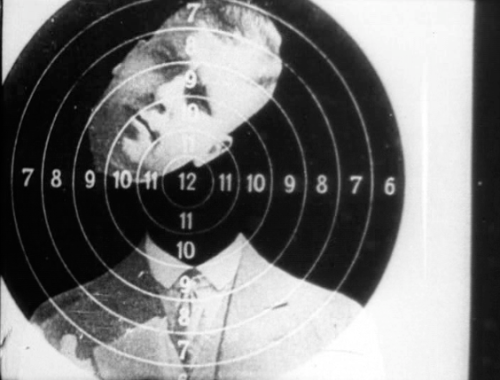
A new month, a new theme for "Fixing a Hole". The year ends with the avant-garde, and today I've tapped Maurizio Roca, whose noir countdown was one of the highlights of 2011, to address three of his favorite avant-garde films of the 1920s. I added the pictures and videos. Maurizio writes about Entr'acte, Emak-Bakia, and Ghosts Before Breakfast here:
"Opening with a startling close-up of a man looking through a movie camera, we are quickly led to a barrage of abstract and animated images (some taken from the earlier Le Retour a la Raison) that instantly plunge us into a world of bewilderment. A similar tact was taken by Clair’s Entr’acte, when after a relatively docile opening, the filmmaker quickly pulled out the rug from under us with a swift journey into abstraction. Emak Bakia (at least in the Kino version) is greatly aided by the mournful string-heavy score that accompanies it. Early on, the visual focus, like Entr’acte, is centered primarily on slow-motion movement. We are given the various traits that make up film art and watch as they are applied in nonlinear and unconventional ways. The concentration always seems to be simply about reveling in this new medium’s impressionistic possibilities above all else. Where the dancer was the underlying image of movement that Clair returned to early in his short, Ray instead decides to devote his time with distorted depictions of artifacts we cannot make out clearly. They come and go with no established delineation other than to reveal the ability to gracefully move before our eyes."
Bambi, book and movie

•
The Story: One spring, a little fawn is born into a world of sunshine and flowers - but as the seasons pass, and the young deer comes of age, neither he nor the world around him will remain so innocent.
_____________
“You’d be forgiven for picturing cute, wide-eyed little critters wandering through daisy fields and singing happy songs,” I wrote when introducing this month’s theme, adding pointedly, “Not so.” And I meant it - yet here we are! Well, let this prove that clichés obscure more than they illuminate. The cute, wide-eyed little critters of Bambi inhabit a violence- and sex-filled world of tragedy, stoicism, and carnage. Despite frequent light and happy moments, this is ultimately a very dark forest indeed. Why? To unearth Bambi's roots, I dug up the book that gave it birth.Felix Salten’s Bambi was published in 1923, and it shares the qualities of much classic children’s literature: quiet, thoughtful, with a delicate playfulness, yet fundamentally somber, elementally instructional and subtly allegorical – simple yet deep. Walt Disney more scrupulously balances the dark and light, yet much of the book’s mood and atmosphere is effectively conveyed. Those majestic moments when Bambi and his mother cautiously approach a meadow, or tiptoe through the snow to hunt for food, admirably capture Salten’s spirit. Even those prototypical Disney elements – anthropomorphized chattering forest critters, resembling gossipy housewives or restless schoolkids – have their source in Salten, who devotes many pages to the silly conversations of little birds.
An Open Letter to Toontown

November 20, 2011
Toontown City Council, c/o Cloverfield Development Co.
Acme Avenue & Avery Alley
Toontown, CA 90@#!
Dear Toons,
Well, gang, I just watched Who Framed Roger Rabbit again, this time for an online series called "Fixing a Hole." (You remember holes, those convenient black discs you carry around in your pockets, portable escape hatches when you're in a pickle. Incidentally, how much those go for nowadays?). Anyway, the movie was a delight as always; though the climax is a bit drawn-out, the appearance of a one-dimensional Judge Doom, crushed and cackling like some maniacal cross between Johnny Paper and Johnny Rotten, is well worth the wait.
I dug that, and I laughed along with Roger, cringed for Baby Herman (somebody tell that middle-aged infant about Viagra, or better yet, don't), and marveled at Bob Hoskins' ability to play it straight even as he was acting against thin ai- er, I mean, against real, live Toons who must have been rather intimidating “in the flesh.” And Jessica Rabbit. Oh Jessica Rabbit. With her in their extended family, it’s no wonder the fluffy-tailed little mammals are so eager to breed.
Dumbo ("Fixing a Hole")

This Sunday brings, as all Sundays do, a fresh "Fixing a Hole." This week I've selected guest writer Stephen Gebbett-Russell of Checking on My Sausages to cover the Disney classic Dumbo, continuing the theme of "Animated Animals" for November.
He has an interesting take on the film, ambivalently noting its drawbacks while appreciating its unique charms. Here's a snippet to whet your appetite, after which you can follow the link for the full piece.
"While the story is a bit of a bore (and by no means offering an inspirational moral to take home, as we shall see), the film occasionally gets off the ground in a few magical details, the red ribbon that wards off the evil eye: Dumbo's bath-time frolics with his mother, a kangaroo cradling its young and creaking like a rocking chair, a clever song that plays on nouns and verbs (“I've seen a fireside chat, a baseball bat...”) and a drunken hallucination that includes a hideous monster made up of elephant heads and ends with floating pachyderms softly morphing into clouds in a dawn sky."
The Story of the Fox

•
The Story of the Fox (1937/France/directed by Wladyslaw and Irene Starewicz)
stars the voices of Claude Dauphin, Romain Bouquet, Sylvain Itkine, Marcel Raine
written by Jean Nohain, Antoinette Nordmann, Roger Richebe, Irene Starewicz, Wladyslaw Starewicz from Johann Wolfgang Goethe • photographed by Wladyslaw Starewicz • designed by Wladyslaw Starewicz • music by Vincent Scotto • animated by Wladyslaw and Irene Starewicz
The Story: The royal lion seeks to punish Monsieur Renard (Mr. Fox) for eating his fellow creatures, yet the crafty animal tricks, manipulates, and fights his way out of every scrape.
_____________

“Animated Animals”: you’d be forgiven for picturing cute, wide-eyed little critters wandering through daisy fields and singing happy songs. Not so: this month there’s one cuddly creature (albeit too mute to sing), an amiable buffoon, a murderous yet still sympathetic monster, and then there’s Monsieur Renard (French for "fox"), the eponymous antihero of the brilliant stop-motion feature The Story of the Fox. Crafty, nasty, and carnivorous, Renard may have the least redeeming qualities of all the November beasts; unsurprisingly, he may also be the most human.
Watching as he assaults and semi-cannibalizes his fellow creatures, regarding us every now and then with an ambiguously conspiratorial twinkle in his eye, we titter nervously. We recognize we aren’t really compatriots in crime but rather spectators in a show enacted only for the fox’s own benefit. Renard has the gifted performer’s contempt for the audience – and we’d probably be his next victim were we onscreen ourselves. Not only the fox but his master are winking at us with raw, mischievous relish.
Dracula & Drácula ("Fixing a Hole")
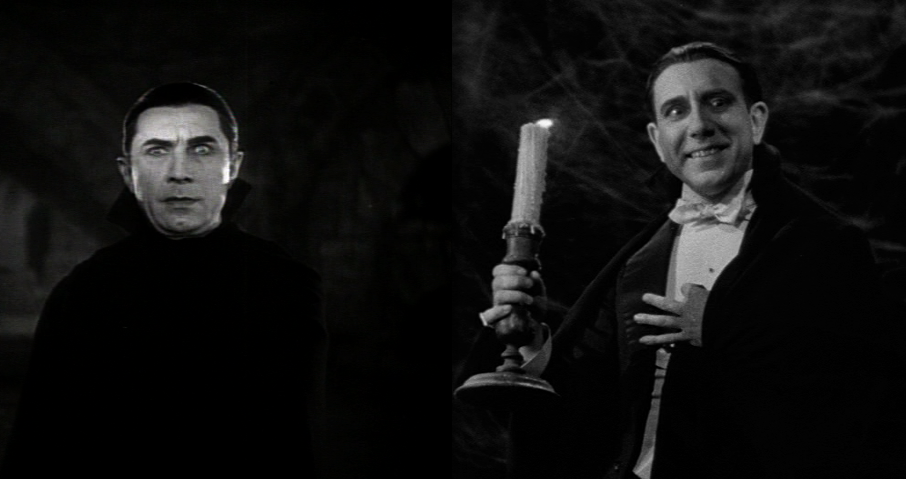
As with Frankenstein, which kicked off the series, I've commissioned another writer to conclude "Universal Horror Month." Jaime Grijalba, a native of Chile and author of Exodus 8:2 (where he is currently wrapping up an ambitious "31 Days of Horror" series), uses his love of horror and knowledge of both Spanish and English to examine the two versions of Dracula, shot simultaneously in different languages back in 1931. I've provided a tantalizing taste of his engaging piece, and a link for you to read the whole thing.
Happy Halloween!
"And maybe that’s the reason why Drácula, the Spanish version of the classic film, is so fresh to the eyes and the mind. It’s different. You react to it in a different manner; the film feels like when you remember a half-forgotten dream, when you see a full vision of what a parallel universe could’ve been if you’d chosen the blonde and not the brunette. Because it is the full vision and scope of what Dracula, the legendary character and its story, can be, this version being far more complete, especially when you watch these two back to back in what can be one of the most splendid double features. While you are in awe due to the visual and poetic nature of the English version, then you are surprised and admiring the longer and more paused plot of the Spanish version, as well as its bold visual and camera style."
The Old Dark House

•
The Old Dark House (1932/United States/directed by James Whale)
stars Boris Karloff, Ernest Thesiger, Charles Laughton, Melvyn Douglas, Gloria Stuart, Lillian Bond, Raymond Massey, Brember Wills, Elspeth Dudgeon
written by R.C. Sherriff and Benn Levy from J.B. Priestley's novel • photographed by Arthur Edeson • designed by Charles D. Hall • music by David Broekman • edited by Andrew Cohen
The Story: On a dark and stormy night, a married couple and their bemused third-wheel friend are forced to stay the night at a gloomy old home, inhabited by the very strange Femms, a family full of neuroses and dark secrets.
_____________
See a movie called The Old Dark House and you think you know what to expect. Well, unless you’re psychic, half-mad yourself (you’d have to be to come up with this scenario), or have already seen it, you’d be dead wrong. Sure, there’s an old house on a hill. Okay, a bickering young couple and their friend wind up having to spend the night there. Yeah, the residents of the house are a bunch of freaks, weirdos, and psychopaths. But the devil’s in the details and if the outline sounds familiar, the details are anything but. Every line of dialogue, every gesture, every plot development is unexpected and off-the-wall.
Who could predict the lesbian onslaught of sister Rebecca Femm (Eva Moore), pausing every now and then in her overbearing religiosity to a cop a feel from the heroine? Who would expect the appearance of 102-year-old Sir Roderick Femm, bedridden, cackling, and despite the misleading cast listing (actor’s name supposedly “John Dudgeon”) quite clearly an old lady with a scraggly beard glued to her wrinkly chin? And best of all, who should foresee the climactic revelation of Saul Femm (Brember Wills), outcast brother locked in his room for twenty years, set free to plead sanity – almost convincing us (we’ve certainly seen how nuts his siblings are) before the hero turns his back and Saul’s meek expression dissolves into a mask of fantastically cunning dementia?
The Black Cat

•
The Black Cat (1934/United States/directed by Edgar G. Ulmer)
stars Boris Karloff, Bela Lugosi
written by Edgar G. Ulmer, Peter Ruric, and Tom Kilpatrick from Edgar Allan Poe's story • photographed by John J. Mescall • designed by Charles D. Hall • music by Heinz Roemheld • makeup by Jack P. Pierce
The Story: On a dark and stormy night, the Allisons, a honeymooning couple, find themselves sidetracked by an auto accident. Dr. Vitus Werdegast (Lugosi), whom they met on the train, takes them the home of architect Hjalmar Poelzig (Karloff), a camp commandant who mistreated Werdegast during World War I. The two men fight a battle of will and wit, with the hapless newlyweds caught in the middle.
_____________
Frankenstein ("Fixing a Hole")
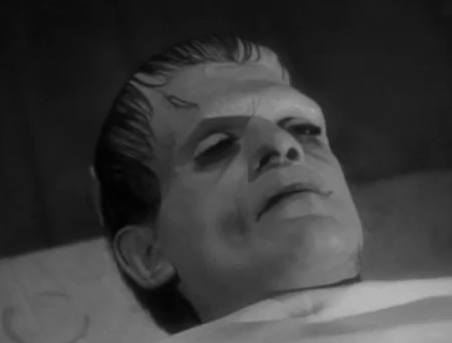
Today's chapter in "32 Days in Movies" - called "A Violent Release" and featuring movies from the half-century mark with violent themes or elements - was posted this morning. But I also want to use today to announce a new series I am launching on Wonders in the Dark. Called "Fixing a Hole" its sole purpose is to review notable films that have not yet been covered on that site (thousands of films have been, but cinematic history is so rich that tens of thousands, including classics, obscurities, and controversial movies among them, have as of yet slipped through the cracks).
Every month will have a theme and this October is designated "Universal Horror Month." I will be writing several of the entries, but I've also invited guest writers to contribute and the inaugural entry is by one such guest writer, the passionate, knowledgeable, and extremely engaging Dennis Polifroni, whose personal pieces for the site I've always admired. I assigned him "Frankenstein" and he's hit the ball out of the park. Here's a sample, and then I encourage you to follow the link and take it all in!
"Karloff so perfectly infuses gentleness into his hand movements when pulling the petals off a daisy stem in his moment with the little girl by the pond that you forget this is just an actor in a costume and some very heavy make-up. In these moments you really believe it’s a being who is trying to recreate, for himself, the same kind of innocent whimsy that attracted him to the smile of this little child. You can see, in the way he crouches next to her and slowly inches his way closer to her, that he sees her as his mentor, someone with answers to his many inner questions, in what is beautiful about a life that has just begun for him."
Update 2018: Unfortunately, this sample is now all that remains of Dennis' essay, as the piece was deleted.
Subscribe to:
Posts (Atom)