Lost in the Movies: universal horror month
Showing posts with label universal horror month. Show all posts

Dracula & Drácula ("Fixing a Hole")


As with Frankenstein, which kicked off the series, I've commissioned another writer to conclude "Universal Horror Month." Jaime Grijalba, a native of Chile and author of Exodus 8:2 (where he is currently wrapping up an ambitious "31 Days of Horror" series), uses his love of horror and knowledge of both Spanish and English to examine the two versions of Dracula, shot simultaneously in different languages back in 1931. I've provided a tantalizing taste of his engaging piece, and a link for you to read the whole thing.

Happy Halloween!


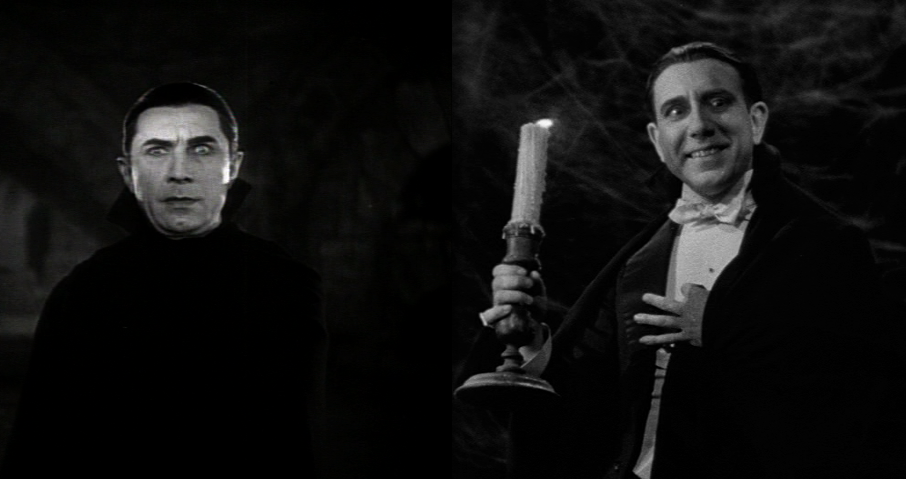
"And maybe that’s the reason why Drácula, the Spanish version of the classic film, is so fresh to the eyes and the mind. It’s different. You react to it in a different manner; the film feels like when you remember a half-forgotten dream, when you see a full vision of what a parallel universe could’ve been if you’d chosen the blonde and not the brunette. Because it is the full vision and scope of what Dracula, the legendary character and its story, can be, this version being far more complete, especially when you watch these two back to back in what can be one of the most splendid double features. While you are in awe due to the visual and poetic nature of the English version, then you are surprised and admiring the longer and more paused plot of the Spanish version, as well as its bold visual and camera style."

The Old Dark House


The Old Dark House (1932/United States/directed by James Whale)

stars Boris Karloff, Ernest Thesiger, Charles Laughton, Melvyn Douglas, Gloria Stuart, Lillian Bond, Raymond Massey, Brember Wills, Elspeth Dudgeon

written by R.C. Sherriff and Benn Levy from J.B. Priestley's novel • photographed by Arthur Edeson • designed by Charles D. Hall • music by David Broekman • edited by Andrew Cohen

The Story: On a dark and stormy night, a married couple and their bemused third-wheel friend are forced to stay the night at a gloomy old home, inhabited by the very strange Femms, a family full of neuroses and dark secrets.

_____________

See a movie called The Old Dark House and you think you know what to expect. Well, unless you’re psychic, half-mad yourself (you’d have to be to come up with this scenario), or have already seen it, you’d be dead wrong. Sure, there’s an old house on a hill. Okay, a bickering young couple and their friend wind up having to spend the night there. Yeah, the residents of the house are a bunch of freaks, weirdos, and psychopaths. But the devil’s in the details and if the outline sounds familiar, the details are anything but. Every line of dialogue, every gesture, every plot development is unexpected and off-the-wall.

Who could predict the lesbian onslaught of sister Rebecca Femm (Eva Moore), pausing every now and then in her overbearing religiosity to a cop a feel from the heroine? Who would expect the appearance of 102-year-old Sir Roderick Femm, bedridden, cackling, and despite the misleading cast listing (actor’s name supposedly “John Dudgeon”) quite clearly an old lady with a scraggly beard glued to her wrinkly chin? And best of all, who should foresee the climactic revelation of Saul Femm (Brember Wills), outcast brother locked in his room for twenty years, set free to plead sanity – almost convincing us (we’ve certainly seen how nuts his siblings are) before the hero turns his back and Saul’s meek expression dissolves into a mask of fantastically cunning dementia?

The Black Cat


The Black Cat (1934/United States/directed by Edgar G. Ulmer)
stars Boris Karloff, Bela Lugosi

written by Edgar G. Ulmer, Peter Ruric, and Tom Kilpatrick from Edgar Allan Poe's story • photographed by John J. Mescall • designed by Charles D. Hall • music by Heinz Roemheld • makeup by Jack P. Pierce

The StoryOn a dark and stormy night, the Allisons, a honeymooning couple, find themselves sidetracked by an auto accident. Dr. Vitus Werdegast (Lugosi), whom they met on the train, takes them the home of architect Hjalmar Poelzig (Karloff), a camp commandant who mistreated Werdegast during World War I. The two men fight a battle of will and wit, with the hapless newlyweds caught in the middle.
_____________

What do secluded mansions, wartime prison camps, violent fear of black cats, modernist architecture, satanic cults, semi-incestuous marriages, floating corpses, and sadomasochistic feuds have to do with one another? Not very much, come to think of it. Except that you can find them all in The Black Cat, along with wickedly stylized sets, idiosyncratic classical music, and - in their first pairing - two pitch-perfect larger-than-life performances from Universal’s biggest horror stars. Neither one cracks a smile or lets a wink betray that they’re in on the joke (though Karloff’s arched eyebrow occasionally suggests a saucy self-awareness), leading us to wonder if it is a joke at all. As he would later with the noir Detour, Edgar G. Ulmer twists genre conventions, stylistic norms, and tonal expectations into perfect pretzels, until we're left wondering whether the result is subversively brilliant or merely ridiculous.

Frankenstein ("Fixing a Hole")


Today's chapter in "32 Days in Movies" - called "A Violent Release" and featuring movies from the half-century mark with violent themes or elements - was posted this morning. But I also want to use today to announce a new series I am launching on Wonders in the Dark. Called "Fixing a Hole" its sole purpose is to review notable films that have not yet been covered on that site (thousands of films have been, but cinematic history is so rich that tens of thousands, including classics, obscurities, and controversial movies among them, have as of yet slipped through the cracks).

Every month will have a theme and this October is designated "Universal Horror Month." I will be writing several of the entries, but I've also invited guest writers to contribute and the inaugural entry is by one such guest writer, the passionate, knowledgeable, and extremely engaging Dennis Polifroni, whose personal pieces for the site I've always admired. I assigned him "Frankenstein" and he's hit the ball out of the park. Here's a sample, and then I encourage you to follow the link and take it all in!

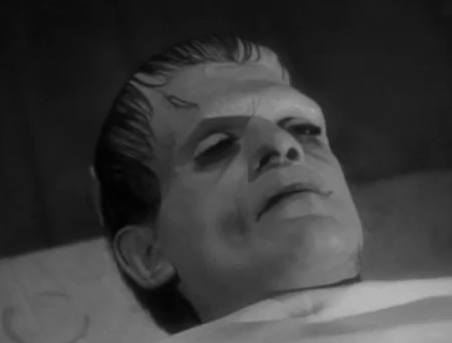
"Karloff so perfectly infuses gentleness into his hand movements when pulling the petals off a daisy stem in his moment with the little girl by the pond that you forget this is just an actor in a costume and some very heavy make-up. In these moments you really believe it’s a being who is trying to recreate, for himself, the same kind of innocent whimsy that attracted him to the smile of this little child. You can see, in the way he crouches next to her and slowly inches his way closer to her, that he sees her as his mentor, someone with answers to his many inner questions, in what is beautiful about a life that has just begun for him."
Update 2018: Unfortunately, this sample is now all that remains of Dennis' essay, as the piece was deleted. 

Search This Blog