 With Jackson's face (or several faces) all over the news, one would expect that we'd be hearing a little more of the music and (especially) seeing a little more of the dancing. Sadly, this is not really the case. We get clips but rarely get to enjoy a whole piece - I understand MTV suspended regular programming for several hours after his death in order to play his old videos, but now they're back to reality shows. So I have embedded a You Tube clip, probably his most famous moment, below (it follows the rest of my thoughts).
Michael Jackson 1958 - 2009
With Jackson's face (or several faces) all over the news, one would expect that we'd be hearing a little more of the music and (especially) seeing a little more of the dancing. Sadly, this is not really the case. We get clips but rarely get to enjoy a whole piece - I understand MTV suspended regular programming for several hours after his death in order to play his old videos, but now they're back to reality shows. So I have embedded a You Tube clip, probably his most famous moment, below (it follows the rest of my thoughts).

The Wild Bunch
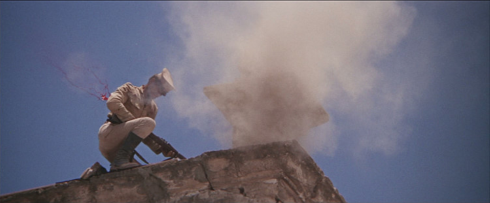
The Wild Bunch, 1969, directed by Sam Peckinpah
Story: After being set up in a bank heist, the dwindling and aging Wild Bunch (a band of outlaws operating in the American frontier of the early 20th century) crosses into Mexico. Pursued by bounty hunters led by one of their former members, the Bunch agree to steal a cache of weapons for a corrupt Mexican warlord – but eventually, they must decide what’s worth more: his gold or their vaguely maintained code of honor.
The Wild Bunch is notorious as a subversive take on the Western genre, with the opening lines of Pike (William Holden) – “If they move, kill ‘em!” – supposedly a declaration of independence from the old-fashioned sanctities of the form. And the ensuing massacre would seem to confirm that we’re a long way from the moralistic shades of High Noon (1952) and Shane (1953), what with old ladies of the Temperance Union being killed in the crossfire by careless deputies, cowering bank tellers being taken hostage and used as live bait by the titular antiheroes, and the innocent babes of the town wandering through a town square littered with the corpses of their elders as they imitate the outlaws’ gunfire. Meanwhile, other children light a bonfire over battling scorpions and red ants, piling violence upon violence in a microcosm of the film’s pathology: lethal but somehow poignant old cretins – the bunch – pitted against the ruthless, small-minded hordes – the bounty hunters and Mexican soldiers and railroad men who are just as violent as the outlaws, but somehow more petty.
Waiting for the 25th Hour

[This review first appeared at Ibetolis' Film for the Soul as part of his great "Counting Down the Zeroes" series, which you should definitely check out. The review is quite long - including a lengthy quote from the movie as an introduction - and discusses crucial plot points, so beware. It begins after the jump.]
Three by Truffaut
 In my introduction to "Reading the Movies," I noted the titles I was reading at the moment. Among the Kael, Sarris, and sundry I declined to mention The Films of My Life by François Truffaut, which I've been reading off and on since April. I already transcribed the marvellous introduction; as for the rest of the book, I'm cool on some of Truffaut's criticism. At times he becomes too absorbed by plot descriptions (which, possibly due to translation, become cumbersome and hard to follow), at others his epigrams seem too obscure (I know, I know, I'm one to talk...). But unlike Truffaut's films, which I can only enjoy from a distance like Moses viewing the promised land, there are passages in his writing which leap from the page and hit me where it hurts - in a good way. Following are three wonderful essays which I've reproduced here for your enjoyment. So making their online debut (to my knowledge):
"Citizen Kane: The Fragile Giant" - Fantastic tribute to one of the greatest movies of all time, not from a perspective of technical admiration but of zealous, totally enraptured enthusiasm (and with a focus on the characters and story, which is also how I first knew and loved Kane - and in some ways, still do).
"Muriel" - Slightly bewildered appreciation of the Resnais film, with a great Hitchcock anecdote. Hitch's punchline, Truffaut's closing paragraph, and the film in question are all somewhat mystifying though I like the first two more than the third.
"Roberto Rossellini Prefers Real Life" - Tip of the hat to a very unique filmmaker, a man Truffaut worked for (much of the essay is devoted to personal reminisces). Years later, he still seems to be astonished by Rossellini's distractible intensity; Truffaut's tone is simultaneously admiring and disbelieving.
Reading the Movies
 A list of the movie books which had the greatest impact on me.
Not so long ago, I moved into a new neighborhood. Before even attempting to settle in, I paid a visit to the local library which, despite its grand exterior, was fairly nondescript within. This was particularly true of the nonfiction section, located downstairs. Endless shelves of books stretched across a close-quartered white-walled basement, completely unadorned and giving off the aura of an abandoned filing room located deep in the bowels of some God-forsaken bureaucracy. There were no labels, cards, or indicators on any of these shelves so I had to scan the stacks by eye to find the movie section.
When I tracked it down (it was one of the first stacks, mid-row, between the circus and television) I was in for a thrilling surprise. Hidden away in this library was a treasury of great seventies film-book classics, many out of print. Consequently, over the past few months, I have read I Lost It at the Movies by Pauline Kael, The Fred Astaire & Ginger Rogers Book by Arlene Croce, Godard by Richard Roud, Confessions of a Cultist by Andrew Sarris, Signs and Meaning in the Cinema by Peter Wollen, The Primal Screen by Sarris, and Kiss Kiss Bang Bang by Kael; at present, I have delved into three more film texts: Politics and Cinema by Sarris, Going Steady by Kael, and The Japanese Film by Joseph L. Anderson and Donald Richie.
I mention this not only to illustrate my passion for reading about the movies, but also to demonstrate that I am only just discovering many seminal texts of the cinema, and that the list which follows is not to be mistaken for a primer on essential reading. I make no claims for the greatness of the following ten books. Nor are they necessarily my favorites; indeed, some have outlived their purpose and I haven't looked at them in years. Many titles are obscure, so fame is not a criterion either. What all these books do have in common is their influence...on me. These are the books that informed me, excited me, provoked me, the ones that introduced me to The Wolf Man and One Flew Over the Cuckoo's Nest and Taxi Driver and Celine and Julie Go Boating and Le Vent d'Est.
Beyond these ten, I will deliver honorable mention to another fifteen books which were not quite as crucial to my development. Nonetheless, they are highly noteworthy and in some cases, may have been even more constant companions than those titles in the top ten. I will (briefly) tell you why...and then the ball is yours. Run with it. I would love for everyone reading this list to compose their own personal top ten. There are no rules in how you chose to play this game, no guidelines save one:
RULE #1:
YOU MUST CREDIT THIS BLOG AND LINK TO THIS POST IN YOUR RESPONSE!
Just a small matter (but one which was sadly neglected the last time I tried this!).
Also one very strong recommendation - please tag five more people so that we can keep this going.
The rest is up to you.
Here is my own list, titles followed by the stories of how we met...
The Great Movies
 Penned by William Bayer, an independent filmmaker and writer on cinema, this lavishly-illustrated, thought-provoking coffee table book, composed of sixty films divided into twelve categories, is by all accounts currently out of print, and long ago forgotten. Or rather, long ago forgotten by most people (if they ever even made its acquaintance), but not by me. Somehow this book, published ten years before my birth, came into my possession in early childhood (I believe my father purchased it before I, along with my cinephilia, came onto the scene). It has had an inordinate influence on how I look at movies to this day. I still own it and have reproduced many of its pages in this post, as a tribute to all those glorious but long-neglected celebrations of the movies - the books which served to engage our curiosity, to focus our eye, to sharpen our intellect, and most of all to fire our imagination so that sights unseen became holy grails. A follow-up post will examine the many books that served this purpose for me, and then I will pass the baton on to my readers, but for now...The Great Movies.
Wonders in the Dark

Lately, while distracted from my own blog, I've become a regular contributor to the commentary on Wonders in the Dark, a great blog run by Allan Fish and friend-of-The Dancing Image Sam Juliano. At this moment, Allan is knee-deep (or deeper) in a long series exploring what he considers to be the greatest films of every decade since the thirties. If you're a movie buff of my sort, who loves list and countdowns, this is definitely for you. Until now, there has not been a collection of all the posts in this series stored in one location, so I've taken it upon myself to gather all the information here. What follows is a complete list of the entire countdown, with links to every post in question.
This list will be regularly updated as Allan continues his epic journey through the years. Feel free to drop by and leave comments, even on old posts; one of the best things about this excellent blog is the lively (to put it mildly) discussion every topic engenders, sometimes straying far away from the movie at hand. For example, 2001 has led to a debate on the value of canons, Viridiana a discussion on the intertwining of ethics and aesthetics in art, and The Young Girls of Rochefort a questioning of the merits of American cinema in the 60s and Allan's views thereof. The list follows the jump and can also be found here. (updated until its conclusion in 2010)
Fred and Ginger
 Several months ago, I scoured the web for every Astaire-Rogers dance I could find. Sure enough, I tracked them all down but within days of posting the videos were disappearing one by one. I resolved to restore these myself, by selecting the scenes I wanted, paring them down to the essentials, and posting them in the place of those deleted You Tube clips. Now the job is done, so I invite you all to revisit (or just plain visit) the Astaire-Rogers ouevre. If you don't feel you have enough time to watch very many, at least treat yourself to "Night and Day" - it's the third clip down, and is one of the sublime moments in musicals - indeed, in movies.
In other news, someone beat me to the punch and posted the 1987 Rankin-Bass Wind in the Willows on You Tube. For those curious enough to see the movie I discussed in February, you can watch the whole thing here. I will probably be putting up my own version eventually - the VHS tape which is missing a few scenes but contains all kinds of goodies in addition to the film itself, from claymation commercials to Donahue and Ralph Nader jamming with Muppets to TV cameos by Keenan Wynn and James Earl Jones.
What Do Critics Dream About?

by Francois Truffaut (from the introduction to The Films of My Life, published 1975):
One day in 1942, I was so anxious to see Marcel Carne's Les Visiteurs du Soir, which at last had arrived at my neighborhood theater, the Pigalle, that I decided to skip school. I liked it a lot. But that same evening, my aunt, who was studying violin at the Conservatory, came by to take me to a movie; she had picked Les Visiteurs du Soir. Since I didn't dare admit that I had already seen it, I had to go and pretend that I was seeing it for the first time. That was the first time I realized how fascinating it can be to probe deeper and deeper into a work one admires, that the exercise can go so far as to create the illusion of reliving the creation.
One day in 1942, I was so anxious to see Marcel Carne's Les Visiteurs du Soir, which at last had arrived at my neighborhood theater, the Pigalle, that I decided to skip school. I liked it a lot. But that same evening, my aunt, who was studying violin at the Conservatory, came by to take me to a movie; she had picked Les Visiteurs du Soir. Since I didn't dare admit that I had already seen it, I had to go and pretend that I was seeing it for the first time. That was the first time I realized how fascinating it can be to probe deeper and deeper into a work one admires, that the exercise can go so far as to create the illusion of reliving the creation.
To Kill a Mockingbird
 Lawyers and critics worth their salt must share a morbid fear of getting it wrong. The greatest of them plunge forward anyhow, recklessly risking ruin for the sake of their duty. Without too close a comparison to the prosecutor who has imprisoned an innocent man or the defense attorney who has acquitted a murderer, we can surmise that the critic lifts pen to paper or finger to keyboard with a biting sense of agony: did I miss the point? If the critic does get it wrong, after all, it isn't a client or victim who will suffer, but the critic himself. Or herself.
Case in point: 1962, when Mr. and Mrs. Critic, the estimable and ever-feuding Andrew Sarris and Pauline Kael, agreed on the demerits of Lawrence of Arabia. What looks today to be the great masterpiece of the year (if not of cinema history) was rather rudely dismissed by Kael as a spectacle with a zero at its centre. Sarris, who went further, looks even more foolish in ever-wise hindsight. Among other bon mots, in escalation of sheer missing-the-point: "dull, overlong, and coldly impersonal"; "In my cultural adolescence I associated the name Lawrence with the initials D.H. rather than T.E."; and "Perhaps I am just plain tired of all these 'serious' moral films with no women in the cast." Sarris, in failing to be moved or even awed by Lawrence of Arabia while dismissing it as yet another shallow big-budget historical epic, shows himself to be missing the movie for the ad campaign.
And yet, as decades of nobly defeated lawyers (at least of the dramatic/cinematic breed) could tell you, there can be a certain honor in miscalculation. A few months after penning his irritated pan of Lawrence, Sarris authored a far more thoughtful - and far more devastating - dismissal of To Kill a Mockingbird, now as then a beloved adaptation of a cherished classic of children's literature. While the film's reputation seems indestructible today, and often for very good reasons, Sarris' arrows more often than not hit their mark. If he's too harsh on the film stylistically ("Before the intellectual confusion of the project is considered, it should be noted that this is not much of a movie even by purely formal standards"), disallowing the quiet poetry of the movie because it is occasionally forced, his observations on the movie's intellectual confusion are withering.
Among others: "I daresay the Maycomb courtroom is still segregated thirty years [later], and so much for Miss Lee's cleverly masked argument for gradualism." "When the Negro is shot (off screen) for attempting to escape, Peck is so upset that, by some inverted logic understood only by liberal southerners, he deplores the Negro's unwarranted impetuosity." "This is a heartwarming resolution of the novel and the film. Yet somehow the moral arithmetic fails to come out even. One innocent Negro and one murderous red-neck hardly cancel each other out." And finally: "It is too early to tell [if the Negro and red-neck are brothers under the skin], but it is too late for the Negro to act as moral litmus paper for the white conscience. The Negro is not a mockingbird."
When I say that Sarris is "wrong" here, it is admittedly in part an ironic assessment - a juxtaposition of his view with what has become the canonical one (at least among middlebrow audiences, but also tacitly by intellectuals, who do not seem to view Mockingbird's reputation with much resentment.) But I do like Mockingbird more than he does, think it is a worthier film than he appreciates (not only stylistically), and ultimately, feel that the film may be more ambiguous than he perceives. Nonetheless, or perhaps therefore, Sarris' criticism is a good place to start looking at the movie.
Just because you are a character, doesn't mean you have character...
 Foolishly, I set out to tackle the 10 Characters meme, started by Squish (I was tagged by Jason Bellamy); only recently have I managed to narrow it down to forty. And even that's sort of a cheat, but you'll have to wait until the end of my list to find out why. In four parts, over nine categories, I revel in the great characters of film history. This list is full of my own prejudices. Hardly any of these people are folks you'd want to invite over for dinner. All but five are men (indeed, there are more non-humans than women), and many of my choices may seem rather arbitrary (especially given all the truly legendary, iconic characters who aren't on the list). I could easily justify a completely different list (well, some names would simply have to remain), but for now, this will suffice. Or, as someone once said to a character I almost included (before my non-human quota ran over): "That'll do, pig..."
Godard/Nixon or, Why I Must See This Movie

From Everything is Cinema, Richard Brody's biography of Jean-Luc Godard, which I'm currently reading:
But there's more:

"As the film [King Lear] inched forward, Godard thought of recruiting Richard Nixon for a '"distancing operation," a sequence of about twenty minutes during which Nixon and [Norman] Mailer would discuss "power and the loss of power".' Godard offered Nixon $500,000 for one day of shooting. Not surprisingly, Nixon did not respond."Oh, how I wish he had.
But there's more:
Subscribe to:
Posts (Atom)