Lost in the Movies: monster movies
Showing posts with label monster movies. Show all posts

belated June 2024 Patreon round-up: EXCLUSIVE - Conversation on The Boy and the Heron & Godzilla Minus One w/ Max Clark + TWIN PEAKS Character Series advance


Two Japanese World War II-era fantasy films from 2023 involving dangerous creatures crown my $5/month tier rewards for June - and they're covered in an unusual way. At this point I'm leaving podcasts for patron's picks every other month and Twin Peaks topics more sporadically than that, so I when I spoke about Hayao Miyazaki's The Boy and the Heron and Takashi Yamazaki's Godzilla Minus One with my friend and previous guest Max Clark (who got me to see both of these films), I decided to edit and present our extensive, two-hour-plus discussion in text form. In addition to exploring how The Boy and the Heron both emerges and differs from previous Miyazaki films (in the past I've covered Spirited Away in prose and podcast), we learn how Studio Ghibli Park in Japan crystallizes the auteur's vision, tease out the film's most-likely-accidental but still intriguing reflections on AI, investigate how the fanciful story reflects the behind-the-scenes Ghibli personalities, and reflect on why the friendship between the characters Mahito and Himi is so affecting. For Godzilla Minus One, which I saw initially in its brief black-and-white cinematic presentation, we dig into the intricacies of the fluid creature design and compare this latest entry - and its monster - to Hideaki Anno's Shin Godzilla (which I've discussed alongside the original and Americanized fifties Gojira/Godzilla in capsule form before; elsewhere I recorded capsules on the 2014 Godzilla and the original King Kong vs. Godzilla). And we get into many other subjects in relation to both films, including Japan's experience in the war and postwar periods. For even more from Max and I, you can check out our podcast episode on Blade Runner 2049 several years ago.

And open to all patrons is an advance entry on another beloved Twin Peaks character, alongside a few quick updates on what else I have been or will be working on this summer...


What are the June rewards?

Precocious Pastiche: Recycled Culture in 80s Kids Cartoons - and Beyond


About a month ago, as several friends got drunk and prepared food for a party later that evening, the TV droned somewhere in the distance. At some point in the afternoon, Alvin and the Chipmunks Meet Frankenstein appeared onscreen, and no one bothered to shut it off. For an hour or two the hypnotically grating high-pitched rodents serenaded us with their screams and weirdly precise vocal delivery; I caught very little of the movie as I wandered in and out of the room but what I saw (and heard) fascinated me. How bizarre that from a dark and stormy night early in 19th century Geneva, as a group of Romantic poets and intellectuals told ghost stories to keep themselves amused, we wind up with a colorful cartoon of squeaky-voiced, commercially-driven anthropomorphized animals chased around by a creature so familiar to us that it's naturally assumed even the toddlers watching will already know his name.

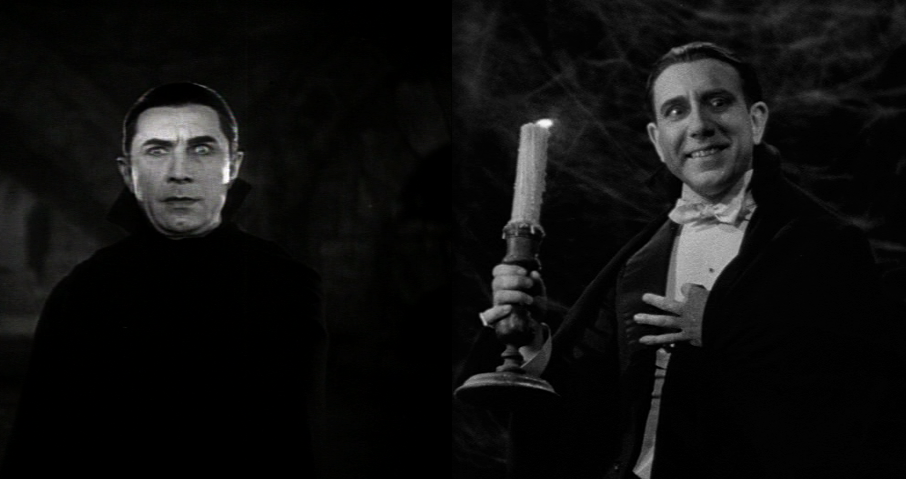
Dracula & Drácula ("Fixing a Hole")


As with Frankenstein, which kicked off the series, I've commissioned another writer to conclude "Universal Horror Month." Jaime Grijalba, a native of Chile and author of Exodus 8:2 (where he is currently wrapping up an ambitious "31 Days of Horror" series), uses his love of horror and knowledge of both Spanish and English to examine the two versions of Dracula, shot simultaneously in different languages back in 1931. I've provided a tantalizing taste of his engaging piece, and a link for you to read the whole thing.

Happy Halloween!


"And maybe that’s the reason why Drácula, the Spanish version of the classic film, is so fresh to the eyes and the mind. It’s different. You react to it in a different manner; the film feels like when you remember a half-forgotten dream, when you see a full vision of what a parallel universe could’ve been if you’d chosen the blonde and not the brunette. Because it is the full vision and scope of what Dracula, the legendary character and its story, can be, this version being far more complete, especially when you watch these two back to back in what can be one of the most splendid double features. While you are in awe due to the visual and poetic nature of the English version, then you are surprised and admiring the longer and more paused plot of the Spanish version, as well as its bold visual and camera style."

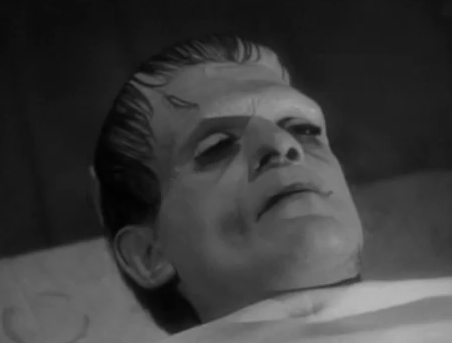
Frankenstein ("Fixing a Hole")


Today's chapter in "32 Days in Movies" - called "A Violent Release" and featuring movies from the half-century mark with violent themes or elements - was posted this morning. But I also want to use today to announce a new series I am launching on Wonders in the Dark. Called "Fixing a Hole" its sole purpose is to review notable films that have not yet been covered on that site (thousands of films have been, but cinematic history is so rich that tens of thousands, including classics, obscurities, and controversial movies among them, have as of yet slipped through the cracks).

Every month will have a theme and this October is designated "Universal Horror Month." I will be writing several of the entries, but I've also invited guest writers to contribute and the inaugural entry is by one such guest writer, the passionate, knowledgeable, and extremely engaging Dennis Polifroni, whose personal pieces for the site I've always admired. I assigned him "Frankenstein" and he's hit the ball out of the park. Here's a sample, and then I encourage you to follow the link and take it all in!

"Karloff so perfectly infuses gentleness into his hand movements when pulling the petals off a daisy stem in his moment with the little girl by the pond that you forget this is just an actor in a costume and some very heavy make-up. In these moments you really believe it’s a being who is trying to recreate, for himself, the same kind of innocent whimsy that attracted him to the smile of this little child. You can see, in the way he crouches next to her and slowly inches his way closer to her, that he sees her as his mentor, someone with answers to his many inner questions, in what is beautiful about a life that has just begun for him."
Update 2018: Unfortunately, this sample is now all that remains of Dennis' essay, as the piece was deleted. 

The Fly


This is an entry in Tony Dayoubs's David Cronenberg Blogathon. It contains spoilers.

Some horror concepts enter the popular consciousness and take on a life of their own. Oftentimes, these are cinematic manifestations of mythic or literary antecedents - the Frankenstein monster predated James Whale's 1931 film by over a century, though it's Boris Karloff whom readers tend to think of when re-visiting Mary Shelley's original. Other pop icons, like Dracula or the Wolf Man, are merely individual variations on long-known archetypes - while later, more human monsters like Norman Bates, Jason Voorhees, and Freddy Krueger have established an enormous cultural presence without transcending the films that made them famous. They are their personalities, not just their images; whereas older monsters seem to exist as pure icons, talismans of the unconsciousness. We know, without quite having to recognize on a personal level, a Dracula or a "Frankenstein" (the creature having taken on his creator's name in a kind of osmosis which The Fly would appreciate).

Likewise, perhaps, The Fly. Even if one does not know the behavior of the mutant insect-human or the plot surrounding it, one probably recognizes and shivers at the image, the idea. First crafted by George Langelaan as a short story, the narrative - losing little in translation - was first presented onscreen in the 1958 film of the same name. In the movie, a scientist builds a teleportation device but in the process of disintegrating/reintegrating him across space, a fly buzzes into the machine and the confused computer mixes up the two creatures. This results in a dreadful fly-headed human, whose inner state detoriates until finally, with his wife's help, he has himself "swatted" by a gigantic hydraulic press.

Certainly this is the version which gave the "fly and man switch body parts" concept its widespread recognition. Whether nicked for a "Ninja Turtles" villain or parodied on "The Simpsons", the fly-headed scientist is usually derived from the '58 version. David Cronenberg's 1986 remake is a bit knottier and headier, more difficult to pin down in a simple image or idea. It is itself a riff on the earlier film, so that's no surprise - yet it has its own distinct cultural legacy, and very much its own flavor. The two Flys share similar outlooks and tap into similar anxieties, but they take the material in different directions, demonstrating its potential for various tangents as well as differences between the 50s and the 80s (culturally and cinematically), and the distinctive stamp of David Cronenberg himself.

Frankenstein

Close on the heels of Dracula, I re-watched Frankenstein, James Whale's 1931 horror classic which is, if anything, even more iconic than the vampire pic. In many ways, Whale's movie has more to offer - while the vampire myths are fun and can be interpreted any variety of ways, Mary Shelley's gothic-romantic classic is compelling on a different level. The idea of man-created man both fascinates and repels us, and it only grows more relevant with time (evidenced by the countless sci-fi and horror spin-offs of the film, as well as the popularization of the term "he's created a Frankenstein monster"). Yet in some ways, I find Frankenstein less satisfying than Dracula, perhaps because it is more ambitious than the other film, and hence it's more noticeable when it falls short.

Dracula

Dracula is a film that can come full-circle if you let it. Ostensibly a straightforward chiller upon its 1931 release, it arguably launched decades of horror films - an avalanche which has kept rolling in one form or another to this day. Of course, as the form kept developing, the original monster movie (or at least the original monster talkie) began to seem creakier and creakier. Though Tod Browning had crafted some distinctive work before and after Dracula, much of his most famous film was confined to English drawing rooms; meanwhile, film technology was still adapting to the advent of sound and while the German master cinematographer Karl Freund was able to memorably maneuver his camera from time to time, the film overall is not especially fluid. Furthermore, Bela Lugosi's legendary performance may have frightened people at the time, but now it's become a museum piece, a template for hams throughout the ages (including Lugosi himself). Right?


Reading the Movies

A list of the movie books which had the greatest impact on me.


Not so long ago, I moved into a new neighborhood. Before even attempting to settle in, I paid a visit to the local library which, despite its grand exterior, was fairly nondescript within. This was particularly true of the nonfiction section, located downstairs. Endless shelves of books stretched across a close-quartered white-walled basement, completely unadorned and giving off the aura of an abandoned filing room located deep in the bowels of some God-forsaken bureaucracy. There were no labels, cards, or indicators on any of these shelves so I had to scan the stacks by eye to find the movie section.

When I tracked it down (it was one of the first stacks, mid-row, between the circus and television) I was in for a thrilling surprise. Hidden away in this library was a treasury of great seventies film-book classics, many out of print. Consequently, over the past few months, I have read I Lost It at the Movies by Pauline Kael, The Fred Astaire & Ginger Rogers Book by Arlene Croce, Godard by Richard Roud, Confessions of a Cultist by Andrew Sarris, Signs and Meaning in the Cinema by Peter Wollen, The Primal Screen by Sarris, and Kiss Kiss Bang Bang by Kael; at present, I have delved into three more film texts: Politics and Cinema by Sarris, Going Steady by Kael, and The Japanese Film by Joseph L. Anderson and Donald Richie.

I mention this not only to illustrate my passion for reading about the movies, but also to demonstrate that I am only just discovering many seminal texts of the cinema, and that the list which follows is not to be mistaken for a primer on essential reading. I make no claims for the greatness of the following ten books. Nor are they necessarily my favorites; indeed, some have outlived their purpose and I haven't looked at them in years. Many titles are obscure, so fame is not a criterion either. What all these books do have in common is their influence...on me. These are the books that informed me, excited me, provoked me, the ones that introduced me to The Wolf Man and One Flew Over the Cuckoo's Nest and Taxi Driver and Celine and Julie Go Boating and Le Vent d'Est.

Beyond these ten, I will deliver honorable mention to another fifteen books which were not quite as crucial to my development. Nonetheless, they are highly noteworthy and in some cases, may have been even more constant companions than those titles in the top ten. I will (briefly) tell you why...and then the ball is yours. Run with it. I would love for everyone reading this list to compose their own personal top ten. There are no rules in how you chose to play this game, no guidelines save one:

RULE #1:
YOU MUST CREDIT THIS BLOG AND LINK TO THIS POST IN YOUR RESPONSE!

Just a small matter (but one which was sadly neglected the last time I tried this!).

Also one very strong recommendation - please tag five more people so that we can keep this going.

The rest is up to you.

Here is my own list, titles followed by the stories of how we met...


Another take on the Holy Grail: Apocryphal ephemera or, Mouse Guts


[The Holy Grail list has been expanded to include blog names. This is worth checking out not only because it allows you to read more about the particular films, but because it will lead you to discover some great blogs that you were completely unaware of before; at least I found that to be the case. Enjoy.]
"We'd often go to the movies. We'd shiver as the screen lit up. But more often, Madeline and I would be disappointed. More often we'd be disappointed. The images flickered. Marilyn Monroe looked terribly old. It saddened us. It wasn't the film we had dreamed, the film we all carried in our hearts, the film we wanted to make... and secretly wanted to live."
-Masculin Feminin
While updating the Holy Grail list, I was reminded of another sort of cinematic holy grail, one far closer to the actual holy grail in that it doesn't actually exist. As I've previously discussed, I was obsessed with horror movies in the first grade. I hadn't actually seen any of them, but the school library had a series of orange, cardboard-bound books which discussed the plots of every Universal horror film (along with other horror classics like King Kong and Godzilla), along with a detailed history of the film's making and historical context (all illustrated by old stills).

The Wolf Man

When I was about seven, around the time I was first getting into movies, I was obsessed with the old horror films. Or more accurately, books about the old horror films. They had thick yellow cardboard covers and their photo-illustrated texts told the movies' stories, followed by the details of their production. These books sparked something in my imagination, but I have to admit that few of the actual movies, when I finally saw them, really lived up to the imaginative brushfires they'd ignited. Unlike the economical gangster pictures or the evocative westerns, the old Universal horror films don't really justify the iconography that they propagated. They are generally clunky, weighed down with exposition, and often hammy and stagey. They can be fun if you're in the right mood but if you're not, it's hard to see what all the fuss was about.

I just saw The Wolf Man for the first time and it certainly fits in with this general trend. And yet. The Wolf Man is one of the oddest of the horror films and its oddities hold a certain fascination which doesn't quite redeem, but at least fills out, the picture. Firstly, whereas the classic Universal horror movies Frankenstein and Dracula were released in the early 30's, The Wolf Man arrived on the scene ten years later amidst a World War that America was about to join. And the film's setting is distinctively contemporary, though its modern elements jar uneasily with the story's medieval roots - automobiles and gypsy carts jostling for room, along with ham-handed psychological analysis and old-fashioned superstition.

Search This Blog