Lost in the Movies: italian film
Showing posts with label italian film. Show all posts

November 2025 Patreon round-up: EXCLUSIVE - Films in Focus podcast #12: The Damned + Advanced Script for Mirrors of Kane narration (w/ Majority Report call-in opposing Chris Pappas)


First suggested by a patron following my episode on The Zone of Interest last year, Luchino Visconti's 1969 melodrama The Damned - set during the rise of dictatorship in thirties Germany - provides a suitably apocalyptic conclusion (for now, at least) to my two-year $5/month tier Films in Focus podcast. Based on patron polls conducted every couple months, I recorded a dozen episodes on films which often followed troubled protagonists trying to figure out themselves, and the world, against a backdrop of socially fraught circumstances (call this "the Fire Walk With Me effect"). Of course, to label Martin von Essenbeck (Helmut Berger) a "protagonist" stretches may associations with that term. He certainly is no hero; aside a few key exceptions like the put-upon anti-Nazi couple of Herbert (Umberto Orsi) and Elizabeth Thallmann (Charlotte Rampling), the film is almost entirely stocked with schemers, cowards, and outright fascists, and yet Martin still emerges as perhaps the worst of them all. Nor does he fit our usual conception of an active central figure; although his illicit desires and self-indulgent actions drive the narrative, it is other characters who manipulate him into or out of the place that they want him. Having inherited his grandfather Joachim's (Albrecht Schoenhals') shares of the family's steelworks following a staged assassination, Martin finds himself in a three-way tug of war. This involves his conniving mother Sophie (Ingrid Thulin) and her lover Friedrich Bruckmann (Dirk Bogarde) who want Martin to serve as an impotent figurehead for their ambitions; his cousin once removed Konstantin (Reinhard Kolldehorf), prominent in the SA paramilitary division of the Nazi Party, who wants to retain his executive control by sidelining Martin completely; and his other cousin once removed, the SS officer Aschenbach (Helmut Griem), who maneuvers various actors in a game of thrones which could tighten the Party's grip on this important industrial firm while also offering Martin a source of ego-stroking pride as well as an outlet for feverish, fetishistic revenge.

This is the plot of The Damned; however, the impression it creates has as much to do with the saturated, operatic quality of its visual flourishes and the darkness of its sexual psychology as with the intricacy of its narrative mechanics. This is especially true during the film's idiosyncratic dramatic centerpiece, a re-creation of "The Night of Long Knives" in which the once-central SA stormtroopers were betrayed by Hitler and slaughtered en masse by the SS and Gestapo amidst a drunken orgy at a country resort. Around here, the film's second half tips into a more intense, brooding, hot-blooded, and exaggerated pitch reminiscent of other Visconti films of the time. Indeed, this discussion encouraged me to dip back into my own Visconti mini-retrospective of sixteen years ago, when I reviewed The Leopard, Rocco and His Brothers, and Ludwig after big-screen viewings in Boston - The Damned very much incorporates elements of all three from its vision of a patriarch presiding over a dying world to its dysfunctional family portrait driven by jealous rivalry to its vision of decadent depravity in the midst of a ruling class' decline.

I'm also re-visiting past work - while setting up a future project - for the sake of the $1/month reward, offering another narration script for the upcoming Mirrors of Kane video series in a continuation of last month's trend. After next month's Twin Peaks Conversations episode, exclusives will be put aside in favor of advances for both tiers, while I work on finally finishing the four big projects behind the scenes in 2026: Mirrors of Kane, and Lost in Twin Peaks, the TWIN PEAKS Character Series, and Journey Through Twin Peaks.


What are the November rewards?

Side by Side: Nights of Cabiria & La Dolce Vita (video)


This video concludes both my five-entry Side by Side series and my run of new video essays this past month - which itself began with a tribute to Federico Fellini ("Far Away Shores" in my Montage series, joining La Strada with the two films featured here). This was the last subject I settled on after all the other videos were conceived, and the very last I edited (I'm writing these words on March 14, after beginning work on the Montage video way back in early 2018). I'm excited to dive into these two films here; the whole point of the Side by Side series is to create a dance between two works' similarities and differences, using each quality to emphasize the other, and Fellini's back-to-back masterpieces provide perfect fodder for this approach. Both chronicle their protagonists' journeys through Roman nights but the two characters begin and end up in very different places. Describing this is one thing; illustrating it was truly a joy. (A poignant one, at that; I had forgotten how profoundly moving the ending of Nights of Cabiria is in particular.)

I reviewed Nights of Cabiria as part of my Favorites series in 2016, reviewed La Dolce Vita as part of my Big Ones series in 2011, and compared La Dolce Vita with Twin Peaks, mostly to the similarly structured seven-days-and-seven-nights film Twin Peaks: Fire Walk With Me, on my Patreon podcast in 2019. That discussion built on a brief juxtaposition (one of my original "side by side" ventures) in "The Last Seven Days of Laura Palmer", a chapter in my Journey Through Twin Peaks series. Speaking of Journey, the next time I post a video essay - in a week to be precise, on the thirtieth anniversary of a certain show's pilot - will be my first entry in that series in five years. Something else (also related to Journey, though not officially a chapter) may post in the meantime, but we'll see. Schedules are welcome, but so are surprises, and there will be plenty of those in the months to come - for better or worse. Let's try to provide some of the better ones.

also available on Vimeo:

Montage: Far Away Music (video)


After three years, I am finally beginning to publish video essays again. As outlined in yesterday's announcement, a new video will be cross-posted here every Monday and Wednesday morning, concluding the series I began back in 2015 with five entries each. First up is the Montage series, with a tribute to one of my favorite directors: images from Federico Fellini's work - La Strada (1954), Nights of Cabiria (1957), and La Dolce Vita (1960) - paired with a stirring version of "Song to the Siren." Each film is matched with a different verse, and I love the way the films are able to echo both the images and themes of one another, as well as the spirit of the song.

Update 3/17: the video is now available on Vimeo as well...

European New Waves in the Sunday Matinee


In 2010, I launched a three-month series called "The Sunday Matinee" for Wonders in the Dark which covered several films each from four different European cinemas of the sixties: Italian, British, Czechoslovakian, and French. The essays are finally gathered here for convenient navigation.

The Favorites - Nights of Cabiria (#18)


The Favorites is a series briefly exploring films I love, to find out what makes them - and me - tick. Nights of Cabiria (1957/Italy/dir. Federico Fellini) appeared at #18 on my original list.

What it is • Cabiria (Giuletta Masina) is caught between two worlds, though it's clear where she ultimately belongs: she is a prostitute, living amongst the poor in a modest home. In an increasingly prosperous Rome this makes her an outcast, able to interact with wealth through her clients but unable to command it herself. She does own her little house, however, and is able to save up her money, aspiring toward marriage and middle-class comfort. Ironically, these aspirations will harm her more than any limitations: the film opens when a lover nearly drowns her to steal a purse and later a crowd at a magic show will laugh mockingly when, hypnotized, she guilelessly reveals her hopes and dreams. Throughout the movie, naive expectations will be raised only to be crushed by the disillusioning indifference or hostility of those - individuals, institutions, and social forces - more powerful or deceitful than she is. Just like its protagonist, Nights of Cabiria has an interesting place in Fellini's oeuvre, hovering between the lingering neorealism of his early works and the flamboyant flowering of his later, colorful dreamscapes. This in-between status is something Cabiria shares with La Strada, probably Fellini's most celebrated collaboration with his wife Masina, but Cabiria feels just a bit closer to his later works thanks to its setting. We are a dozen years out from the wartime rubble and the capital of Italy is already becoming a glamorous hotspot...for those who can afford the glamor. Cabiria captures a fifties Rome which Fellini made internationally iconic in his next film, La Dolce Vita. There is an interesting relationship between these two movies: Cabiria, warm and earthy, suffering but full of heart; Dolce Vita, a bit more cerebral, living the "sweet life" but searching for a soul. Both follow a character's episodic ups and downs through Roman days and nights, but one film features a plucky, downtrodden female prostitute and the other stars an aloof, handsome male journalist. There's even a scene in which a suave man makes love to an old flame instead of the woman he picked up on the street - but in La Dolce Vita this scene is told from the john's point of view, whereas in Nights of Cabiria it is told from the streetwalker's. The endings also seem to reflect one another: Cabiria, heartbroken but still spiritually alive, tears and a smile together on her face as she is surrounded by a sea of humanity; Marcello, cheerfully lost as he cannot hear "the call of the angel" from across a shallow stream on a beach.

Why I like it •

The Favorites - Mamma Roma (#25)


The Favorites is a series briefly exploring films I love, to find out what makes them - and me - tick. Mamma Roma (1962/Italy/dir. Pier Paolo Pasolini) appeared at #25 on my original list.

What it is • Mamma Roma (Anna Magnani) has paid her dues, sacrificing her son to another family and surviving on her own through prostitution. Now she feels that she has earned the right to a steady, legitimate job in Rome, providing for her adolescent son in the hope that he will achieve a prosperity and happiness. It is not so easy. The past haunts them in various forms, including Carmine (Franco Citti), Mamma Roma's former pimp who claims to have been corrupted by her. Ettore drifts from his mother into the arms of a lively young woman (Silvana Corsini) and a dangerous crowd. We can feel the threats emerging from all directions, as a mother attempts to shield her son from the forces that shaped her own life. This was only the second film by the prolific Pasolini, who would rack up twenty-five credits in his fourteen-year career, cut short by his notorious, shady murder in 1975. It was variously condemned and banned like many of his other movies, although today it seems like one of his most accessible and universal stories (if he was new to directing, he wasn't to writing - this was his twentieth screenplay including the similarly-themed Nights of Cabiria which you'll see covered soon). The film exists at a crossroads (which Pasolini's scripts for Fellini had helped construct) between the grounded, socially-concerned neorealist films of the forties and fifties and the more abrasive, flamboyant features of the sixties by young directors like Marco Bellochio (Fists in the Pocket) and Bernardo Bertolucci, who trained under Pasolini. This context fits the film's narrative, caught between the search for economic security and the temptation of youthful rebellion, and also its style, characterized by sharp cutting and fluid camera movements. There is grace and anxiety in Mamma Roma, released in equal measure by the film's final moments.

Why I like it •

The Favorites - Fists in the Pocket (#28)


The Favorites is a series briefly exploring films I love, to find out what makes them - and me - tick. Fists in the Pocket (1965/Italy/dir. Marco Bellochio) appeared at #28 on my original list.

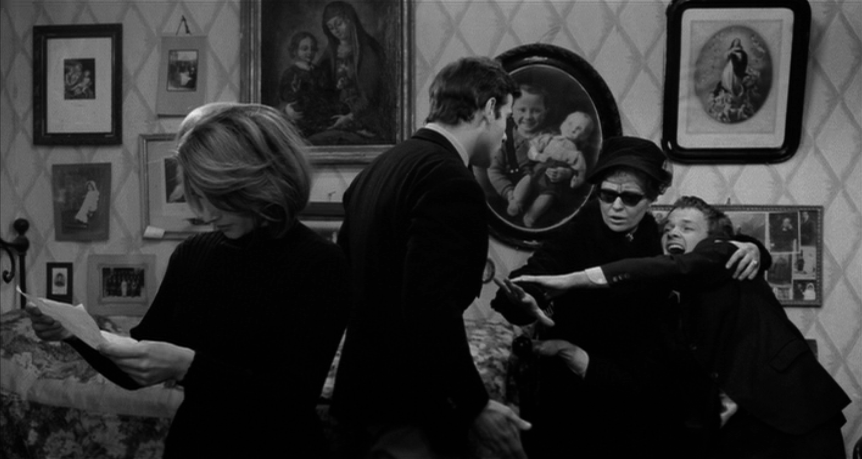
What it is • Up in the villa overlooking a vast valley, as in an enchanted castle in a child's fable, a family remains frozen in time. Surrounded by old pictures and heirloom furniture, buried in conservative Catholic publications, a blind mother (Liliana Gerace) "watches" over her brood of malcontents: Augusto (Marino Mase), the normal one with a job and a girlfriend in the town below who chafes at his obligations to the rest of the family; Giulia (Paola Pitagora), a striking but immature young woman; Leone (Pier Luigi Troglio), a mentally and physically disabled young man who needs to be looked after; and finally, Alessandro (Lou Castel), the brooding, combustible rebel who slinks around the grounds like a cat, stirring trouble and cultivating his own sense of bitterness. It will ultimately be Ale who concocts a half-cocked plan to violently break this spell - but will he have the courage to follow through on his brutal convictions? When the film was released in the mid-sixties, it felt shocking even amidst its revolutionary milieu. No less a subversive than Luis Bunuel found it too provocative, condemning it as an exercise in bad taste. Much of the movie plays - to me at least - like a black comedy, yet Fists in the Pocket is deadly serious at heart. And the film perfectly matches its beautiful but abrasive, unsettling style to its troubling story. This is one of the all-time great fucked-up family portraits, and deserves to be more widely known.

Why I like it •

The Favorites - L'Eclisse (#53)


The Favorites is a series briefly exploring films I love, to find out what makes them - and me - tick. L'Eclisse (1962/Italy/dir. Michelangelo Antonioni) appeared at #53 on my original list.

What it is • The story? Vittoria (Monica Vitti) breaks up with her boyfriend, and begins a romance with a young stockbroker (Alain Delon) in chic early sixties Rome. But is that really what the film "is"? At the very least, it's a stunningly photographed film, with some of the most gorgeous images in cinema history. But there are many films with jaw-dropping cinematography which nonetheless feel vapid - hell, a lot of TV commercials are quite nice to look at. L'Eclisse is something more. Like the greatest examples of still photography, L'Eclisse uses inventive compositions to capture our eye, stirring our senses on a fundamental level we weren't even aware of. Objects loom unusually in the frame, conjuring up uncanny sensations, while the actors' expressions convey deep sensitivity yet maintain an intriguing reserve. Even more importantly, this is cinema, not still photography. Antonioni is a master of subtle, arresting movement - of both camera and subject: sometimes only the actor's faces flicker or flinch but that's enough to thrill us. I can't find the exact quote, but Antonioni once claimed to be driving along a road flanked by a scenic landscape on the one side and rundown, abandoned industry on the other. He recalled shifting his gaze over to the empty factories, despite the natural beauty out one window. Why? Because "people had been there." However alienating/alienated his characters, however much he privileges the blocking and movement of performers over their dialogue, however dominated by empty space his frames can be, Antonioni's pictorialism is ultimately defined by a deep humanism.

Why I like it •

La Dolce Vita


This is an entry in "The Big Ones," a series covering 32 classic films for the first time on The Dancing Image. There are spoilers.

There aren't too many movies I've watched twice in the same day. I can, however, think of at least one: La Dolce Vita. It's not the likeliest candidate for that honor - after all, there's the length (almost three hours) and the episodic narrative, creating the impression of several movies rather than just one. Not exactly an experience screaming for instant replay. And yet... Many years ago, during a summer vacation when I was home alone, I rented La Dolce Vita and gave it a spin. I was disappointed; the film left me cold, unfurling across the screen without letting me in. Its idea of decadent fun seemed tame and outdated, its characters smugly unsympathetic, its themes and ideas pretentious and overblown. I was bored, and missed the warm, magical aura of Fellini classics like La Strada and Nights of Cabiria.

That night, I felt a vague stirring. I kept thinking about the movie; something about it, something I couldn't quite put my finger on, was drawing me back. Around 10 or 11 at night I went downstairs, put the video cassette back into the player and started the film over again. This time, I was hooked. Somehow, without meaning to, I had discovered the way into the movie - at least for me. Often celebrated as a visual feast, albeit more philosophically shallow than it seemed at the time (and derided by its detractors for the same reason), La Dolce Vita is actually most successful - to my eyes - as a film of ideas, albeit ideas difficult to articulate (which is why some of the dialogue seems too pretentious and on-the-nose). The emptiness that drove me away from the film initially was now what reeled me in - or rather the sense of anxiety and alienation beneath the flashy but shallow facade. There was a "there" there after all, brought into existence by its own self-doubt.

Bicycle Thieves


This is an entry in "The Big Ones," a series covering 32 classic films for the first time on The Dancing Image. There are spoilers.

"Put the blame on Mame," sang the red-haired girl in the poster, the one that Antonio is gluing to the wall when his bicycle is stolen. If it only it were that easy. Bicycle Thieves has scorn and skepticism aplenty, for the overwhelmed bureaucracy and government of postwar Italy that can't put men to work, for the Catholic Church with its phony sentiments and bourgeois charity offering a shave if you'll grovel low enough, for the pompous bedroom psychics who offer cheap pessimism and recoil from money as if it reminds them what they're really doing. And for the small-minded, jeering mobs who gang up on desperate men, and the snobby little brats who turn up their noses over plates of spaghetti, and even the Communist Party which writer Cesare Zavattini belonged to, which seems distant and rhetorical compared to the desperate needs of the stumbling human beings interrupting its gatherings in the catacombs of Rome.

And yet this is a film of context and, ultimately, compassion. If the film refuses to sentimentalize institutions or ideals, it is ever-attuned to the complications that motivate and mitigate human behavior. As Jean Renoir said, "Everyone has their reasons." And those reasons have an awful lot in common - one of the signature motifs of the movie is that in an atmosphere of competition, desperation, and degradation, every man feels compelled to look out for himself. Bicycle Thieves does not endorse this ethos, nor does it offer a hopeful alternative - this is not a film which offers cheap inspiration, or even much hope at its conclusion. Yet it observes this atmosphere unblinkingly, leaving us to draw our own conclusions, and the climax refuses to let us wallow in self-defeating despair or condescending pity. Instead at its end we feel angry, uncertain what should be done, but knowing that this situation, whether in 1948 or now, is unacceptable.

Does it seem strange to say that this movie is also beautiful, often warm, occasionally quite funny, and suffused with a careworn romanticism and naturalistic poetry? It is also, very pointedly, a "movie" - a slice of life, yes, in a sense, but filtered through the structures, motifs, and payoffs of the movie world.

The Sunday Matinee: Before the Revolution


This is an entry in The Sunday Matinee series.

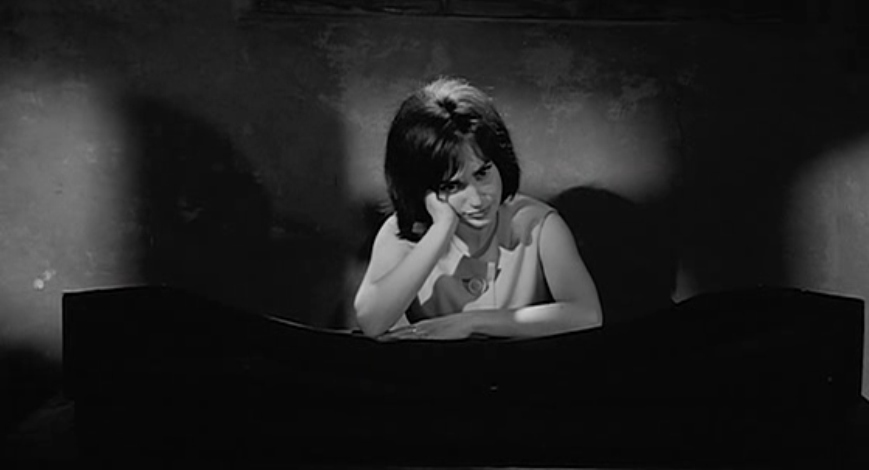
Before the Revolution, Italy, 1964, dir. Bernardo Bertolucci, starring Adriana Asti, Francesco Barilli

Story: In Parma, a young Communist feels torn between his romantic hunger for life, the security of his bourgeois background, and his ideological duty to the cause. Meanwhile, he carries on an affair with his emotionally unstable aunt.

The opening scene of Before the Revolution, or Prima della rivoluzione as it’s more poetically known in Italy, stands among the most elating passages in cinema. You can’t quite pinpoint how this works; trying to relate the alchemy of these moments in typed prose, my fingers tie themselves in knots. Bertolucci, only twenty-two when he shot the movie, would go on to direct more lush, illustrious sequences especially once he began to use color. But somehow here we feel we are getting closest to the pulsating consciousness powering his vision - a sensitivity and sensibility swooning with the pregnant possibilities and numinous actualities of the moment. What exactly do we see? Close-ups of Fabrizio (Frencesco Barilli), our hero, which loom like wall-sized portraits, even on a small screen; soaring overhead shots of Parma as if Bertolucci began to run through his hometown and in his enthusiasm sprouted wings and began to fly. What do we hear? Fabirizo’s neurotic narration, a mixture of lush language and furious, uneasy denunciation, underpinned by Ennio Morricone’s lush, heart-bursting score – fully invested in its sense of operatic intensity, and as unashamed of it as Fabrizio is wary. This film then is a sensuous experience, maybe even first and foremost, but it is also a film of ideas, and a dialectic exists between Fabrizio’s notions and his feelings (as well as amongst the various feelings themselves).


The Sunday Matinee: Il Posto


This is an entry in The Sunday Matinee series.

This series is going to continue with European classics from the 60s, with three in turn from a given country - Italy, Britain, Czechoslovakia, perhaps France. After Fists in the Pocket last week, the Italian theme continues with...

Il Posto, Italy, 1961, dir. Ermanno Olmi, starring Sandro Panseri, Loredana Detto

Story: A quietly observant young man gets an office job in the city, where he takes his first tentative steps into the adult world, and falls in love with a pretty co-applicant.

I once read a cartoon featuring an old man lying in bed, covers pulled up to his nostrils. Next to him, an obnoxiously cheerful wife hovered, chirping, “Wake up, honey! Today’s the first day of the rest of your life!” The next panel switched to a courtroom, with the sleeping man standing in the docket and a judge slamming down his gavel. A speech balloon conveyed the verdict - “Justifiable homicide, case dismissed.” A curious anecdote with which to introduce Il Posto, because the cartoon’s arch cynicism could hardly be more out of tune with Ermanno Olmi’s warm, open humanism. Yet it serves to set the film in stark relief, because Il Posto also opens with a character in bed, his eyes wide open, a mother rather than a wife calling out to him. There are times in one’s life where clichés shake off the accoutrements of familiarity and take on a fresh, glowing meaning - “oh, that’s what they meant,” we think to ourselves. If someone told Domenico Cantoni, “Today is the first day of the rest of your life,” he would know exactly what they meant, and it would not be cause for a bitter, murderous outburst but rather excitement, anticipation, worry, and a bit of fear.

The Sunday Matinee: Fists in the Pocket


This is an entry in The Sunday Matinee series.

Fists in the Pocket, Italy, 1965, dir. Marco Bellochio, starring Lou Castel, Paola Pitagora

Story: A restless, intermittently fitful young man seeks an escape - violent, if necessary - from his provincial villa and oppressive family.

Fists in the Pocket begins with a threatening note, but this j'accuse is just a bad joke. (Disturbing letters will recur throughout the movie, but the written word is an afterthought here; these characters, barbarians after a fashion, write their lives with their bodies and motions, not with mind or pen.) Composed in childlike fashion, words cut out from magazines in an attempt to seem ominous and anonymous, the missive threatens Augusto's girlfriend by revealing the existence of a pregnant mistress. As Augusto patiently reveals to his distraught lover, there is no pregnant girlfriend, no "other woman." There's only little sister Giulia trying to keep the family's sole breadwinner from having a life. Subtext to Augusto's revelation: you wouldn't believe my family. It's telling then that Augusto, the "normal" sibling, is least central to the story, and in some ways the least sympathetic. Within moments we are introduced to Giulia herself, and what an introduction!

Three shots, jump cuts between, and we zoom past her on a motorbike. She glances at the camera furtively and then laughs when two flirtatious bikers skid into the dirt and fly off their vehicle; played by Paola Pitagora, whose gorgeous, slightly gawky sensuality draws us like a magnet, Giulia is compulsively watchable. So is Lou Castel as Giulia's brother Alessandra or Ale, our (anti)hero who descends into the frame in a flash, landing on his feet from a tree perch, restlessly prowling the yard like a caged animal, snapping at his harmless nuisance of a brother. That's seemingly semi-retarded Leone (Pierluigi Troglio), who will later sigh, "What torture, living in this house." Ale is more ambiguous in his own lament - tediously reading the newspaper to his blind mother, he begins to concoct his own headlines. Eventually he moodily declares, "The king of England has died, leaving in darkest despair and desolation..." His mother cuts him off - "But there's still the queen." "Precisely," Ale says, and in his morbid mind the wheels begin to turn.

Stromboli

(Though already written before I was aware of the series, I am now submitting this as an entry in the For the Love of Films: Film Preservation Blog-a-Thon of Ferdy on Films & Self-Styled Siren. A full-fledged entry will be appearing on the Dancing Image on Sunday, the last day of the blog-a-thon. Stay tuned.)

Despite seeing many of his films, I've never really responded to Rossellini the way many cinephiles do. His holy simplicity has occasionally struck me as, well, just plain simple. Flowers of St. Francis (a blind buy on my part, and a satisfying one) is charming and Voyage in Italy compelling - though I wonder if Antonioni didn't eventually pick up Rossellini's ball and run further with it a few years later. Europa 51 I found embarrassing and remain rather mystified as to how its obviousness is supposed to be transcendent. Open City and Germany Year Zero are effective and absorbing but they're films I respected without being enthralled by. Neither one seemed to capture the lingering, simple, pure power of Bicycle Thieves (though both are overripe for revisiting, especially in the wake of the recent Criterion releases). Paisan was compelling in the abstract but I found its actuality too messy. Unlike Rossellini's acolytes (one recalls the zealous cineaste in Before the Revolution who admonishes the protagonist, "Remember, Rossellini is a god!") I was always unable to take the raggedness of his work in stride, to embrace it as not just a necessary evil but somehow fundamental to the work's appeal.

Search This Blog