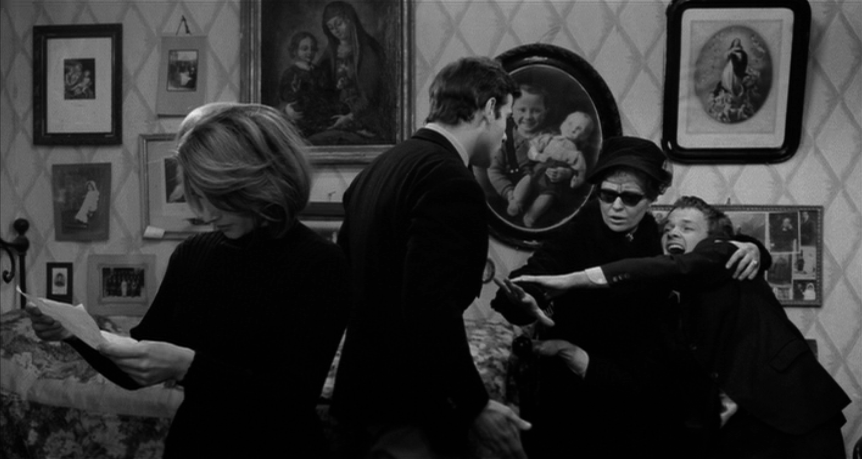
Lost in the Movies: fists in the pocket
Showing posts with label fists in the pocket. Show all posts

The Favorites - Fists in the Pocket (#28)


The Favorites is a series briefly exploring films I love, to find out what makes them - and me - tick. Fists in the Pocket (1965/Italy/dir. Marco Bellochio) appeared at #28 on my original list.

What it is • Up in the villa overlooking a vast valley, as in an enchanted castle in a child's fable, a family remains frozen in time. Surrounded by old pictures and heirloom furniture, buried in conservative Catholic publications, a blind mother (Liliana Gerace) "watches" over her brood of malcontents: Augusto (Marino Mase), the normal one with a job and a girlfriend in the town below who chafes at his obligations to the rest of the family; Giulia (Paola Pitagora), a striking but immature young woman; Leone (Pier Luigi Troglio), a mentally and physically disabled young man who needs to be looked after; and finally, Alessandro (Lou Castel), the brooding, combustible rebel who slinks around the grounds like a cat, stirring trouble and cultivating his own sense of bitterness. It will ultimately be Ale who concocts a half-cocked plan to violently break this spell - but will he have the courage to follow through on his brutal convictions? When the film was released in the mid-sixties, it felt shocking even amidst its revolutionary milieu. No less a subversive than Luis Bunuel found it too provocative, condemning it as an exercise in bad taste. Much of the movie plays - to me at least - like a black comedy, yet Fists in the Pocket is deadly serious at heart. And the film perfectly matches its beautiful but abrasive, unsettling style to its troubling story. This is one of the all-time great fucked-up family portraits, and deserves to be more widely known.

Why I like it •

Fragments of Cinephilia, Pt. V


If you're looking for further details on the Maya Deren video I just posted on YouTube, here is the blog post mentioned at the end.

Short thoughts on: Fists in the Pocket • Michael Medved • Goodbye, Mr. Chips • Russian Ark • My Night at Maud's • Claire's Knee • Paris Belongs to Us • 2 or 3 Things I Know About Her • Jean-Luc Godard • Europa '51

I've become a broken record on this subject, but I swear that within a few weeks I will have a huge backlog of Monday posts, more than I know what to do with - including a video that relates to the above picture. January is going to be very busy (although the work is mostly done, I'm waiting for other sites to cross-post). Unfortunately at this moment an interview, a guest post, at least four videos, and a podcast appearance are all waiting in the wings rather than in the bag. (That said, I did finally upload the "Cinepoem" video I blogged about back in November.) So I'm turning to one of my old standbys today, the archival of my old IMDb comments, where my online film commentary began. I've done this four times before, each time moving a bit further into the past. Some of these comments are actually almost a decade old, so be advised that they may no longer reflect my opinions (hell, I even left in some of the typos!). In many cases they represent my first engagement with the work in question, as a 23-year-old hungry for as many cinematic experiences as he could devour.

In fact 2006-07 was in many ways a peak viewing period for me; I was falling back into cinephilia after many years of caring more about music than movies. Most of the topics below relate to mid-century European films, particularly French filmmakers like Rohmer, Rivette, and Godard. Some of these films I loved, some I did not, but all of them seemed to me worthy of discussion - and still do. I would like to hear your thoughts as well, if you've seen these films (and if you haven't, I hope this serves as encouragement). Did Fists in the Pocket surprise you? Is Europa '51 too didactic? Does Goodbye Mr. Chips need a stronger narrative throughline? Is Rohmer subtly encouraging us to criticize the protagonist of Claire's Knee? Is Godard an incredibly consistent genius, an emperor with no clothes, or a hit-and-miss experimenter? Let me know what you think, and I'll let you know where I do and don't agree with the old me.

(I originally used a different image, culled from a Wonders in the Dark post several years earlier, but I replaced it with this one in 2017 when I cross-posted that Wonders piece on this site.)

That Total Film 1964 - 1966 • "32 Days of Movies" Day 16


The sixteenth chapter in "32 Days of Movies", an audiovisual tour through 366 films.
(2015 update: included Vimeo embed after the jump)


That Total Film

The films in today's chapter form an entity thrilling, melancholy, beautiful, and tragic - the end of a beginning and the beginning of an end. When asked to write about Fists in the Pocket forty years later, Jean-Pierre Gorin noted ruefully, "every scene ... with the convulsive beauty of its framing and composition, amply proves how much this period was made by people so steeped in classical culture that they fantasized it could be solid beyond its fragility, shaking it to the core and ultimately ushering in a world they could themselves hardly live in." Oh, you can see that all over the place today, in a chapter that - not accidentally - finds itself exactly halfway through the series, to the point where the closing clip is even divided in two, to be concluded tomorrow.

The Sunday Matinee: Fists in the Pocket


This is an entry in The Sunday Matinee series.

Fists in the Pocket, Italy, 1965, dir. Marco Bellochio, starring Lou Castel, Paola Pitagora

Story: A restless, intermittently fitful young man seeks an escape - violent, if necessary - from his provincial villa and oppressive family.

Fists in the Pocket begins with a threatening note, but this j'accuse is just a bad joke. (Disturbing letters will recur throughout the movie, but the written word is an afterthought here; these characters, barbarians after a fashion, write their lives with their bodies and motions, not with mind or pen.) Composed in childlike fashion, words cut out from magazines in an attempt to seem ominous and anonymous, the missive threatens Augusto's girlfriend by revealing the existence of a pregnant mistress. As Augusto patiently reveals to his distraught lover, there is no pregnant girlfriend, no "other woman." There's only little sister Giulia trying to keep the family's sole breadwinner from having a life. Subtext to Augusto's revelation: you wouldn't believe my family. It's telling then that Augusto, the "normal" sibling, is least central to the story, and in some ways the least sympathetic. Within moments we are introduced to Giulia herself, and what an introduction!

Three shots, jump cuts between, and we zoom past her on a motorbike. She glances at the camera furtively and then laughs when two flirtatious bikers skid into the dirt and fly off their vehicle; played by Paola Pitagora, whose gorgeous, slightly gawky sensuality draws us like a magnet, Giulia is compulsively watchable. So is Lou Castel as Giulia's brother Alessandra or Ale, our (anti)hero who descends into the frame in a flash, landing on his feet from a tree perch, restlessly prowling the yard like a caged animal, snapping at his harmless nuisance of a brother. That's seemingly semi-retarded Leone (Pierluigi Troglio), who will later sigh, "What torture, living in this house." Ale is more ambiguous in his own lament - tediously reading the newspaper to his blind mother, he begins to concoct his own headlines. Eventually he moodily declares, "The king of England has died, leaving in darkest despair and desolation..." His mother cuts him off - "But there's still the queen." "Precisely," Ale says, and in his morbid mind the wheels begin to turn.

Search This Blog