Lost in the Movies

The Lost Son of Havana


Thirty years after the chants of "Lou-eee, Lou-eee!" have faded from Fenway, six miles from the spot of a very important and long-awaited 1975 reunion, the National Amusements Showcase Cinemas in Revere screened The Lost Son of Havana in Theater 1 at 7:35 pm; one of four daily screenings for at least the remainder of the week (if it is not held over any longer). The name of the movie was left out of the "Now Playing" flyers adorning the lobby, and there weren't any placards emblazoned with large quotes from Entertainment Weekly or video installments running trailers in loops. When asked for a ticket to the film, one of the theater's employees warned, "You do know it's a documentary, right?" Apparently, this disclaimer was necessary: some customers have been complaining. No one complained on this particular night, though - the four other people in the near-empty theater seemed perfectly content with their choice of entertainment.

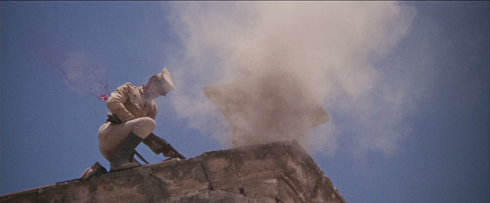
Apocalypse Now Redux


Apocalypse Now Redux, 1979 (revised in 2000), directed by Francis Ford Coppola

The Story: Capt. Willard, an increasingly strung-out Special Forces commando, is assigned a top-secret mission in late 60s Vietnam: travel up the Da Nang river to assassinate the renegade Col. Kurtz, a mysterious military genius who has set up a private empire in the wilderness. Along the way, Willard and his shipmates encounter increasingly bizarre characters and situations, and by the time they arrive in Kurtz’s unholy domain, it has become clear that the colonel is only as mad as the war around him.

When the troubled production of Francis Ford Coppola’s Apocalypse Now was mired for years in the Philippines, Hollywood wags dubbed the film “Apocalypse Later.” The implication, of course, being that such a crazy idea – an adaptation of Joseph Conrad’s Heart of Darkness, transposed to Vietnam, and shot in conditions which were themselves often warlike (literally, the crew had to negotiate with both sides of a civil war which was raging around them) – could only exist on paper or perhaps in Coppola’s crazed, grandiose mind. When the film arrived at Cannes finally, at the tail end of the 70s, it could have merely been a footnote to the legendary turmoil of its making, something like the later big-budget flop Heaven’s Gate, labeled a “folly” and quickly cast aside.

The Movie Bookshelf

A gathering of all the movie books that influenced, enlightened, and excited me, you, and everyone else - a diverse and highly personalized canon.

Six weeks ago I launched a new "meme" (another word I don't particularly enjoy, but which fits), calling it Reading the Movies and inviting you all to respond. There was a great response, and here are the results: a canonical list of, by my count, 364 titles which impacted these particular bloggers. A list of the 37 blogs that participated appears at the end of the post. I hope you will visit these blogs, because this list is only a starting point - many bloggers described their choices in loving detail, some devoting entire posts to a single book. And the discussion continues in the commentary, where many blog-readers have let their own choices be known. If I've missed anyone, please let me know and I'll add your selections as soon as possible. I've also included book covers wherever provided by the blogger.

Finally, if you've yet to participate - if this has been on the back burner for a while, or you've only just discovered the exercise - keep in mind that this is just the beginning. Jump right in, and comment below to let me know that you've joined. That's the nice thing about a virtual bookshelf - no size limits.

*(And, please, when you've read a book on this list for the first time, return to the thread below and let us know what you thought. No time frames on bookshelves either...)

Gone With the Wind


Gone With the Wind, 1939, directed by Victor Fleming (with uncredited assistance from George Cukor and Sam Wood)

Story: In an age of “cotton and cavaliers,” spoiled Scarlett O’Hara (Vivien Leigh) is the belle of the plantation barbecue. But then war – the Civil War – comes to her chivalric South, and her way of life is swept away, or gone with the wind, as author Margaret Mitchell put it in her bestselling novel. Soon this young beauty (who was once fanned by slaves during afternoon naps) is vowing to the angry sky, “As God as my witness, I’ll never be hungry again!” Even as she pursues the married and genteel Ashley Wilkes (Leslie Howard), and is alternately seduced and bedeviled by the charming anti-gentleman Rhett Butler (Clark Gable), Scarlett does her best to keep good to this promise.

Michael Jackson 1958 - 2009

With Jackson's face (or several faces) all over the news, one would expect that we'd be hearing a little more of the music and (especially) seeing a little more of the dancing. Sadly, this is not really the case. We get clips but rarely get to enjoy a whole piece - I understand MTV suspended regular programming for several hours after his death in order to play his old videos, but now they're back to reality shows. So I have embedded a You Tube clip, probably his most famous moment, below (it follows the rest of my thoughts).

The Wild Bunch


The Wild Bunch, 1969, directed by Sam Peckinpah

Story: After being set up in a bank heist, the dwindling and aging Wild Bunch (a band of outlaws operating in the American frontier of the early 20th century) crosses into Mexico. Pursued by bounty hunters led by one of their former members, the Bunch agree to steal a cache of weapons for a corrupt Mexican warlord – but eventually, they must decide what’s worth more: his gold or their vaguely maintained code of honor.

The Wild Bunch is notorious as a subversive take on the Western genre, with the opening lines of Pike (William Holden) – “If they move, kill ‘em!” – supposedly a declaration of independence from the old-fashioned sanctities of the form. And the ensuing massacre would seem to confirm that we’re a long way from the moralistic shades of High Noon (1952) and Shane (1953), what with old ladies of the Temperance Union being killed in the crossfire by careless deputies, cowering bank tellers being taken hostage and used as live bait by the titular antiheroes, and the innocent babes of the town wandering through a town square littered with the corpses of their elders as they imitate the outlaws’ gunfire. Meanwhile, other children light a bonfire over battling scorpions and red ants, piling violence upon violence in a microcosm of the film’s pathology: lethal but somehow poignant old cretins – the bunch – pitted against the ruthless, small-minded hordes – the bounty hunters and Mexican soldiers and railroad men who are just as violent as the outlaws, but somehow more petty.

Waiting for the 25th Hour


[This review first appeared at Ibetolis' Film for the Soul as part of his great "Counting Down the Zeroes" series, which you should definitely check out. The review is quite long - including a lengthy quote from the movie as an introduction - and discusses crucial plot points, so beware. It begins after the jump.]

Three by Truffaut

In my introduction to "Reading the Movies," I noted the titles I was reading at the moment. Among the Kael, Sarris, and sundry I declined to mention The Films of My Life by François Truffaut, which I've been reading off and on since April. I already transcribed the marvellous introduction; as for the rest of the book, I'm cool on some of Truffaut's criticism. At times he becomes too absorbed by plot descriptions (which, possibly due to translation, become cumbersome and hard to follow), at others his epigrams seem too obscure (I know, I know, I'm one to talk...). But unlike Truffaut's films, which I can only enjoy from a distance like Moses viewing the promised land, there are passages in his writing which leap from the page and hit me where it hurts - in a good way. Following are three wonderful essays which I've reproduced here for your enjoyment. So making their online debut (to my knowledge):

"Citizen Kane: The Fragile Giant" - Fantastic tribute to one of the greatest movies of all time, not from a perspective of technical admiration but of zealous, totally enraptured enthusiasm (and with a focus on the characters and story, which is also how I first knew and loved Kane - and in some ways, still do).

"Muriel" - Slightly bewildered appreciation of the Resnais film, with a great Hitchcock anecdote. Hitch's punchline, Truffaut's closing paragraph, and the film in question are all somewhat mystifying though I like the first two more than the third.

"Roberto Rossellini Prefers Real Life" - Tip of the hat to a very unique filmmaker, a man Truffaut worked for (much of the essay is devoted to personal reminisces). Years later, he still seems to be astonished by Rossellini's distractible intensity; Truffaut's tone is simultaneously admiring and disbelieving.

Reading the Movies

A list of the movie books which had the greatest impact on me.


Not so long ago, I moved into a new neighborhood. Before even attempting to settle in, I paid a visit to the local library which, despite its grand exterior, was fairly nondescript within. This was particularly true of the nonfiction section, located downstairs. Endless shelves of books stretched across a close-quartered white-walled basement, completely unadorned and giving off the aura of an abandoned filing room located deep in the bowels of some God-forsaken bureaucracy. There were no labels, cards, or indicators on any of these shelves so I had to scan the stacks by eye to find the movie section.

When I tracked it down (it was one of the first stacks, mid-row, between the circus and television) I was in for a thrilling surprise. Hidden away in this library was a treasury of great seventies film-book classics, many out of print. Consequently, over the past few months, I have read I Lost It at the Movies by Pauline Kael, The Fred Astaire & Ginger Rogers Book by Arlene Croce, Godard by Richard Roud, Confessions of a Cultist by Andrew Sarris, Signs and Meaning in the Cinema by Peter Wollen, The Primal Screen by Sarris, and Kiss Kiss Bang Bang by Kael; at present, I have delved into three more film texts: Politics and Cinema by Sarris, Going Steady by Kael, and The Japanese Film by Joseph L. Anderson and Donald Richie.

I mention this not only to illustrate my passion for reading about the movies, but also to demonstrate that I am only just discovering many seminal texts of the cinema, and that the list which follows is not to be mistaken for a primer on essential reading. I make no claims for the greatness of the following ten books. Nor are they necessarily my favorites; indeed, some have outlived their purpose and I haven't looked at them in years. Many titles are obscure, so fame is not a criterion either. What all these books do have in common is their influence...on me. These are the books that informed me, excited me, provoked me, the ones that introduced me to The Wolf Man and One Flew Over the Cuckoo's Nest and Taxi Driver and Celine and Julie Go Boating and Le Vent d'Est.

Beyond these ten, I will deliver honorable mention to another fifteen books which were not quite as crucial to my development. Nonetheless, they are highly noteworthy and in some cases, may have been even more constant companions than those titles in the top ten. I will (briefly) tell you why...and then the ball is yours. Run with it. I would love for everyone reading this list to compose their own personal top ten. There are no rules in how you chose to play this game, no guidelines save one:

RULE #1:
YOU MUST CREDIT THIS BLOG AND LINK TO THIS POST IN YOUR RESPONSE!

Just a small matter (but one which was sadly neglected the last time I tried this!).

Also one very strong recommendation - please tag five more people so that we can keep this going.

The rest is up to you.

Here is my own list, titles followed by the stories of how we met...


The Great Movies

Penned by William Bayer, an independent filmmaker and writer on cinema, this lavishly-illustrated, thought-provoking coffee table book, composed of sixty films divided into twelve categories, is by all accounts currently out of print, and long ago forgotten. Or rather, long ago forgotten by most people (if they ever even made its acquaintance), but not by me. Somehow this book, published ten years before my birth, came into my possession in early childhood (I believe my father purchased it before I, along with my cinephilia, came onto the scene). It has had an inordinate influence on how I look at movies to this day. I still own it and have reproduced many of its pages in this post, as a tribute to all those glorious but long-neglected celebrations of the movies - the books which served to engage our curiosity, to focus our eye, to sharpen our intellect, and most of all to fire our imagination so that sights unseen became holy grails. A follow-up post will examine the many books that served this purpose for me, and then I will pass the baton on to my readers, but for now...The Great Movies.

Wonders in the Dark


Lately, while distracted from my own blog, I've become a regular contributor to the commentary on Wonders in the Dark, a great blog run by Allan Fish and friend-of-The Dancing Image Sam Juliano. At this moment, Allan is knee-deep (or deeper) in a long series exploring what he considers to be the greatest films of every decade since the thirties. If you're a movie buff of my sort, who loves list and countdowns, this is definitely for you. Until now, there has not been a collection of all the posts in this series stored in one location, so I've taken it upon myself to gather all the information here. What follows is a complete list of the entire countdown, with links to every post in question.

This list will be regularly updated as Allan continues his epic journey through the years. Feel free to drop by and leave comments, even on old posts; one of the best things about this excellent blog is the lively (to put it mildly) discussion every topic engenders, sometimes straying far away from the movie at hand. For example, 2001 has led to a debate on the value of canons, Viridiana a discussion on the intertwining of ethics and aesthetics in art, and The Young Girls of Rochefort a questioning of the merits of American cinema in the 60s and Allan's views thereof. The list follows the jump and can also be found here. (updated until its conclusion in 2010)


Fred and Ginger

Several months ago, I scoured the web for every Astaire-Rogers dance I could find. Sure enough, I tracked them all down but within days of posting the videos were disappearing one by one. I resolved to restore these myself, by selecting the scenes I wanted, paring them down to the essentials, and posting them in the place of those deleted You Tube clips. Now the job is done, so I invite you all to revisit (or just plain visit) the Astaire-Rogers ouevre. If you don't feel you have enough time to watch very many, at least treat yourself to "Night and Day" - it's the third clip down, and is one of the sublime moments in musicals - indeed, in movies.

In other news, someone beat me to the punch and posted the 1987 Rankin-Bass Wind in the Willows on You Tube. For those curious enough to see the movie I discussed in February, you can watch the whole thing here. I will probably be putting up my own version eventually - the VHS tape which is missing a few scenes but contains all kinds of goodies in addition to the film itself, from claymation commercials to Donahue and Ralph Nader jamming with Muppets to TV cameos by Keenan Wynn and James Earl Jones.

Search This Blog