Lost in the Movies

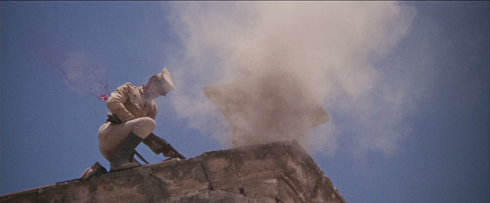
Lawrence of Arabia


Lawrence of Arabia, 1962, directed by David Lean

The Story: T.E. Lawrence (Peter O’Toole), a minor British officer stationed in Cairo during World War I, is sent into the Arabian desert to “assess” the state of the Arabs’ revolt against the Turks. The revolt is a mess, but instead of reporting back, Lawrence himself leads a band of Arabs through the harshest sectors of the desert into victory against the Turks. Astonished and delighted, his superiors give him free reign and so T.E. becomes “Lawrence of Arabia,” an enigmatic, brilliant, and narcissistic guerrilla leader whose genius and bravado is matched only by his eccentricity and insecurity.

Mark Rudd and the Weather Underground


Microphone in hand, impatiently trailing the wire behind him as he paced at the front of the old theater with about forty people gathered before him, Mark Rudd emphatically, if a tad regretfully, declared that he was not a "revolutionary." At least not any more. On Saturday, July 18th, the Music Hall in Portsmouth, NH held a seminar as part of the Maine Film Festival entitled "A New Century - A New Activism." The talk began before the screening of The Weather Underground (a 2002 documentary about the radical left-wing group Rudd belonged to in the 1960s and 1970s) but spilled over into a post-film discussion as well.


16 Days into July (One Year and Counting)

Links to all of my online work, on an ongoing basis

On the first anniversary of this blog, I compiled a complete directory. It has now been moved here in its entirety.

2001: A Space Odyssey


2001: A Space Odyssey, 1968, directed by Stanley Kubrick

The Story: Monkeys kill each other. Millions of years later, a murderous computer is dismantled while singing a vaudeville tune. An astronaut travels through a wormhole, ages rapidly, and is reborn as a gigantic fetus floating amongst the stars. Sleek, black monoliths appear intermittently. Lots of ships and satellites and stations float through outer space.

The plot both is and isn’t the point of 2001: A Space Odyssey. On the one hand, its rather sketchy (and on paper, ridiculous, as the above indicates) plot is easily overwhelmed by the cosmic light shows, the long demonstrations of space travel technique and ritual, the passages featuring the apes who can’t talk and the bloodless bureaucrats who can but probably shouldn’t, and of course the lavish visual effects (which hold up so much better than CGI from two years ago – or for that matter, from this year). On the other hand, if the overarching plot seems haphazard and thin, the narrative arc – spanning millions of years as the human race progresses from a mindless ape to a cosmic star child – is all-important. Composing the arc are several generally separate stories, four in all: the prehistoric men, the trip to the moon sponsored by Howard Johnsons, the showdown with HAL, the mystical and mystifying finale.

The Lost Son of Havana


Thirty years after the chants of "Lou-eee, Lou-eee!" have faded from Fenway, six miles from the spot of a very important and long-awaited 1975 reunion, the National Amusements Showcase Cinemas in Revere screened The Lost Son of Havana in Theater 1 at 7:35 pm; one of four daily screenings for at least the remainder of the week (if it is not held over any longer). The name of the movie was left out of the "Now Playing" flyers adorning the lobby, and there weren't any placards emblazoned with large quotes from Entertainment Weekly or video installments running trailers in loops. When asked for a ticket to the film, one of the theater's employees warned, "You do know it's a documentary, right?" Apparently, this disclaimer was necessary: some customers have been complaining. No one complained on this particular night, though - the four other people in the near-empty theater seemed perfectly content with their choice of entertainment.

Apocalypse Now Redux


Apocalypse Now Redux, 1979 (revised in 2000), directed by Francis Ford Coppola

The Story: Capt. Willard, an increasingly strung-out Special Forces commando, is assigned a top-secret mission in late 60s Vietnam: travel up the Da Nang river to assassinate the renegade Col. Kurtz, a mysterious military genius who has set up a private empire in the wilderness. Along the way, Willard and his shipmates encounter increasingly bizarre characters and situations, and by the time they arrive in Kurtz’s unholy domain, it has become clear that the colonel is only as mad as the war around him.

When the troubled production of Francis Ford Coppola’s Apocalypse Now was mired for years in the Philippines, Hollywood wags dubbed the film “Apocalypse Later.” The implication, of course, being that such a crazy idea – an adaptation of Joseph Conrad’s Heart of Darkness, transposed to Vietnam, and shot in conditions which were themselves often warlike (literally, the crew had to negotiate with both sides of a civil war which was raging around them) – could only exist on paper or perhaps in Coppola’s crazed, grandiose mind. When the film arrived at Cannes finally, at the tail end of the 70s, it could have merely been a footnote to the legendary turmoil of its making, something like the later big-budget flop Heaven’s Gate, labeled a “folly” and quickly cast aside.

The Movie Bookshelf

A gathering of all the movie books that influenced, enlightened, and excited me, you, and everyone else - a diverse and highly personalized canon.

Six weeks ago I launched a new "meme" (another word I don't particularly enjoy, but which fits), calling it Reading the Movies and inviting you all to respond. There was a great response, and here are the results: a canonical list of, by my count, 364 titles which impacted these particular bloggers. A list of the 37 blogs that participated appears at the end of the post. I hope you will visit these blogs, because this list is only a starting point - many bloggers described their choices in loving detail, some devoting entire posts to a single book. And the discussion continues in the commentary, where many blog-readers have let their own choices be known. If I've missed anyone, please let me know and I'll add your selections as soon as possible. I've also included book covers wherever provided by the blogger.

Finally, if you've yet to participate - if this has been on the back burner for a while, or you've only just discovered the exercise - keep in mind that this is just the beginning. Jump right in, and comment below to let me know that you've joined. That's the nice thing about a virtual bookshelf - no size limits.

*(And, please, when you've read a book on this list for the first time, return to the thread below and let us know what you thought. No time frames on bookshelves either...)

Gone With the Wind


Gone With the Wind, 1939, directed by Victor Fleming (with uncredited assistance from George Cukor and Sam Wood)

Story: In an age of “cotton and cavaliers,” spoiled Scarlett O’Hara (Vivien Leigh) is the belle of the plantation barbecue. But then war – the Civil War – comes to her chivalric South, and her way of life is swept away, or gone with the wind, as author Margaret Mitchell put it in her bestselling novel. Soon this young beauty (who was once fanned by slaves during afternoon naps) is vowing to the angry sky, “As God as my witness, I’ll never be hungry again!” Even as she pursues the married and genteel Ashley Wilkes (Leslie Howard), and is alternately seduced and bedeviled by the charming anti-gentleman Rhett Butler (Clark Gable), Scarlett does her best to keep good to this promise.

Michael Jackson 1958 - 2009

With Jackson's face (or several faces) all over the news, one would expect that we'd be hearing a little more of the music and (especially) seeing a little more of the dancing. Sadly, this is not really the case. We get clips but rarely get to enjoy a whole piece - I understand MTV suspended regular programming for several hours after his death in order to play his old videos, but now they're back to reality shows. So I have embedded a You Tube clip, probably his most famous moment, below (it follows the rest of my thoughts).

The Wild Bunch


The Wild Bunch, 1969, directed by Sam Peckinpah

Story: After being set up in a bank heist, the dwindling and aging Wild Bunch (a band of outlaws operating in the American frontier of the early 20th century) crosses into Mexico. Pursued by bounty hunters led by one of their former members, the Bunch agree to steal a cache of weapons for a corrupt Mexican warlord – but eventually, they must decide what’s worth more: his gold or their vaguely maintained code of honor.

The Wild Bunch is notorious as a subversive take on the Western genre, with the opening lines of Pike (William Holden) – “If they move, kill ‘em!” – supposedly a declaration of independence from the old-fashioned sanctities of the form. And the ensuing massacre would seem to confirm that we’re a long way from the moralistic shades of High Noon (1952) and Shane (1953), what with old ladies of the Temperance Union being killed in the crossfire by careless deputies, cowering bank tellers being taken hostage and used as live bait by the titular antiheroes, and the innocent babes of the town wandering through a town square littered with the corpses of their elders as they imitate the outlaws’ gunfire. Meanwhile, other children light a bonfire over battling scorpions and red ants, piling violence upon violence in a microcosm of the film’s pathology: lethal but somehow poignant old cretins – the bunch – pitted against the ruthless, small-minded hordes – the bounty hunters and Mexican soldiers and railroad men who are just as violent as the outlaws, but somehow more petty.

Waiting for the 25th Hour


[This review first appeared at Ibetolis' Film for the Soul as part of his great "Counting Down the Zeroes" series, which you should definitely check out. The review is quite long - including a lengthy quote from the movie as an introduction - and discusses crucial plot points, so beware. It begins after the jump.]

Three by Truffaut

In my introduction to "Reading the Movies," I noted the titles I was reading at the moment. Among the Kael, Sarris, and sundry I declined to mention The Films of My Life by François Truffaut, which I've been reading off and on since April. I already transcribed the marvellous introduction; as for the rest of the book, I'm cool on some of Truffaut's criticism. At times he becomes too absorbed by plot descriptions (which, possibly due to translation, become cumbersome and hard to follow), at others his epigrams seem too obscure (I know, I know, I'm one to talk...). But unlike Truffaut's films, which I can only enjoy from a distance like Moses viewing the promised land, there are passages in his writing which leap from the page and hit me where it hurts - in a good way. Following are three wonderful essays which I've reproduced here for your enjoyment. So making their online debut (to my knowledge):

"Citizen Kane: The Fragile Giant" - Fantastic tribute to one of the greatest movies of all time, not from a perspective of technical admiration but of zealous, totally enraptured enthusiasm (and with a focus on the characters and story, which is also how I first knew and loved Kane - and in some ways, still do).

"Muriel" - Slightly bewildered appreciation of the Resnais film, with a great Hitchcock anecdote. Hitch's punchline, Truffaut's closing paragraph, and the film in question are all somewhat mystifying though I like the first two more than the third.

"Roberto Rossellini Prefers Real Life" - Tip of the hat to a very unique filmmaker, a man Truffaut worked for (much of the essay is devoted to personal reminisces). Years later, he still seems to be astonished by Rossellini's distractible intensity; Truffaut's tone is simultaneously admiring and disbelieving.

Search This Blog