Lost in the Movies

The World


#70 in Best of the 21st Century?, a series counting down the most acclaimed films of the previous decade.
"It's a small world after all, it's a small world after all, it's a small world after all, it's a small, small, small, small world..."
"The world" of this film’s title is a theme park which combines a lushly wooded landscape with reproductions of international monuments: a towering yet smaller-than-normal Eiffel Tower which looms over the whole park like a panopticon, a small set of the New York skyline which still includes the World Trade Center, a bite-size Leaning Tower of Pisa which perpetually invites tourists to stand twenty feet in front of it with their hand out so that photographic "tricks" can make them appear to be holding it up. (Director Zhang Ke Jia always shoots these particular tourists from the side, so that the absurd artificiality of their gesture is highlighted.) This demi-monde, further dislocated by being placed in Beijing instead of the American setting (say, World Showcase in Disney World, or else any number of miniature golf courses) where we might expect it, is fascinating enough to sustain the film even if there isn’t a plot. Which, at first glance, there isn’t, really. Still, a story of sorts develops over the course of the film, or rather several stories, glimpses into characters' lives which remind us how vast and implacable is the real world outside the bounds of our dreamlike global village.

Boomer Baseball: Field of Dreams & the American 60s


“Ray Kinsella, child of the sixties, builds baseball field and at end of movie meets his dead father.”
-Japanese tagline for Field of Dreams, paraphrased by writer/director Phil Alden Robinson

Beloved for its family drama, revered for its sporty caché (at least among those who can forgive a rightie Shoeless Joe), Field of Dreams is generally less recognized for its cultural-historical importance. It was one of the crucial films signifying a late 80s trend: the ascension of the baby boom generation to Hollywood's height of power, accompanied by a burst of 60s nostalgia which helped (re-)define the era for a generation. Preceded by "thirtysomething" and "The Wonder Years" on TV, big hits like The Big Chill and smaller films like Running on Empty (among others) in the cinema, as well as cultural events like the 20th anniversary of Woodstock and the release of the Beatles catalog on CD, Field of Dreams arrived at a crucial crossroads. In 1989, the Berlin Wall was crashing down and a new world was being born - for many in the West, the first time such a sensation had arisen in two decades. Meanwhile, the baby boomers were all hitting or approaching 40, many heading nuclear families and holding professional jobs they never would have foreseen, or so we were told.

The Reagan era, encapsulating a strong reaction to the 60s counterculture and New Left, was coming to an end, with President Bush half-heartedly promising "a kinder, gentler America." As the Wall crashed, and conservatism tentatively relaxed its hold on the American consciousness, pop culture experienced a renewed burst of creativity. New filmmakers like Spike Lee and Oliver Stone emerged to point a light at the country's darker aspects; TV suddenly grew adventurous and subversive with "Twin Peaks" and "The Simpsons"; postmodernism exploded from an academic subculture into the dominant media approach; meanwhile, a reversion to authenticity in mainstream rock was just around the corner. At the center of all these phenomena (except for the last) were baby boomers, who after plugging away and working their way up had finally emerged as mainstream trendsetters. Not only did they point the way forward; they also looked back at their own history, which was ripe for mythologization and nostalgia after a decade in the "dated" bin. Field of Dreams, with its attempt to synchronize America's National Pastime and the Age of Aquarius, its yearning to fuse youthful dreams, old traditions, and adult responsibilities, may be the quintessential film of this moment.

A Serious Man


#67 in Best of the 21st Century?, a series counting down the most acclaimed films of the previous decade. This review contains spoilers.

In his four-star review of A Serious Man, Roger Ebert writes, “I’m sure you’ve heard the old joke where Job asks the Lord why everything in his life is going wrong. Remember what the Lord replies? If you don’t remember the joke, ask anyone. I can’t prove it but I’m absolutely certain more than half of everyone on Earth has heard some version of that joke.” Well, no, I don’t remember what the Lord replies, because I don’t think I’ve ever heard some version of that joke (is that the joke?). However, Ebert’s withholding the punchline is very much in the spirit of the film he’s reviewing. This is a film that begins with a ghost (is it a ghost?) getting stabbed and ends with a tornado bearing down on a Hebrew school while the tinny sound of Jefferson Airplane reverberates from a transistor radio. In between, a woman kicks her husband out of the house and then makes him pay for her suddenly dead lover’s funeral; a boy tokes up before his Bar Mitzvah and receives a Grace Slick-inspired blessing from his 90-year-old rabbi; an uncle with cysts is charged with gambling and arrested for soliciting sodomy; an escape across the Canadian border is brought to a bloody halt by anti-Semitic hunters (don’t worry, it’s all a dream!); and a Jewish dentist discovers a hidden Hebrew script on the inside teeth of a gentile. Larry Gopnik (Michael Stuhlbarg) is trapped in the center of this eventually literal cyclone, and throughout the film he wears a dumbly neurotic, perpetually perplexed expression. He doesn’t understand what’s going, yet at times he seems to behave just as irrationally as the incidents befalling him, particularly with all the crap he takes from his shrewish wife. Everyone in the movie seems to be acting according to the dictates of some hidden humor – in both senses of the word; gee, I wish someone would let me in on the joke.

Visit the picture gallery

Check it out here. I've also updated labels, which can now be found in a "cloud" near the bottom of the sidebar. And if you missed it this weekend, here is the update on my blogging status.

Consolidation

___________

As you can see, The Dancing Image has now incorporated posts from my two other blogs, The Sun's Not Yellow and Lost in the Movies, which have ceased to be active. It's also received a minor makeover. To replace the functions of several blogs I have added tabs to the top of the page: one which highlights my stronger pieces so they don't get lost in the shuffle, plus a full directory of all my writing, the Wonders in the Dark lineup, and my annual "best of the blogosphere" round-ups. There may be more changes down the line, but then again this may be the end of said line, more or less.

Following my break from online work (save the biweekly "21st Century" pieces, constituting my entire output for the past couple months), I intended to work on some long-term, in-depth essays and series I'd placed on the backburner long ago. None came to fruition, partly because of waning enthusiasm, partly because of a busy schedule, and partly because - upon reflection - some of them were never all that promising to begin with. Anyway, a commitment to blogging has really served its purpose by now; it got me through some lean years, gave me a (semi-)creative and intellectual outlet, and engaged me with a lot of great people whose work and commentary I enjoyed.

From now on this blog will serve three purposes, aside from the dubious distinction of storing my past work. One: It will continue to link up writing I do elsewhere. For now this means the "Best of the 21st Century?" series for Wonders in the Dark, as I intend to fulfill my promise of completing that venture. I'm doubtful that it will mean much else. Two: It will continue to provide an outlet for any random musings on film or films, either in review form or (more likely) loose, impressionistic observations. Most likely there will not be any such pieces, but I certainly don't want to rule out the possibility.

Three: There is one planned project I have not entirely abandoned though I am wobbling on a 50/50 axis as to whether or not I'll still attempt it. This is my canonical exercise in which I draw up a personal list of favorite great films and go through them one by one, looking individually at story, film history, formal analysis, first impressions; incorporating a fair amount of research and eventually illustrating my take with video, picture, and short written essays, each set of posts would culminate with a piece diving right into a particular aspect of the movie. All in all, it's a nice idea, but will require a lot of work and I don't know if I want to go there anymore. That I'm even humoring it in the midst of my general disengagement from blogging demonstrates its tenacity.

Because I want this work to stand on its own, I would probably isolate this series on its own blog; however, at the end of dealing with a particular film, I'd link to all the different chapters in a post here. Even if I do begin this project, it is doubtful I will ever finish it, as it could take years and years to complete. Other demands have my ear but, again, it's a nice idea, so we'll see. Till then, thanks for your support and continue with your own good work, "onscreen" and off.

The Lives of Others


#66 in Best of the 21st Century?, a series counting down the most acclaimed films of the previous decade.

Hauptmann Gerd Wiesler (Ulrich Mühe) is a top Stasi agent, not the kind whose flashy skills and pride draw attention to himself, but the kind who quietly and methodically does his job, never questions authority, and seems to actually believe in the principles he operates under – or at least has never given them enough thought to really object. Then again, it’s hard to tell; the very reticence which makes him an ideal snoop and a hard-to-read interrogator means that we can’t quite be sure what’s going on in his mind: is he a loyal soldier, or merely someone who knows his place? German director Florian Henckel von Donnersmarck’s debut film, the 2006 winner for Best Foreign Film, The Lives of Others is about Wiesler’s slipping grasp on his own stoic rigidity, internal and consequentially external as well. The suggestive title conflates state-sanctioned snooping with sympathetic voyeurism, and indeed as Wiesler spies on a bourgeois artist couple, playwright Georg Dreyman (Sebastian Koch) and actress Christa-Maria Sieland (Martina Gedeck), his impassive surveillance gives way to emotional involvement – eventually one will have to give in to the other. Village Voice critic J. Hoberman has astutely noted the similarity to Wim Wenders’ seminal Wall- era Wings of Desire, writing, “No less than Bruno Ganz’s empathetic seraphim, Wiesler longs to be human.” Indeed, after listening in on a robust lovemaking session, Wiesler orders himself a home visit from a busy (and buxom) prostitute; though perhaps physically satisfying, it doesn’t quite scratch the spiritual itch Wiesler has been developing. Perhaps more telling is an encounter on an elevator just prior. A little boy, bouncing a ball casually asks Wiesler if he’s “really Stasi”; asked if he knows what this even means, the boy inadvertently informs on his father’s bilious characterization of the secret police. “What is the name of your f-” Wiesler stops himself, and pauses: “…of your ball?” The little boy chuckles and runs off, not knowing how close he came to turning the old man in. And Wiesler probably wonders what possessed him to show mercy, a quality he may not even have realized was within his power until now.

The 80s Tape: Commercial Break


This was not actually cross-posted on any blog at the time, but since all my other video uploads have been archived on this site, I decided to create an accurately dated post for this one too. It's one of my earliest uploads - an extract from a VHS tape that contained the Wind in the Willows cartoon, which was posted at this date. At one point I planned to upload all of the tape, but this remains the only clip I shared. (video uploaded in 2010, blog post added 2017)

The Gleaners & I


#59 in Best of the 21st Century?, a series counting down the most acclaimed films of the previous decade.
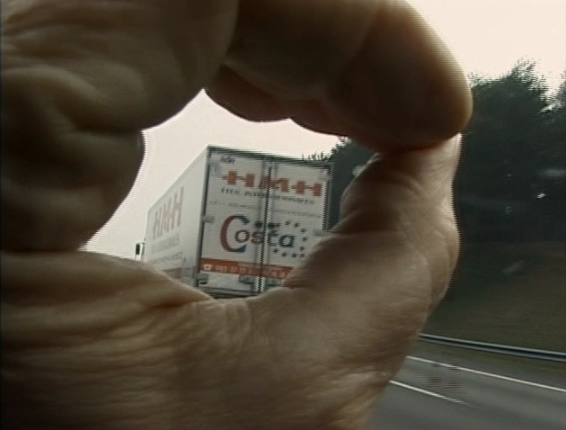
"Again one hand filming the other hand, and more trucks. I'd like to capture them. To retain things passing? No, just to play."
In Agnes Varda's documentary The Gleaners & I (a more literal translation from the French would be "The Gleaners & The Gleaner", or even "Gleaneress") play, investigation, and contemplation are all intricately yet loosely wound together - each element distinct yet forming an unpretentiously ambitious whole, much like the found-object artpieces Varda highlights throughout. Her subject, as you might have gathered (no pun intended), is gleaning: in all its forms. We are introduced to the classical gleaners, the peasant women who would follow the harvest by crouching and stooping through the fields, rummaging for leftovers once the more illustrious agricultural bounty was carried off. We see such gleaners in famous French paintings, and meet one or two who reminisce only - it seems that this more traditional form of gleaning has fallen by the wayside: mechanized reaping has become too precise and so few crops are left behind these days. This we learn in the first five minutes of the 90-minute film; what follows is an eager, inquisitive investigation of gleaning in all its latter-day manifestations...

L'Enfant

#57 in Best of the 21st Century?, a series counting down the most acclaimed films of the previous decade.

You’re about halfway through L’Enfant when you realize whom exactly the title refers to. Sonia (Déborah François) has just had a baby boy, and when the movie opens, she’s seeking the child’s father. He’s not at his apartment, which is occupied by a surly couple who slam the door in her face (a gesture that will be repeated throughout the film, although eventually she’s the one doing the slamming). When she finds him he’s on the street, wandering between cars stalled at a stop light, begging for change. Bruno (Jérémie Renier) is a scruffy young man, who could be anywhere from mid-twenties to early thirties. The indeterminacy of his age is telling; while his thick features suggest a manliness, his mop of hair, puppy-dog eyes, and perpetually mischievous grin suggest perpetual boyhood. Though Sonia is clearly his junior, she manages to mix a girlish playfulness (she’s constantly goofing around with Bruno, amidst shrieks of laughter) with a motherly concern for her new charge. Bruno, on the other hand, as soon as he’s left alone with the baby, tries to sell his own son.

Tropical Malady

#55 in Best of the 21st Century?, a series counting down the most acclaimed films of the previous decade.

We’ve heard that love’s a bitch, and a battlefield, but in the 2004 Thai film Tropical Malady, writer/director Apichatpong Weerasethakul tells us it’s a tiger too. Or at least that’s one interpretation. Actually, at times it can be hard to know exactly what Apichatpong is after. As with the filmmaker’s later Syndromes and a Century (reviewed in a previous incarnation of this series), Tropical Malady divides neatly into two halves, but the way the halves relate to each other is different. In Syndromes, the different parts of the film are symmetrical, like parallel lines – they relate similar events in radically different surroundings. Malady on the other hand connects its first half and second half with a joint and then lets them spin in entirely different directions, until the thread connecting them seems stretched awful thin. The two halves are perpendicular rather than parallel – maybe they’re better considered as two separate films, but here they are presented together, their interconnections left for us to tease out.

Twin Peaks at 20


Update March 2016: From 2014 to 2016, this post contained a larger directory to ALL of my Twin Peaks work. But I have now moved all of those links to a new page, "The Complete Twin Peaks Directory", and returned this post to its original 2010 form, as a simple lineup of my first episode guide. If you had this bookmarked as a Twin Peaks directory, please change your bookmark to the above link.

Spurred on by Radiator Heaven's declaration of "Twin Peaks week" (the series premiered twenty years ago yesterday) I'm taking a momentary break from my break, to re-present my 2008 episode-by-episode analysis of the groundbreaking TV show. It covered all of season one, the first half of season two (through the conclusion of the murder mystery), and the final episode. I also wrote about the disturbing and powerful prequel film, Fire Walk With Me, and put out a few other, random posts on the series as well. Without further ado, then, I present a centralized nexus for all my "Twin Peaks" pieces:


The top picture came from Jeremy Richey's always eye-catching blog, Moon in the Gutter. Check out his post on the show. (Update: images for each episode added to directory in August 2019)

This post was originally published on The Sun's Not Yellow.

Now Playing: How to Train Your Dragon


If there's one form that's been thriving recently, it's the animated film. In the live-action realm, other genres have proved popular without really tapping it into the traditional sources of America's cinematic strength (imagination, storytelling, fantasy). Non-animated movies often seem to have lost touch with the power that old Hollywood exuded. Contemporary screenwriting focuses more often on themes and ideas than stories and feelings, technique has adopted the fragmented point of view, and while naturalism has been avoided a surface "realism" is all the rage - blockbusters are darker and grittier than they were in the past (though, ironically, excessive CGI has rendered their textures less real than ever). Live-action films have achieved a "flatness" - a focus on surfaces and text - while animated films thrive in a world of created depth, in which computer animation is finally un-shackled from its obligation to dutifully mimic reality and allowed to range free. Most of the great animated films of the epoch have been Pixar movies, but How to Train Your Dragon may be Dream Works' strongest contribution to the pantheon yet.

Search This Blog