Both highly relevant and very much a time capsule, Adam Curtis' The Power of Nightmares depicts the War on Terror as a clash between two delusional, unpopular ideologies attempting to replace unfashionable hope with paranoid fear. Curtis' polemical approach involves not just interviews and illustrative b-roll but also propulsive editing of heavily manipulated found footage with immersive electronic pop soundtracks; this is my podcast's third stylistically unconventional, thematically retrospective 2010s documentary in a row (after Heart of a Dog and Blue Velvet Revisited). Coming back to the movie now, I can actually relate to it much more than when I initially watched a few years after its release. Its portrait of an American empire willfully blinded by hubris resonates with how I see the world at present. But Nightmares is also a portrait of a neoconservative right wing that differs from the more cynical, less ambitious national "populism" of the current moment. Even the film's one dip into domestic culture war (a curiously outdated view of the Clinton impeachment) emphasizes the idiosyncrasy. I found the film fascinating to dig into given the passage of time; while the emphasis is more on 9/11, Afghanistan, and domestic prosecutions (as well as the Islamic fundamentalism and Cold War context that birthed the neocons and al Qaeda), the recent twentieth anniversary of the Iraq War makes this episode feels even more apropos.
Showing posts with label 9/11. Show all posts
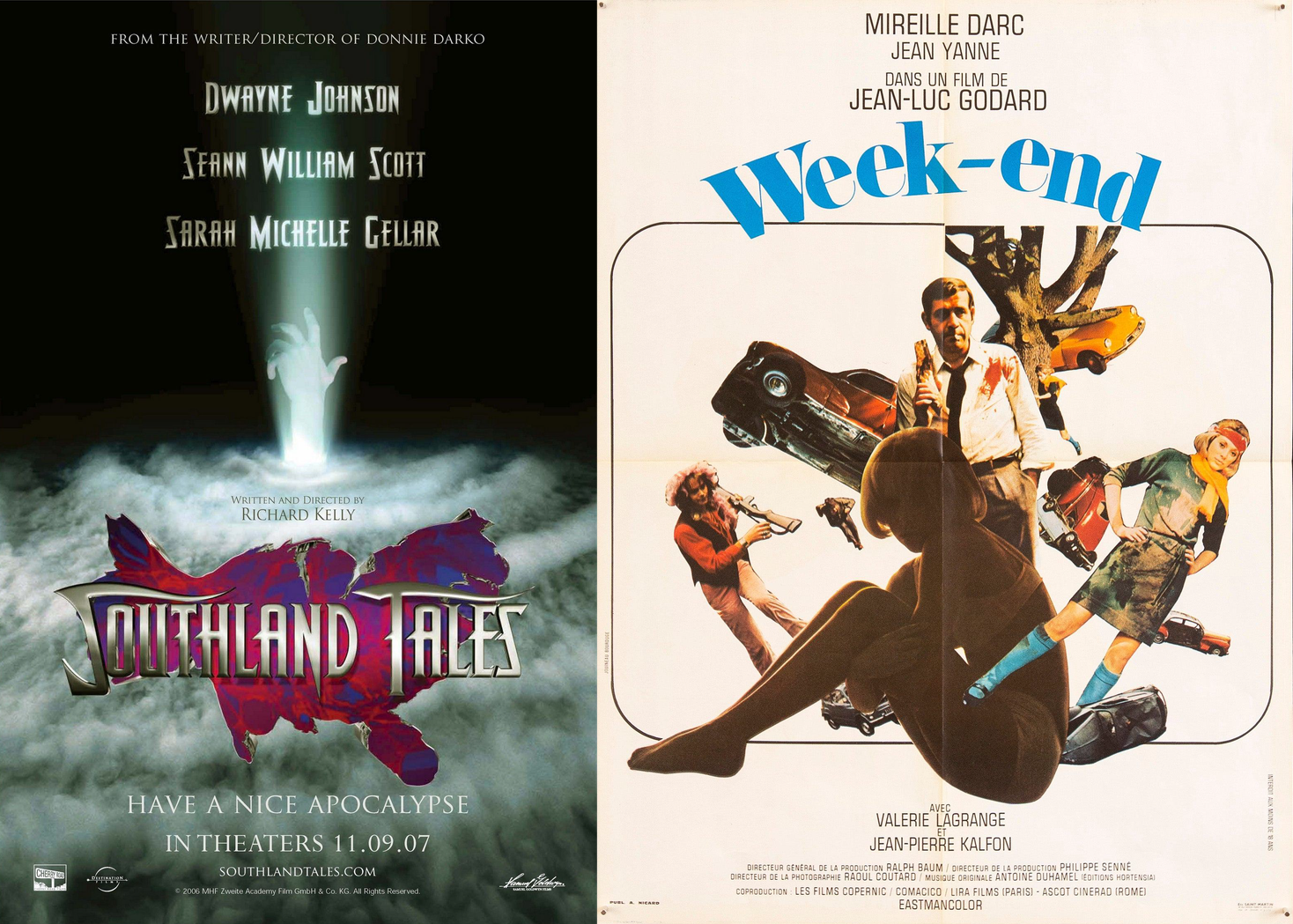
belated November 2022 Patreon round-up • LOST IN THE MOVIES patron podcast #97 coming this week: The 00s in November (& beyond) + 60s bonus & Concluding the 90s & 70s... Godard's Weekend & Southland Tales w/ guest Andrew Cook (w/ his feedback & my capsule on 300, more capsules on Bonnie & Clyde, The Graduate, Midnight Cowboy, The Swimmer, Dr. Strangelove, No Country for Old Men, There Will Be Blood, Zodiac, A History of Violence, Brokeback Mountain, Eternal Sunshine of the Spotless Mind, The Darjeeling Limited, The Dark Knight, Gangs of New York, 500 Days of Summer, The Ring, Donnie Darko, The Box, Dog Day Afternoon, The Muppet Movie, The Muppet Christmas Carol, The Witches, Heat, The Blair Witch Project, Edward Scissorhands, Election, Groundhog Day, Total Recall, Dick Tracy, archive readings of my reflections on the 00s decade, To Kill a Mockingbird, Breathless + much, much more including feedback/media/work updates) + 3 TWIN PEAKS Character Series advances & Twin Peaks Conversations podcast
The Patreon episode intended for last month will be released in four parts.
These links will be updated as the episodes are published in mid-December...
Jean-Luc Godard's Weekend (capsules on Bonnie & Clyde, The Graduate, Midnight Cowboy, The Swimmer, Dr. Strangelove, Dog Day Afternoon, The Muppet Movie, The Muppet Christmas Carol, The Witches, Heat, The Blair Witch Project, Edward Scissorhands, Election, Groundhog Day, Total Recall, Dick Tracy, archive reading of To Kill a Mockingbird + feedback/media/work updates & more)
Listen to PUBLIC Episode 97B: Everybody Look What's Going Down - The 60s Archive
(readings of Breathless, The Wild Bunch, Cleo From 5 to 7, Before the Revolution, The Loneliness of the Long-Distance Runner, Loves of a Blonde, Primary, 4 Days in November, Dear Brigitte, The Trip, Greetings & the Olympics + 60s/00s crossover w/ The Life & Death of Peter Sellers)
Southland Tales w/ guest Andrew Cook (w/ his feedback & my capsule on 300 + capsules on No Country for Old Men, There Will Be Blood, Zodiac, A History of Violence, Brokeback Mountain, Eternal Sunshine of the Spotless Mind, The Darjeeling Limited, The Dark Knight, Gangs of New York, 500 Days of Summer, The Ring, Donnie Darko, The Box & archive reading of my reflections on the decade)
Listen to PUBLIC Episode 97D: Hall of Mirrors - The 00s Archive
(readings of 25th Hour, Inland Empire, earlier reviews of The Dark Knight & 500 Days of Summer, You Can Count on Me, Funny Ha Ha, Thirteen, The World, Iraq in Fragments, The Story of Marie and Julien, The Girlfriend Experience & the Olympics)
Introducing the episodes
As we spread out from August's focus on the eighties, moving into earlier and later decades in each direction, we reach two eras forty years apart. Yet they make the perfect pairing in my mind, in part because I was obsessed with the sixties during the zeroes, a time I experienced firsthand and which shaped my perceptions of the world for better or worse. In a way, these decades are a natural fit at least from the American perspective: both haunted by national traumas (Kennedy's assassination and 9/11), both dogged by quagmire wars of choice (Vietnam and Iraq in particular), both racked by technological transformations which troubled as well as enticed (inward for the age of the iPhone, outward for the epoch of the moonshot). But while the sixties gave birth to a vibrant youth counterculture and political resistance, the zeroes often felt like a dead zone to those of us living through it. This was part of my hunger for sixties media; I sought work which excavated and explored the turbulence that I could feel under the surface in the cold, sterile, repressed Bush era but which somehow always remained locked off. These were periods of deep societal alienation which expressed that alienation in very different ways.
With all that in mind what better film to focus on than Richard Kelly's Southland Tales, the sprawling, notorious follow-up to his cult classic Donnie Darko (which I discuss more briefly in this podcast, along with its own deep if different zeroes zeitgeist connections)? Set in an alternate version of 2008 but shot in 2006, it imagines an America whose War of Terror tremors have caught up with a culture that just wanted to go shopping - transforming the country into a manic police state with an active resistance and wild sci-fi developments emerging virtually overnight. Ambivalent after my first viewing years ago, I invited Andrew Cook as a return guest (after our Eyes Wide Shut episode); he's a big Kelly fan who knows the film inside and out which made for an interesting dynamic as I tried to wrap my head around it. This is one of the longest film in focus podcast segments I've ever recorded, running over an hour as we dig into both the film and the era it depicts...and re-invents as something else (perhaps the Trump era to come). This also makes for an offbeat but appropriate pairing with my sixties film in focus, the very different avant-garde apocalypse of Weekend. Here Jean-Luc Godard reaches the apotheosis and negation of his radical sprint through the decade, anticipating the chaos of May '68 months ahead of time. The selection, in which I wrestle with a film that converted me to Godard when I first saw it but which I had more trouble with this time, is one more tribute to the legendary director who passed away in September (I also focused on his eighties film Hail Mary in a previous episode).
Elsewhere, Andrew's contributions continue when I read his in-depth feedback (alongside my own short reflection) on Zack Snyder's 300, an iconic, and much more popular, film by another of his favorite directors. In capsule form, I run through a number of memorable zeroes films alongside a smaller selection of sixties classics, wrap up my viewings of the nineties (alongside a pair of quite different seventies classics), and offer updates on my recent intake and output in several mediums. Most notably, in addition to a couple archive pieces that I wanted to center and share on their own - a meditation on the power and limitation of To Kill a Mockingbird and a broad polemic expressing my frustration with the state of American culture in the Bush era - I'm also gathering a number of pieces focused on each decade into two public archive episodes, offering a survey not just of zeroes and sixties cinema, but my own perception of them at various points.
As noted in the introduction to this podcast, I am planning to wrap up this podcast approach - combining updates with film reviews and other topics in a main montly episode - after reaching #100 in February. Though there's still much content to come in those months, I can't think of a better way to begin my ending than with this particular episode(s).
Meanwhile, I've continued chugging along with my advance character studies every month - although I need to pick up the pace if I want to have the necessary backlog ready at year's end for a 2023 public debut. November's trio includes one of the third season's scummiest characters alongside one of its most heroic. Unlock these pieces for $1/month to learn more...
(become a patron to discover their identities)
And Patreon also housed my $5/month tier reward, the second part of my discussion with the director of The People's Joker (as discussed in last week's cross-post). Southland Tales comes up again too!
Podcast Line-Ups for...
belated July 2022 Patreon round-up: LOST IN THE MOVIES patron podcast #93: Coffee and Cigarettes (+ feedback/media/work updates including Captain America: The Winter Soldier, Russian Revolution, failures of the decadent right, history of malls, archive reading: Lady and the Tramp & more) + 3 TWIN PEAKS Character Series advances & Twin Peaks Conversations podcast
Once again, a fairly random viewing - one of just two movies I watched in July - provides the film in focus to anchor this month's podcast. I happened to see Jim Jarmusch's quirky Coffee and Cigarettes because I was visiting someone who had an old DVD of it onhand and was intrigued by the title. Reflecting on both its seventeen-year production (assembled into an anthology from disparately shot but aesthetically similar short films) and the nineteen years since its release, I'm able to explore themes that always interest me regarding the passage of time - alongside other threads working their way through these blackout sketches of (usually) two actors playing themselves in a fictional, often contentious, conversation.
There were a lot of political topics dredged up by this month's podcast recommendations, including the legacy of revolutions, what Boris Johnson's resignation tells us about the state of the right and its appeal, and how shopping malls have evolved as cultural touchstones. There's a bit more feedback this time than last time (all from YouTube), another Marvel movie to discuss in brief capsule form, and for the second month in a row I have an essay on a fifties classic to share from my archive.
Meanwhile, having finally caught up to June's Twin Peaks character studies in late July, I caught up to July's just a few days into August. That's an improvement at least, and now I'm on pace to provide three advance entries to patrons every month going forward. This trio was particularly striking despite the low ranking, not only for the characters' onscreen antics but also the performers' offscreen lives...
(become a patron to discover their identities)
I introduced and cross-posted the full conversation on the site last week but actually the one post to make it up on schedule in July was Part 2 of this exchange with the hosts of the weird fiction podcast Counter Esperanto for the $5/month tier's reward...
Podcast Line-Ups for...
belated June 2022 Patreon round-up: LOST IN THE MOVIES patron podcast #92 - The Power of Nightmares (+ feedback/media/work updates: King Kong vs. Godzilla, In the Line of Fire, political shifts, the Iraq War, archive reading: An American in Paris & more) + 3 TWIN PEAKS Character Series advances & Twin Peaks Conversations podcast
Just a few weeks after my last (belated) monthly podcast, there wasn't much to update in terms of viewing, listening, or behind-the-scenes work, but I did have one film/series I wanted to zoom in on. Adam Curtis' eccentric 2004 BBC program The Power of Nightmares offers a cutting, hypnotic audiovisual analysis of the dance between American neoconservatives and Middle Eastern Islamists which eventually led to the War on Terror. I'd seen, and never forgotten, the first chapter not long after it was first released. This time I watched the whole thing and reflected on it from a different standpoint than I had at the time, further to the left and more deeply skeptical of the government line on Al Qaeda (even so, some of the wild discrepancies and overreaches that the film highlights remain astounding). Hopefully I can watch more Curtis films in the near future; I've been fascinated by his style for a long time but never really explored his work. A year ago, my all too ambitious plans included a chapter-by-chapter reaction to the director's recent analysis of the left's ambitions and failures, Can't Get You Out of My Head. Perhaps that will be next in my exploration - when I finally find some time in my schedule.
Elsewhere, I offer some capsules on a handful of films I watched in June, riff on similar Bush era themes based on some podcasts I listened to (touching on my own political evolution - or evolutions), and end the podcast on a lighter note with a reading from my past work on a Gene Kelly musical, albeit one that also toys with issues of war, loss, and wistful regrets.
As I struggled to keep up with various projects, particularly Lost in Twin Peaks, I fell behind on the latest patron reward: the presentation of three character studies each month. Only several weeks after the month ended could I finally share the first one (the other two followed the next week, and I'm already moving ahead on July's advances so they won't suffer the same fate). Despite the delay, this represents a major breakthrough. Remarkably, I never wrote a single character study in all the years since The Return - despite my oft-stated goals. That half-decade was spent, when I focused on this work at all, slowly putting together the posts on minor characters and the like. Hopefully from now on I can move forward at a much quicker pace (on a positive note, when I finally got down to writing it, the first piece didn't take very long at all). (This cross-post accidentally went up last week with most of what you see here, and the reason I removed it and re-publushed today was because two these character studies were not yet ready.)
I won't discuss who these entries cover - the public gets to find that out if/when the series begins official publication in early 2023. But here's where you can find out, and read them ahead of time...
(become a patron to discover their identities)
following the announcement of
I've already cross-posted both parts of my conversation with Cameron Cloutier in a separate entry, but just to be thorough, here's the $5/month exclusive that went up in June...
Podcast Line-Ups for...
SEVEN AMERICAN GENERATIONS: zoomers, millennials, X, boomers, silent, greatest, and lost
An illustrated guide to the living American generations (excluding those born after 2013) and the unique periods of the past century they experienced at different ages
INTRODUCTION
Although intended as a useful reference going forward, I'm publishing this entry in the particular context of December 2019. Between the "ok boomer" meme, Xers fretting over their "forgotten middle child" status, questions about where the millennial generation actually begins, and uncertainty about what to call post-millennials, there's been a lot of talk about generations in the past few months. No wonder: the 2020 presidential campaign has sharpened divisions between different age groups, with majorities of boomers and millennials not only supporting different parties, but different candidates within the Democratic primary (ironically, the oldest candidate has overwhelming youth support while the youngest is disproportionately popular with an aging crowd). We're also reaching the end of a decade defined by millennials, while in the past few years an even younger tech-savvy, politically activated generation has begun to come of age.
Meanwhile, dramatic demographic changes hover on the horizon. By the end of the 2020s, the last of the lost generation will probably pass away; the entire greatest cohort will cross their century mark and the first silent will turn one hundred; the oldest boomers will hit eighty while the youngest boomers and oldest Xers become senior citizens; millennials will enter middle age as zoomers constitute the majority of young adults; and an even newer generation will emerge onto the scene (the oldest of them are already five, but most haven't been born yet so I'm leaving them out of this analysis). This is an especially dramatic turn for my own generation since the Age of the Thinkpiece has made the terms "millennial" and "young" synonymous - often negatively so. As I once joked, around 2032 a thirtysomething will write a "damn millennial kids are ruining ______" essay, only to be informed that they're actually younger than the youngest millennial. Indeed, by my own admittedly controversial calculations, the first millenial will turn forty in a few weeks; with all of this in mind, December 2019 seems like a good time to take stock, try to lock some of this down and ponder the phenomenon both visually and statistically. Please note, as the title suggests, I am focusing exclusively on a U.S. context especially when it comes to defining the different eras.
The following entry is the result of a year's worth of off-and-on pondering and about a week's worth of hunting and gathering images to illustrate these ideas - as well as a lifetime of being inordinately obsessed with eras, generations, and the process of aging, and how these stack up against each other in a kind of historical grid. I think it's mostly self-explanatory and don't want to further clog up this introduction, but if you're confused I offer an "explanation of process" at the end of this entry. This is not academic work for which I've been trained to follow certain procedures, it's purely the result of my own curiosity and speculation, so take it as you will! Hopefully it's as helpful and absorbing to peruse as it was to assemble.
Descriptions/credits for "Seven American Generations"
This entry lists all of the actors, events, and photographers (for the era collages, where available) in my "Seven American Generations" post. I didn't want to disrupt the flow of that piece but knew readers might be curious. Where there's an accompanying video, it's linked in the description. The above image, by the way, is of Eddie Fisher and Debbie Reynolds with a space man (how prescient) on the opening day of Disneyland in 1955. It didn't fit with the collage I created but I'm glad I found a place for it somewhere.
Also, since there are no repetitions here and everything is full-size you can use this as an image gallery too (click an image to fill your screen).
If you stumbled across this post via a Google image search or another similarly blind route, you're probably confused...click below for context:
VISIT
The 10th anniversary of September 11
I had planned to write something for the occasion of the 10th anniversary of 9/11, but did not go through with it. However, I did not want the event to go unremarked upon here. Here are four pieces I've written related to that day and its aftermath. If you are seeking some sort of commentary or meditation on the day, hopefully these provide some degree of what you are looking for.
• My review of 9/11, the documentary by the Naudet brothers, focuses on the event itself.
• Waiting for the 25th Hour, a review of 25th Hour, deals with the emotional and psychological aftermath of the terrorist attacks.
• The Way We Weren't is a response to a Newsweek article about art in the Bush era; it is my take on the cultural and political fallout from 9/11.
• Man on Wire was a documentary about Phillip Petit, the man who walked a tightrope between the Twin Towers in the early 70s. Though not directly related to 9/11, the film provides an interesting counterpoint to the sorrow of that day.
Man on Wire
Best of the 21st Century? (#196)(Counting down the most acclaimed films of the decade.)
We're skipping ahead quite a few spots on the list, because Philippe Petit didn't play by the rules, and neither should we. So at #196, sure to advance (as the more recent films usually do over time)...Man on Wire, the true story of a man who walked on air, 1,368 feet of it to be exact. While observing that Petit did not play by the rules, it should not be assumed he was careless, absent-mindedly whimsical, or entirely spontaneous. His spirit may have conveyed such vivacious joie de vivre but within the impulsive performance artist was a rigorous disciplinarian. This is almost always the case with a great artist, but it's especially true of one whose art involves standing upon a thin wire, suspended between the two tallest buildings in the world, dancing 110 stories up from the pavement, where one wrong move, one ill-read gust of wind can end with the kind of flop you don't recover from.
Waiting for the 25th Hour

[This review first appeared at Ibetolis' Film for the Soul as part of his great "Counting Down the Zeroes" series, which you should definitely check out. The review is quite long - including a lengthy quote from the movie as an introduction - and discusses crucial plot points, so beware. It begins after the jump.]
The Way We Weren't: Art Under Bush

"A cloying cliché presented as profundity" - so Peter Plagens, Newsweek art critic, describes Jeff Koons' Hanging Heart and, by turn, the Bush era in Newsweek's recent article, "The Way We Were: Art and Culture In the Bush Era." One could add that it's also a particularly apt description of what passes for socio-cultural criticism these days, with the contents of Newsweek's run-down providing the latest example. The article's opening reads, "If artists depend on angst and unrest to fuel their creative fire, then at least in one sense the 43rd presidency has been a blessing." The implication is that somehow the Zeros have been a bonanza of cultural expression, angry fist-waving at our social conditions, a constant artistic outcry at the folly of our times. This is, of course, absurd, and to be fair, many of Newsweek's critics take a different tack, highlighting - as Plagens does with Koons' Heart - the ways in which glib, narcissistic, or tacky art has inadvertently reflected the ethos of the epoch. Yet even here their critique is problematic, for if the arts are thrown in the lion's den with our much-maligned president, the castigators largely refrain from applying the same vitriol towards themselves, the cultural (and mostly liberal) establishment, or us, the American people. Reading this article stirred up a variety of thoughts and feelings, criticisms which both reflected the writing and responded to it. The rest of my reaction follows after the jump.
Frontline: The Al Qaeda Files
With the bogeyman spectre of Osama bin Laden lingering over the Western world's head, the threat posed by terrorism and Al Qaeda specifically - and Osama bin Laden even more specifically - sometimes seems almost metaphysical. John McCain likes to call it "an existential threat," which may be true in its own way, but also implies something unfathomable, almost abstract in its evil. What "Frontline" does, in this series of episodes aired between 1999 and 2005, is lift the curtain a bit and show us what lies behind the organization of Al Qaeda, the events of 9/11, and the terrorist attacks since then. It's a riveting, fascinating, and sometimes disturbing look at a culture often alien to Americans, and also sometimes weirdly familiar.Fahrenheit 9/11
Fahrenheit 9/11 achieves a more total immersion than any other documentary I've seen. Which is to say, it erases the distance between the audience and the material, the emotional remove that remains when we watch the news on TV. Fahrenheit 9/11 plays as a narrative film, a story unwinding before our eyes in the way all Hollywood stories unwind, complete with the appropriate formal tricks (cutting footage to echo the mise-en scene of a screen drama) and subtle manipulations (streamlining facts to fit a conventional narrative). In erasing this distancing effect, in adopting the tools of narrative fiction rather than exploratory documentary, Moore crafts a powerful work, as personal as any auteurist art film, as immersive as any escapist entertainment. He also disables our ability to think and critically analyze what we are seeing, fashions a work of sublime propaganda, and crafts an intensely manipulative, misleading, and demagogic pseudo-doc.9/11
On September 11, 2001, I was 17 years old, a high school senior in New England. In my morning science class, the teacher was discussing global warming when a voice came over the intercom. It was the principal, who had a deep voice that only popped up when tragedy struck (that spring, he'd announced the death of a student who'd been ill). At this point it was already about 10:15 am, and he stated, as flatly (and terrifyingly) as possible that terrorists had hijacked commercial airliners and crashed them into the World Trade Center and the Pentagon. I know a lot of my friends heard the news sooner, with the details building bit by bit, but for me it was like being hit with a ton of bricks. We all stared at each other, jaws dropped...was this real, or just a movie? One kid, a bit of an oddball who later joined the military to do psych ops proclaimed, "this is going to wipe Chandra Levy out of the news!" My science teacher, without missing a beat, pivoted in his anti-Bush argument vis a vis global warming, to attack the idea of a missile defense shield: "how the hell would a missile shield block airplanes?"We just remained in our seats, stunned, until the bell rang. En masse, everybody moved downstairs into a lobby where there were TVs hanging from the ceiling. On them, one of the Twin Towers was collapsing, over and over again. A teacher nearby suddenly started babbling, hysterically: "They're gone? They're really GONE? They're not there?" One of my friends, a die-hard Democrat who later joined the Navy (I believe he's still serving) told us, "this is when I'm glad Bush is president, because he won't let them get away with this." I told my classmates it was probably that guy Omar Laden or something...I'd heard his name mentioned in the past few months. We sat in my history classroom and stared at the television. John McCain appeared on the commentary to say that we were at war. At the time this struck me as a strange notion. My initial thought that morning had not been, "We're at war and must defend ourselves," but rather "My God, the world is coming to an end."
I generally like to avoid personal stories on this blog; the Internet is fun for the way it confers anonymity and anyway, it all gets in the way of what I'm really doing here. Lest you think I'm departing from the blog's mission, this entry is not a recollection of what happened 7 years ago, but a review/reaction to the television film "9/11" aired, I believe, one year later (it may have premiered on the six-month anniversary but I saw it for the first time on 9/11/02, by which time I was living in New York). I open with my own memory, at once mundane and shocking in the way that everyone's memories of that day will always be shocking, as a reminder of how personally 9/11 struck everyone and how, with so much water under the bridge (yet so little accomplished) the emotions and sensations of the day can come rolling back instantly. And that's what "9/11" is about.
Subscribe to:
Posts (Atom)