Lost in the Movies

Desert Island Discs

 
All movie buffs have asked themselves that question sooner or later, a variation of the same question audiophiles, bookworms, and other assorted enthusiasts have posed: were I stranded on a desert island, accompanied only by a solar-powered TV and DVD player, what proud few movies would accompany me into the wilderness? In the age of streaming video, this may seem a quaint, unnecessarily limited exercise - after all, even desert islands have wifi, right?

Well, I find myself in a unique predicament - soon to move, packing lightly, and with no computer, TV, or DVD player for the foreseeable future. When I am eventually watching movies again, it will probably be because I'm buying new equipment "out there," not because I sent for what I left behind. Which means that the bulk of my collection will still be on the other side of the country.

With that in mind, I wondered: assuming I find myself once again with a DVD player, but without (most) of my current DVDs, what small selection would I want to bring with me, just to keep me company in that dark age between purchase of player and shipping of discs? Like a monk in a monastery, what cinematic texts will I hover over to keep the flame alive?

What's your best post this year?


...Or your personal favorite, or your most popular, or your most original, or the one that covers the film you'd most like to highlight? For the fourth year, I'm going to do a blogosphere round-up, so I'm inviting readers' submissions for their own strongest work.

The piece could be a personal essay, a picture post, a video tribute, a clever conceit, or a straight-up movie review. It could embrace all of cinema, zero in on one movie, or have nothing to do with film at all. It's up to you.

You can submit a comment below (I will delete after reading and recording the choice) or email me at movieman0283 at gmail.

This year I have to be stricter with (my own) deadline as last year I let the project go until February when, no doubt, some of you weren't even aware that it went up! This year the deadline for submissions will be December 15 and I will crack the whip on myself to ensure that the post itself goes up between then and New Years Day.

If you want to take a look at past years, here are the round-ups from 2008 - 2010.

My #1 noir: Laura


In the past year, the website Wonders in the Dark has conducted four genre countdowns. The first covered horror, and I responded to it by naming my #1 horror film as The Shining. Shortly thereafter, an animation countdown led me to write up my #1 animated film, the Quay Brothers' haunting Street of Crocodiles. In the next week or two, the site will wrap up its most ambitious and wide-ranging countdown, a musical list that featured a dozen or so contributors and spanned seventy entries. I myself submitted three selections: The Gay Divorcee, 42nd Street, and An American in Paris. As the countdown concludes, I will offer a review of my own #1 musical, though I'm keeping the title under wraps until this Thursday.

But first, there's unfinished business. Lost in the shadows, appropriately enough, is a response to the site's third countdown - on that genre/style/movement, film noir. The noir countdown took place between February and May earlier this year, a time when I was all but absent (and eventually just plain absent) from the blogosphere. As such, I didn't get to read the pieces until recently, but they were worth the wait. Unlike the jovial, cheerful crowd that comprised the musical countdown, the noir beat was handled by just one person, Maurizio Roca, who wandered those cold dark streets alone, allowing one guest essay but policing the series parameters and placements with a strict understanding.

Unlike the expansive horror, animation, and musical lists, the noir selection was as focused and intense as a harsh streetlight: early forties to late fifties only, two Brits allowed but otherwise American only, no Hitchcocks (he was practically his own genre), and please, black and white only need apply. Well, my selection also fits those restrictions, and it was on Maurizio's list too, at #18. It took a while, but noir (anti?)heroes are a patient, unrushed lot, waiting for the right moment to pounce and catch their prey. My prey is quite lovely, enigmatic, and perhaps a bit dangerous. Without further, ado, my #1 noir: Laura (1944). And yes, there are spoilers.

Is it the portrait? Waldo Lydecker (Clifton Webb) tells us the alluring painting doesn't quite capture Laura's essence. Maybe it's Waldo's loving descriptions - we see them played out in flashbacks, but for Detective McPherson (Dana Andrews), they must unreel in his mind like imaginary movies, half-glimpsed through a haze of perfume and cigarette smoke. An elusive image dazzling yet blinding, like the "silver sun" Waldo describes in his memorable opening monologue ("I shall never forget the weekend Laura died...").

Then again, perhaps it's something more intangible that makes McPherson fall in love with, not a corpse as Waldo cynically puts it, but Laura Hunt (Gene Tierney) herself - the girl before she was murdered. He's in love with something gone, something that once existed, that "essence" still lingering in the afternoon air but dissipating rapidly, a presence just missed by McPherson, in the room right before he entered but now vanished for good. Or has it?

The Story of the Fox


•

The Story of the Fox (1937/France/directed by Wladyslaw and Irene Starewicz)

stars the voices of Claude Dauphin, Romain Bouquet, Sylvain Itkine, Marcel Raine

written by Jean Nohain, Antoinette Nordmann, Roger Richebe, Irene Starewicz, Wladyslaw Starewicz from Johann Wolfgang Goethe • photographed by Wladyslaw Starewicz • designed by Wladyslaw Starewicz • music by Vincent Scotto • animated by Wladyslaw and Irene Starewicz

The Story: The royal lion seeks to punish Monsieur Renard (Mr. Fox) for eating his fellow creatures, yet the crafty animal tricks, manipulates, and fights his way out of every scrape.

_____________


“Animated Animals”: you’d be forgiven for picturing cute, wide-eyed little critters wandering through daisy fields and singing happy songs. Not so: this month there’s one cuddly creature (albeit too mute to sing), an amiable buffoon, a murderous yet still sympathetic monster, and then there’s Monsieur Renard (French for "fox"), the eponymous antihero of the brilliant stop-motion feature The Story of the Fox. Crafty, nasty, and carnivorous, Renard may have the least redeeming qualities of all the November beasts; unsurprisingly, he may also be the most human.

Watching as he assaults and semi-cannibalizes his fellow creatures, regarding us every now and then with an ambiguously conspiratorial twinkle in his eye, we titter nervously.  We recognize we aren’t really compatriots in crime but rather spectators in a show enacted only for the fox’s own benefit. Renard has the gifted performer’s contempt for the audience – and we’d probably be his next victim were we onscreen ourselves. Not only the fox but his master are winking at us with raw, mischievous relish.

Cinema in Pictures


The complete directory (in images) for "32 Days of Movies"

(Update: If these links don't work for you, use THIS PAGE instead)

It's all here - every movie I included in my video series, completed yesterday. If you click on a picture it will take you directly to the video chapter including that clip. From there you can either press play, or navigate to the chapter intro via the "Return to the Dancing Image" link below the video player. You may want to do so for more information before watching (spoilers, NSFW, links to my reviews, even historical context), or you may just want to dive in and start swimming.

You can read the introduction if you have any questions about the intent of the series (based on my DVD collection, not canonical/favorites) or visit the Video Gallery if you'd like to browse the series by chapter rather than clip. If you're at work, be warned that a few of the images below contain nudity.

This post is really exciting for me to look at all laid out; it fits my image of cinema (encompassing multitudes, like some crazy quilt; see also Allan Fish's more canonical and ambitious timeline poster) and it feels a satisfactory conclusion to a project that was the most extensive I've ever done outside of school and among the five or six most time-consuming endeavors I've undertaken period. It was worth it, for me at least, and I can only hope the results work for you as well.

The End of Evangelion and Boiler Room were added in 2015.

Falling into the Future 2006 - 2009 • "32 Days of Movies" Day 32


Thirty-second chapter in "32 Days of Movies", an audiovisual tour through 366 films
(2015 update: included Vimeo embed after the jump)


View "Chapter 32: Falling into the Future"


Falling into the Future

Today we end quietly, mournfully, and, I think, beautifully. Many of these clips deserve that adjective - there is a sinuous grace to the films in this chapter, a kind of painterly impression as if figures and backgrounds on a canvas were being animated. As if, in a way, we had returned to the very roots of cinema, yet with a memory of where we'd been. This is less death than a kind of anti-birth, which makes the final clip deeply appropriate. It might help here to explain that my storytelling sensibility trends neither optimistic nor flatly pessimistic, but rather toward the tragic. Tragic conclusions are at once sad and deeply transcendent - not a happy ending, but still a glorious one. This certainly describes the last two clips, over which I played a single soundtrack - the music derives from the second film but works equally well with the first. Together they form a kind of swan song, and so this chapter's final moments can stand with the 40s dream chapter and the lightning montage ending the 60s episode as one of the most unified and telling moments in the video series.

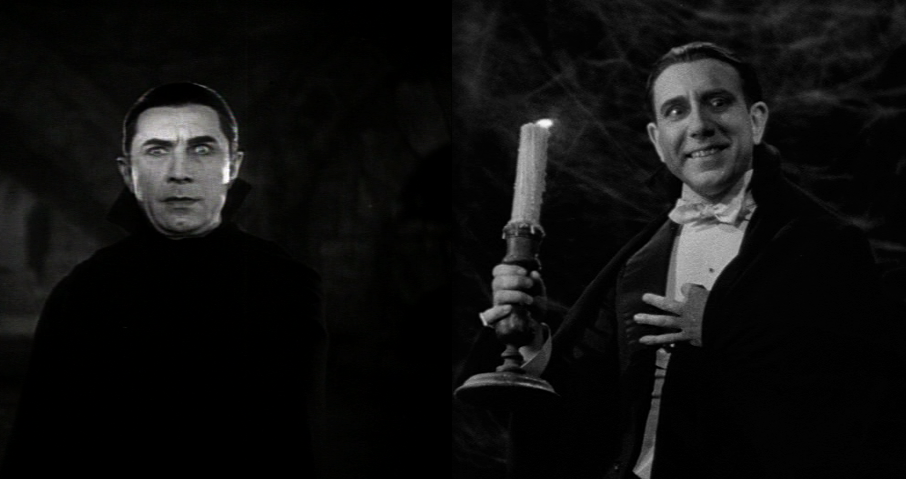
Dracula & Drácula ("Fixing a Hole")


As with Frankenstein, which kicked off the series, I've commissioned another writer to conclude "Universal Horror Month." Jaime Grijalba, a native of Chile and author of Exodus 8:2 (where he is currently wrapping up an ambitious "31 Days of Horror" series), uses his love of horror and knowledge of both Spanish and English to examine the two versions of Dracula, shot simultaneously in different languages back in 1931. I've provided a tantalizing taste of his engaging piece, and a link for you to read the whole thing.

Happy Halloween!


"And maybe that’s the reason why Drácula, the Spanish version of the classic film, is so fresh to the eyes and the mind. It’s different. You react to it in a different manner; the film feels like when you remember a half-forgotten dream, when you see a full vision of what a parallel universe could’ve been if you’d chosen the blonde and not the brunette. Because it is the full vision and scope of what Dracula, the legendary character and its story, can be, this version being far more complete, especially when you watch these two back to back in what can be one of the most splendid double features. While you are in awe due to the visual and poetic nature of the English version, then you are surprised and admiring the longer and more paused plot of the Spanish version, as well as its bold visual and camera style."

Reality Cinema 2002 - 2006 • "32 Days of Movies" Day 31


Thirty-first chapter in "32 Days of Movies", an audiovisual tour through 366 films
(2015 update: included Vimeo embed after the jump)

The first clip contains footage from inside the World Trade Center on September 11, and the third includes images of a violent bus hijacking in Brazil. Neither contains graphic content, but as with the Rodney King footage from Chapter 27, it may not be something people are comfortable watching in this context.
Reality Cinema

This was the age of ubiquituous "reality" - reality TV of course, but also a slew of film documentaries, a form that had never been more popular or prolific. This entry contains more documentaries than any other, from historical subjects to on-the-spot current affairs to raw cinema-verite-style concerts. Some of the non-documentary clips reflect this fascination with reality as well, from ultra-low budget "home movies" to the stylized humanism of a prolific and creative Asian cinema.

Yet there's an element of escapism too, not the old-fashioned bang-bang kind, but something more ethereal and moody - a sort of impressionistic daydream stylization reflecting the era of iPod and internet, in which inner space expanded to swallow up a whole generation. Sometimes the two trends (impressionism and realism) merge, as they do in the last clip, a sad and brilliant sequence mirroring the first clip across an unbridgeable gap of time and space. To a certain extent, today's chapter plays like a fitful waking dream, mixing fragments of memory, fantasy, and reality.

Before reverting to a more straightforward title, I considered calling Chapter 31 "Screening Reality" as a play on words, because this was a time not only of reality onscreen but filters and strategies applied to take the edge off of it.

(continued below, along with NSFW warnings)

The Millennial Mood 1999 - 2002 • "32 Days of Movies" Day 30


Thirtieth chapter in "32 Days of Movies", an audiovisual tour through 366 films
(2015 update: included Vimeo embed after the jump)


View "Chapter 30: The Millennial Mood"


The Millennial Mood

From optimism to despair (which arrives next week), the fleeting mood of the new millennium can sometimes seem longer ago than ten years. Yet we are still living in its aftermath - here are several movies stylized to the nth degree, in a fashion that would come to characterize the new century. The clips tend either towards a candy-colored lightness or (more often, at least in this early stage) a grim, monochrome palette - color photography is more than ever a tool to capture an impression rather than a filter to catch reality.

(continued below, along with NSFW warnings)

Living in the Nineties 1995 - 1999 • "32 Days of Movies" Day 29


Twenty-ninth chapter in "32 Days of Movies", an audiovisual tour through 366 films
(2015 update: included Vimeo embed after the jump)


View "Chapter 29: Living in the Nineties"


Living in the Nineties

When I was in jr. high, I used to see infomercials for a CD compilation called "Living in the 90s." It struck me as absurd at the time - nostalgia for a decade that was still unfolding - but it also made me think. How would people remember the nineties? From the standpoint of 1997 or so, the decade seemed hard to classify. The eighties were gaudy, flashy, and plastic, the seventies shaggy and mauve, the sixties bright and psychedelic. Of course it was easy to think this way when I'd more or less missed out on these eras and could only soak up the pop culture's later depictions of them. Yet I had to wonder: would later decades be able to classify and identify the nineties in such a way?

I'm still not so sure we can - partly because the pop culture had become too self-aware and fast-paced to fall into a "natural" groove, partly because there were few larger-than-life events (with the Cold War over, economic prosperity fostering complacency and inward absorption) to unify cultural experience. Yet if the nineties can be characterized, I think these clips capture some of its spirit.

(continued below, along with NSFW warnings)

Name That Film


First off, apologies to those who tried to visit "Pulp and Popcorn", the latest entry in "32 Days of Movies" this morning. The video link was not working, but it has been fixed.

Since some people were curious/baffled/frustrated about what movies were used in the rapid-fire "60 Years of Cinema (in 40 Seconds"), I created a video post to "decode" it. Truth be told, it's a bit redundant for readers of this blog, as you can find out the films simply by checking out my video series, but you may enjoy the screen-caps and music anyway, or find it simpler to look here than look through every chapter and find out the films right now (though I hope you'll keep returning to do so over time!).

Plus, this offers a sneak preview of the picture post going up Wednesday, in which twice as many screen-caps with titles will be compiled for a picture directory linking directly to the videos that incorporate that particular film (albeit to the beginning of the chapter, as I couldn't create bookmarks).

Without further ado, then, here are "The Answers for 60 Years of Cinema (in 40 Seconds)":

Pulp and Popcorn 1993 - 1995 • "32 Days of Movies" Day 28


Twenty-eighth chapter in "32 Days of Movies", an audiovisual tour through 366 films
(2015 update: included Vimeo embed after the jump)


View "Chapter 28: Pulp and Popcorn"


Pulp and Popcorn

Here is where the history of the movies truly begins to coincide with my own personal movie history. I was ten years old in the fall of 1993, and already an avid movie buff, combing the weekly listings to see what was coming out, studying the box office reports as if they contained esoteric messages from the beyond, and wandering down the hallway of coming attractions at the local movie theater to study the teaser posters. That said, I think I only saw one of these films in theaters at the time - however, I was aware of the presence of all of them, and it was only a few years later that I would see them on video as a teenager.

(continued below, along with NSFW warnings)

Search This Blog