Lost in the Movies

(Extremely) Brief Appearances in TWIN PEAKS (1st Preface to TWIN PEAKS Character Series)


The TWIN PEAKS Character Series surveys one hundred ten characters from the series Twin Peaks (1990-91 on ABC and 2017 on Showtime as The Return), the film Twin Peaks: Fire Walk With Me (1992), and The Missing Pieces (2014), a collection of deleted scenes from that film. A new character study will appear every Monday, Wednesday, and Friday although patrons will have immediate access to each entry a month before it goes public. This entry is a preface surveying characters who won't get standalone treatment. There will be spoilers.

There are many faces and voices in Twin Peaks, dozens (even hundreds) we see or hear for just a few seconds. Sometimes we can't place them afterwards (and sometimes they're even hard to represent in pictures - hence Andy's two medical phone calls); on other occasions they're among the most memorable icons of Twin Peaks even if we only glimpse them for a moment. (Update: The masked mystery man in the woods, initially overlooked, was added in August 2024. Incredibly, I also forgot to include the bird from the opening credits but in April 2025 I added this very first "character" we see.)

The character series is a meal of many courses, and there are naturally appetizers. You can scroll through the columns I've lined up here but probably the best way to explore is to click on an image and linger for a moment. Together they form a running Rosencrantz and Guildenstern sideline to the full Twin Peaks narrative, from pilot to season three finale, as seen by the shooting stars who crossed the horizon so briefly.

Who were these people? Did they frequently interact with the more familiar folks we see alongside them? Or did they just lightly glance off the massive narratives of Cooper, Laura, Audrey this one time...do they view those legendary characters as mere bit players in their own dramatic lives? What are their stories? From next week on, starting with a line or two and eventually reaching dozens of pages, we'll be diving into individual narratives. Today, however, your imaginations will have to fill in those gaps.

Introducing the (revised) TWIN PEAKS Character Series


Guide to all one hundred fifteen entries in the (revised)
TWIN PEAKS Character Series

•

(Initially, this page included a directory which can now be found here.)

Introduction

There are so many different ways to experience Twin Peaks. We might tour its locations, from the cozy red-and-white checkered comforts of the RR Diner to the majestic, vaguely magical woodsy decor of the Great Northern to the brooding, bittersweet musical milieu of the neon-soaked Road House. We can sample its various motifs: sipping hot coffee, savoring a flaky cherry pie, jolting at the hoot of an owl. Or we could delve into each genre in turn, spinning the wheel to land on the cheerful tone of wacky farce, the sleek style of midnight noir, or the visceral chill of creeping horror.

This written and illustrated online series will focus on another aspect that is able to touch on all of the above. Character is how many viewers, probably a majority, develop a personal connection to the material they are watching. Despite its unique qualities - the eccentric setpieces, the prevailing ethereal mood - Twin Peaks has proven itself to be no exception. As often as they point to touchstones like the iconic Red Room or Angelo Badalamenti's ethereal score, fans will cite characters as the reason they keep coming back to Twin Peaks.

Who is your favorite? Agent Cooper, with his mixture of boyish enthusiasm and professional genius? Audrey Horne, slinking around corners with a diabolical grin? The Log Lady, speaking softly and carrying her big "stick"? Deputy Andy, crying when he finds a dead body; Big Ed, solid as a redwood while the one-eyed buzzsaw Nadine hovers nervously around his trunk; Gordon Cole, cheerfully shouting his way through the hearing world like a deaf version of Mr. Magoo; or Albert Rosenfield, cynically ripping apart the small town's sentimental platitudes before revealing the heart on his own sleeve?

Twin Peaks characters have a cartoonish quality; even the straight men - Ed, Sheriff Truman - are outlined with stark simplicity. Brad Dukes, author of Reflections: An Oral History of Twin Peaks, has described Cooper and the Log Lady as resembling Sesame Street characters in their appeal to him as a child viewer. Indeed, the ability to paint these figures in broad strokes perpetuates their iconography, endearing them to generations of fans. At the same time, Twin Peaks has a serious core, with nearly fifty hours to flesh out the complexities within these broad sketches. And the show makes the best of that potential, always delighting to reveal hidden sides of its citizens, leaving us uncertain about their demons and capabilities. This is especially true in the show's first fifteen episodes, dominated by the question "Who killed Laura Palmer?" Perhaps the most famous character of all, she's gone but still haunting the town before the pilot even begins.

• What to expect in 2023

The (revised) TWIN PEAKS Character Series reboots the Character Series I began but didn't finish in 2017, before the third season. This is scheduled to run three times a week through July 31 on Monday, Wednesday, and Friday. The series consists of four prefaces, twenty-four bonus entries, eighty-six official character entries, and an extra surprise on the final day. These entries will be compressed into ninety individual posts. There will be three types:

NEW: completely original entries for new characters or old ones I didn't reach in 2017

LINKS: redirecting readers to old characters whose stories were not continued

REVISED: re-publishing old characters with new material reflecting changes in their stories
(revisions to the text will be marked with a gold ball • for the reader's benefit)

For further details, check out the extensive "Notes on the 2023 Edition" section below, following the methodology I mostly laid out in 2017.

•

2023 on Lost in the Movies: Finally the Characters, Pausing the Podcasts, and the Final Journey (status update)


Journey Through Twin Peaks will conclude in 2023 with the Part 6 video essays.
The TWIN PEAKS Character Series will finally resume next week (but may not conclude).
As for the season two episodes of the Lost in Twin Peaks podcast, well...

I'm approaching a crescendo for my online work after nine years of Twin Peaks and fifteen years more broadly. Where do things stand at the end of this year?

Scott Pilgrim vs. the World (The Unseen 2010)


"The Unseen" is a series in which I watch popular films for the first time. The list, which moves backwards in time, is based on the highest-ranked film I've never seen each year on Letterboxd (as of April 2018). Scott Pilgrim vs. the World was #4 for 2010.

The Story: Scott Pilgrim lives across the street from the house he grew up in, although we never meet his parents. His world, the world the title tells us he'll be fighting (though he looks awfully passive when we meet him), consists of practice sessions for his garage rock band Sex Bob-Omb; pep talks - or helpful negging - from sister Stacey (Anna Kendrick) over the phone or roommate Wallace Wells (Kieran Culkin) in the basement flat where Wells brings a rotating cast of male hook-ups; gigs performed or attended in little Toronto clubs or, when a competition occasionally calls, swallowed up in a more massive venue; and walks through lonely, steep city parks on snowy nights, ideally with a girl he loves. At first, that girl is ostensibly Knives Chau (Ellen Wong), whose problematic age - seventeen (he's twenty-two) - provides the film's first line of dialogue. However, their companionship is chaste, more of a crush that Scott indulges while brooding over his ex, rising pop star Envy Adams (Brie Larson) and, before long, pining after his literal dream girl, pink-haired Amazon delivery woman Ramona Flowers (Mary Elizabeth Winstead) who arrives in Canada from New York with baggage that Scott will spend the rest of the film unpacking.

Scott's dates with Ramona (even though he has yet to break up with Knives) end up devolving into fantastical battles with all of her exes. This is not a film which concerns itself with realism, creating an alternate universe with its own rules, or delineating between what is and isn't imagined by the protagonist. Rather, some already exaggerated semblance of everyday existence breaks open for a few minutes - sometimes just a second or two - and then returns to normal without comment or sideways glance. Think of the fight scenes as song-and-dance sequences in a musical; Wright himself quite explicitly did, and several battles double as both. First on the docket is Matthew Patel (Satya Bhaba) in a flamboyant Bollywood showdown. Next up the vain Hollywood action star Lucas Lee (Chris Evans in what appears to be prosthetic chin and...eyebrows?) unleashes not only his own muscled fury but that of his stuntmen on poor, spindly Scott. He's finally undone by his own vanity, attempting a deadly skating trick on a long, snaking stair rail down a hill. Likewise, supervegan Todd Ingram (Brandon Routh) is betrayed when he accidentally breaks his own dietary code. Roxy Richter (Mae Whitman), Ramona's "bi-furious" former girlfriend, must be defeated by Ramona herself - only she knows the lover's weak spot - while Scott's own unique skills equip him to take down both of the Katayanagi twins (Shoto and Keita Saito), electronic music whizzes facing off against Scott's crunchy punk guitar in a battle of the bands.

Finally, Scott's strongest opponent turns out to be the music industry impresario Gideon Graves (Jason Schwartzman), the ex-boyfriend with the strongest hold over Ramona - literally; he's implanted a mind-control chip inside of her - and the most power to wield over Scott as threat and enticement. All of these battles unfold with video game effects from bright flashes of light to cascading coins, leading to the climactic confrontation with Gideon in which Ramona and Knives clash alongside and against Scott, as well as with one another. But is Gideon the final boss Scott must face? Or is the final boss Scott himself?

The Context:

December 2022 Patreon round-up • LOST IN THE MOVIES patron podcast #98: Holiday Special / Continuing the 60s... The Apartment (capsules on How the Grinch Stole Christmas, Rudolph the Red-Nosed Reindeer, A Charlie Brown Christmas, 00s archive reading of A Christmas Tale, Andrew Cook's further reflections on 300 & 00s cinema + my plans for the 3 big Twin Peaks projects, feedback/media/work updates & more) + 3 TWIN PEAKS Character Series advances & Twin Peaks Conversations podcast


As with Halloween, I'm taking a breather between massive omnibus decade studies for a slimmer holiday-themed episode that still maintains the latest decade theme. In this case, I'm continuing my sixties coverage by exploring a favorite Christmas/New Year's comedy - Billy Wilder's iconic The Apartment - in a full review alongside shorter capsules on classic cartoon specials from the era. I'm also diving deep into my plans for the coming week and (depending how that goes) year. And I received some great written feedback from last month's guest, who has more thoughts to offer on Southland Tales and 300 alongside a number of other zeroes films I discussed in that episode.


To wrap up the year, I'll be offering three more character studies just for patrons (these entries aren't ready yet at the time of this cross-post but will be linked here as soon as they are). Behind the scenes, I'm hoping to plunge deep into a backlog over the next week so that I can finally justify prioritizing this series for public release come 2023. Patrons will continue to receive access to full pieces at least a month ahead at that point.

(become a patron to discover their identities)


December's Twin Peaks Conversations was cross-posted on Patreon a week ago but here's the official $5/month reward on its own. The second part of the discussion runs fifty-two minutes and dives deeper into the details of my guests' unique experiences with Twin Peaks and Neon Genesis Evangelion (one of them started with The Return, the other with the "Rebuild" films) - and what we each see as connections between the two works.


Podcast Line-Up for...

Rashomon as Twin Peaks Cinema #20 - Disordered Stories (podcast)


When focusing on "disordered stories" - the theme of the Twin Peaks Cinema season/miniseries that closes this month after episodes on Back to the Future Part II and The Vanishing - it's hard to avoid the granddaddy of them all, Akira Kurosawa's gleaming prism Rashomon (1950). The investigation of a woodland rape/murder from the perspective of the three participants (even the one who diad) is capped by a surprise fourth point of view which throws all of the others into relief. Who is telling the truth? The bandit (Toshiro Mifune) who presents a boastful, fairly one-dimensional portrait of conflict? The dead husband (Masayuki Mori), conveyed through a medium in contact with the other side, who focuses almost entirely on his wife's "betrayal"? The wife (Machiko Kyō) whose version of events both condemns and exculpates herself by the standards of the day? Or the woodsmen (Takashi Shimura) who drags all of the self-mythologizing figures down to earth? Is even he implicated in the surrounding crimes? The first part of this podcast reads an older essay on the film to establish its narrative and themes before I offer newer reflections emphasizing the way this story, and particularly its telling, relate to Twin Peaks. There are certainly similarities within the world of the two works: setting, character, and particularly the way that this fragmented reality is rooted in the trauma of a woman victimized by powerful men (and determined to assert her presence despite their power). But the most striking connections may be how the storytelling elements *within* Rashomon are mirrored by meta elements *around* Twin Peaks. Just as the characters themselves in the Japanese film adjust, loop back on, and transform the story they're telling, so the creators of the American TV show would shift, reverse, and expand their perspectives over the course of years.


Subscribe, rate, and review on Apple Podcasts
You can also listen on Pinecast and Spotify
(and most places podcasts are found)


LINKS FOR EPISODE 20

Neon Genesis Evangelion - Evangelion 3.0 + 1.0


This concludes my episode guide to the Japanese anime television show Neon Genesis Evangelion (1995 - 96) and the spin-off films after ten years.

Does this little town nestled into the mountains have a name? Does it need one? The place where a gently perplexed Rei, embittered Asuka, and near-catatonic Shinji find themselves near the start of Evangelion 3.0 + 1.0 provides a bracing break in the action and opportunity for reflection to these traumatized characters. A community founded after the devastation of the Near-Third Impact, this cross between a desperate refugee camp and a determined early settlement has simply been dubbed Village-3. While down-to-earth in its pragmatic daily activity, it carries a vaguely enchanted air, a fable-like flavor reinforced by the pink walls of chemical fairy dust protecting the villagers from roving monsters and the presence of a princess released from her dungeon - only to discover that the evil king has conditioned and limited her existence with a kind of techno-spell. Not to mention the uncanny "curse of the Evas" which traps our protagonists in perpetual adolescence while their former classmates grow up, raise families, and find their places in the world. This village is the sort of spot you drift upon by accident, settle into on a temporary basis with the intention of mere rest, and then never leave. You tell yourself the stay is only temporary, but the years go by, your roots sink into the ground, and suddenly you look up to realize how much time has passed, and that a lifetime of the same stretches before you. Regret may mix with a surprised sense of relief - after all, there are worse fates than this.


TWIN PEAKS CONVERSATIONS #17 w/ Twin Peaks: Evangelion hosts Craig & Vinny (YouTube & extended PATREON) premieres on Wednesday


The idea of a Twin Peaks fan watching Neon Genesis Evangelion for the first time while an Evangelion fan watches Peaks for the first time is already intriguing enough - but Craig and Vinny of the Twin Peaks: Evangelion podcast have taken the concept much further. Craig, an anime skeptic, begins his journey not with the original Evangelion series but with the Rebuild films, while Vinny, a David Lynch novice, jumps right into The Return without ever having viewed seasons one and two of Peaks. Their takeaways are absolutely fascinating, including perspectives on characters they meet long after most viewers were introduced, speculation about parts of the show they missed, and - when they eventually get back to the earlier material - surprised reactions to what built the material before they came in. Both hosts are joining me on my own podcast this month, now that their own project is concluded (along with viewings of some additional anime/Lynch pairings and other fun exercises like casting Twin Peaks characters/actors in Evangelion). We discuss how they initially approached each series, how their expectations were met or defied, and whether or not this has reshaped their perception of broader genres or mediums. We avoid Evangelion spoilers for much of the first half, until I give fair warning. (UPDATE: This cross-post was intended for 8am Sunday morning but went up at 4pm due to a publication mishap; apologies for the confusion.)

You can bookmark and refresh this page within the next few days (or keep an eye on my YouTube channel) for the upcoming premiere...

(premieres at 8 pm Wednesday, December 21)

For my $5/month patron tier, we dig deeper into connections between the two shows, discuss why the hosts placed the respective feature films in different parts of their parallel watch-throughs, and explore the impact of the show's finales (meaning both the last parts they watched as newies, and the more conventional endpoints they reached as veterans with recently released material).

Listen to...
(also premieres at 8 pm Wednesday, December 21)


(& follow them on Twitter: @TPEvangelion & Instagram: @tpcolonepodcast)


All of my own work on Neon Genesis Evangelion & Twin Peaks
including a brand new review of Evangelion 3.0 + 1.0 as of Wednesday, December 21


Marie Antoinette from 1938 (LOST IN THE MOVIES podcast #48)


The 1938 Marie Antoinette is a fascinating portrait of its time and sensibility: a Golden Age Hollywood production that luxuriates in the opulent life at Versailles while mocking the pretensions of European royalty, its American skepticism of an entitled ruling class co-existing with an even deeper hostility to the radicalized rabble overthrowing it. Unlike Sofia Coppola's 2006 biopic of the French queen (which next month's episode will cover), this Marie does not stop short of the Revolution. Nor does it brush past Marie's (Norma Shearer's) relationship to her husband, here played both pathetically and sympathetically by Robert Morley. John Barrymore is also a notable presence as the previous king, while Tyrone Power appears a significant lover, a foreigner in the French court. Digging into the contemporary context, director Woody Van Dyke's approach to shooting, and reactions over the years, I conclude my appreciation with a counterpoint to the film's perspective by quoting Mark Twain's scathing critique of the loud Terror vs. the silent one that continued for centuries. This episode not only concludes - on a dark note - my "Classic Hollywood" season that began in July with the frothy Swing Time, it also forms the middle in a trilogy of episodes on wayward rulers, with my upcoming discussing of the other Marie Antoinette on one side and last month's omnibus "The Vulnerable Throne" (highlighted by Frank Capra's The Bitter Tea of General Yen) on the other.


Subscribe, rate, and review on Apple Podcasts
You can also listen on Pinecast and Spotify
(and most places podcasts are found)


Captain America: The First Avenger (The Unseen 2011)


"The Unseen" is a series in which I watch popular films for the first time. The list, which moves backwards in time, is based on the highest-ranked film I've never seen each year on Letterboxd (as of April 2018). Captain America was #2 for 2011.

The Story: He's always an odd man out - initially as a scrawny Brooklyn kid who fails every Army physical and eventually as a fossil reawakened in a world he can't understand. But in between those two demoralizing positions, Steve Rogers (Chris Evans) gets to be exceptional in the best way possible. Chosen for a top secret World War II experiment due to his fighting spirit and unpretentious sense of virtue, Rogers is injected with a high-tech serum which expands his muscle mass and increases his endurance. The goal is to create a fierce fighting force of fellow supersoldiers; unfortunately, he remains an army of one when the leading scientist Dr. Abraham Erskine (Stanley Tucci) is killed, and the formula which transformed Rogers dies with him. Reduced to selling war bonds and touring the European theater in a tacky costume with the hokey name "Captain America," Rogers receives another opportunity for valor. He discovers that his childhood best friend Bucky Barnes (Sebastian Stan) has been taken prisoner by the renegade German faction Hydra, led by the scientist Johann Schmidt (Hugo Weaving). Schmidt has received the same serum as Rogers and becomes his nemesis, especially after Rogers defies Colonel Phillips' (Tommy Lee Jones') orders to rescue Barnes.

With the encouragement of the smitten British officer Peggy Carter (Hayley Atwell) and the technical support of Howard Stark (Dominic Cooper), Rogers leads a band of misfit commandos on war raids, eventually climaxing with a battle against Schmidt over the Atlantic. Saving New York City from a devastating weapon (powered by the mysterious Tesseract that later shows up in The Avengers), Rogers is forced to crash land on an icy island where his body is discovered in 2011. He wakes up in a familiar forties hospital room...but it's a bit too familiar: he remembers the baseball game on the radio from several years before his disappearance. Breaking out of the false soundstage where he's being held, Rogers races into the modern Times Square and is confronted by Nick Fury (Samuel L. Jackson), head of the S.H.I.E.L.D. agency that has been cultivating superheroes across the Marvel Cinematic Universe. Informed that he's been frozen and comatose for seven decades, Rogers is most morose about the final conversation he had with Peggy shortly before his fate was sealed. "I had a date," he sighs, a Rip Van Winkle dismayed rather than relieved to discover the passage of time.

The Context:

belated November 2022 Patreon round-up • LOST IN THE MOVIES patron podcast #97 coming this week: The 00s in November (& beyond) + 60s bonus & Concluding the 90s & 70s... Godard's Weekend & Southland Tales w/ guest Andrew Cook (w/ his feedback & my capsule on 300, more capsules on Bonnie & Clyde, The Graduate, Midnight Cowboy, The Swimmer, Dr. Strangelove, No Country for Old Men, There Will Be Blood, Zodiac, A History of Violence, Brokeback Mountain, Eternal Sunshine of the Spotless Mind, The Darjeeling Limited, The Dark Knight, Gangs of New York, 500 Days of Summer, The Ring, Donnie Darko, The Box, Dog Day Afternoon, The Muppet Movie, The Muppet Christmas Carol, The Witches, Heat, The Blair Witch Project, Edward Scissorhands, Election, Groundhog Day, Total Recall, Dick Tracy, archive readings of my reflections on the 00s decade, To Kill a Mockingbird, Breathless + much, much more including feedback/media/work updates) + 3 TWIN PEAKS Character Series advances & Twin Peaks Conversations podcast


The Patreon episode intended for last month will be released in four parts.
These links will be updated as the episodes are published in mid-December...

Jean-Luc Godard's Weekend (capsules on Bonnie & Clyde, The Graduate, Midnight Cowboy, The Swimmer, Dr. Strangelove, Dog Day Afternoon, The Muppet Movie, The Muppet Christmas Carol, The Witches, Heat, The Blair Witch Project, Edward Scissorhands, Election, Groundhog Day, Total Recall, Dick Tracy, archive reading of To Kill a Mockingbird + feedback/media/work updates & more)

(readings of Breathless, The Wild Bunch, Cleo From 5 to 7, Before the Revolution, The Loneliness of the Long-Distance Runner, Loves of a Blonde, Primary, 4 Days in November, Dear Brigitte, The Trip, Greetings & the Olympics + 60s/00s crossover w/ The Life & Death of Peter Sellers)

Southland Tales w/ guest Andrew Cook (w/ his feedback & my capsule on 300 + capsules on No Country for Old Men, There Will Be Blood, Zodiac, A History of Violence, Brokeback Mountain, Eternal Sunshine of the Spotless Mind, The Darjeeling Limited, The Dark Knight, Gangs of New York, 500 Days of Summer, The Ring, Donnie Darko, The Box & archive reading of my reflections on the decade)

(readings of 25th Hour, Inland Empire, earlier reviews of The Dark Knight & 500 Days of Summer, You Can Count on Me, Funny Ha Ha, Thirteen, The World, Iraq in Fragments, The Story of Marie and Julien, The Girlfriend Experience & the Olympics)


Introducing the episodes

As we spread out from August's focus on the eighties, moving into earlier and later decades in each direction, we reach two eras forty years apart. Yet they make the perfect pairing in my mind, in part because I was obsessed with the sixties during the zeroes, a time I experienced firsthand and which shaped my perceptions of the world for better or worse. In a way, these decades are a natural fit at least from the American perspective: both haunted by national traumas (Kennedy's assassination and 9/11), both dogged by quagmire wars of choice (Vietnam and Iraq in particular), both racked by technological transformations which troubled as well as enticed (inward for the age of the iPhone, outward for the epoch of the moonshot). But while the sixties gave birth to a vibrant youth counterculture and political resistance, the zeroes often felt like a dead zone to those of us living through it. This was part of my hunger for sixties media; I sought work which excavated and explored the turbulence that I could feel under the surface in the cold, sterile, repressed Bush era but which somehow always remained locked off. These were periods of deep societal alienation which expressed that alienation in very different ways.

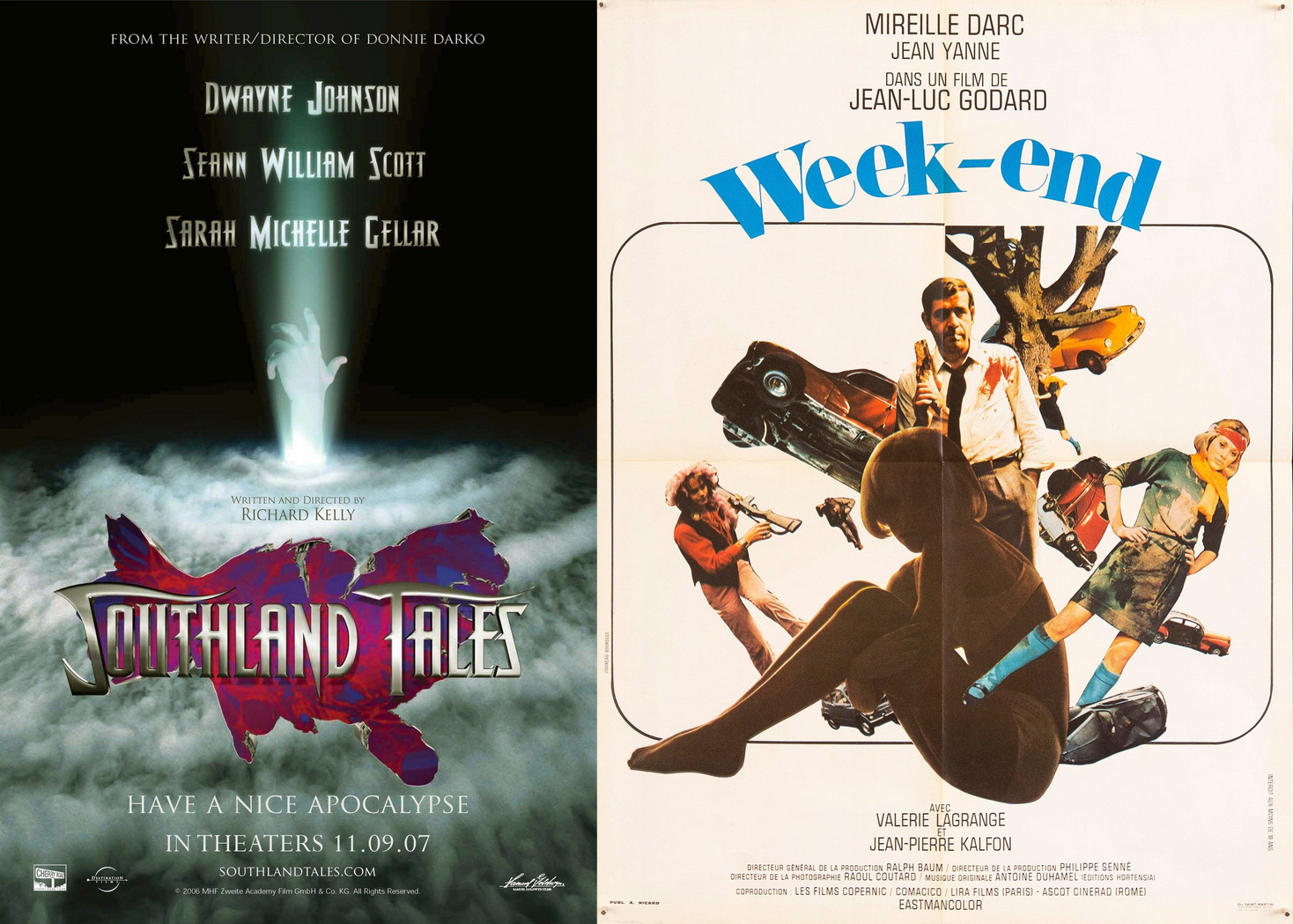
With all that in mind what better film to focus on than Richard Kelly's Southland Tales, the sprawling, notorious follow-up to his cult classic Donnie Darko (which I discuss more briefly in this podcast, along with its own deep if different zeroes zeitgeist connections)? Set in an alternate version of 2008 but shot in 2006, it imagines an America whose War of Terror tremors have caught up with a culture that just wanted to go shopping - transforming the country into a manic police state with an active resistance and wild sci-fi developments emerging virtually overnight. Ambivalent after my first viewing years ago, I invited Andrew Cook as a return guest (after our Eyes Wide Shut episode); he's a big Kelly fan who knows the film inside and out which made for an interesting dynamic as I tried to wrap my head around it. This is one of the longest film in focus podcast segments I've ever recorded, running over an hour as we dig into both the film and the era it depicts...and re-invents as something else (perhaps the Trump era to come). This also makes for an offbeat but appropriate pairing with my sixties film in focus, the very different avant-garde apocalypse of Weekend. Here Jean-Luc Godard reaches the apotheosis and negation of his radical sprint through the decade, anticipating the chaos of May '68 months ahead of time. The selection, in which I wrestle with a film that converted me to Godard when I first saw it but which I had more trouble with this time, is one more tribute to the legendary director who passed away in September (I also focused on his eighties film Hail Mary in a previous episode).

Elsewhere, Andrew's contributions continue when I read his in-depth feedback (alongside my own short reflection) on Zack Snyder's 300, an iconic, and much more popular, film by another of his favorite directors. In capsule form, I run through a number of memorable zeroes films alongside a smaller selection of sixties classics, wrap up my viewings of the nineties (alongside a pair of quite different seventies classics), and offer updates on my recent intake and output in several mediums. Most notably, in addition to a couple archive pieces that I wanted to center and share on their own - a meditation on the power and limitation of To Kill a Mockingbird and a broad polemic expressing my frustration with the state of American culture in the Bush era - I'm also gathering a number of pieces focused on each decade into two public archive episodes, offering a survey not just of zeroes and sixties cinema, but my own perception of them at various points.

As noted in the introduction to this podcast, I am planning to wrap up this podcast approach - combining updates with film reviews and other topics in a main montly episode - after reaching #100 in February. Though there's still much content to come in those months, I can't think of a better way to begin my ending than with this particular episode(s).


Meanwhile, I've continued chugging along with my advance character studies every month - although I need to pick up the pace if I want to have the necessary backlog ready at year's end for a 2023 public debut. November's trio includes one of the third season's scummiest characters alongside one of its most heroic. Unlock these pieces for $1/month to learn more...

(become a patron to discover their identities)


And Patreon also housed my $5/month tier reward, the second part of my discussion with the director of The People's Joker (as discussed in last week's cross-post). Southland Tales comes up again too!


Podcast Line-Ups for...

Search This Blog