Lost in the Movies

The Sunday Matinee: Fists in the Pocket


This is an entry in The Sunday Matinee series.

Fists in the Pocket, Italy, 1965, dir. Marco Bellochio, starring Lou Castel, Paola Pitagora

Story: A restless, intermittently fitful young man seeks an escape - violent, if necessary - from his provincial villa and oppressive family.

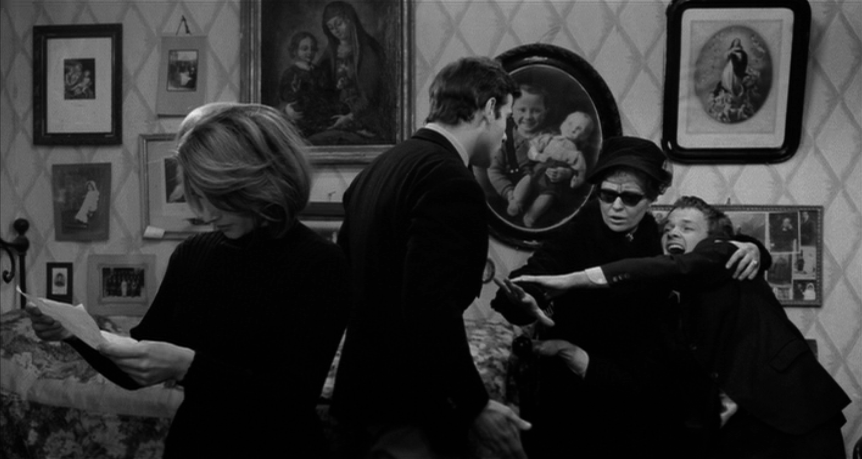
Fists in the Pocket begins with a threatening note, but this j'accuse is just a bad joke. (Disturbing letters will recur throughout the movie, but the written word is an afterthought here; these characters, barbarians after a fashion, write their lives with their bodies and motions, not with mind or pen.) Composed in childlike fashion, words cut out from magazines in an attempt to seem ominous and anonymous, the missive threatens Augusto's girlfriend by revealing the existence of a pregnant mistress. As Augusto patiently reveals to his distraught lover, there is no pregnant girlfriend, no "other woman." There's only little sister Giulia trying to keep the family's sole breadwinner from having a life. Subtext to Augusto's revelation: you wouldn't believe my family. It's telling then that Augusto, the "normal" sibling, is least central to the story, and in some ways the least sympathetic. Within moments we are introduced to Giulia herself, and what an introduction!

Three shots, jump cuts between, and we zoom past her on a motorbike. She glances at the camera furtively and then laughs when two flirtatious bikers skid into the dirt and fly off their vehicle; played by Paola Pitagora, whose gorgeous, slightly gawky sensuality draws us like a magnet, Giulia is compulsively watchable. So is Lou Castel as Giulia's brother Alessandra or Ale, our (anti)hero who descends into the frame in a flash, landing on his feet from a tree perch, restlessly prowling the yard like a caged animal, snapping at his harmless nuisance of a brother. That's seemingly semi-retarded Leone (Pierluigi Troglio), who will later sigh, "What torture, living in this house." Ale is more ambiguous in his own lament - tediously reading the newspaper to his blind mother, he begins to concoct his own headlines. Eventually he moodily declares, "The king of England has died, leaving in darkest despair and desolation..." His mother cuts him off - "But there's still the queen." "Precisely," Ale says, and in his morbid mind the wheels begin to turn.

Remembering the Movies, Oct. 15 - 21

Every Friday, we look back at films released 10-100 years ago this week.

This is a week of outlaws, villains, and renegades - some good, some very bad. Quite a few gangsters, a dictator, and even Satan himherself make appearances, yet there's still room for more ambiguous or even positive rebels, ranging from a vigilante-fleeing hoodlum to a couple precocious punker girls. There are mavericks behind the camera as well: a silent clown taking on the world's leading tyrant, an Establishment-loathing Frenchman paying tribute to the American crime films that inspired him (wait, make that two Establishment-loathing Frenchmen), and another French citizen - this time a Frenchwoman - not only shooting pictures but establishing a studio on American soil. Vive la français (et les diaboliques)!

Gosford Park (Best of the 21st Century?)


#89 in Best of the 21st Century?, a series in which I view, for the first time, some of the most critically acclaimed films of the previous decade.

As Gosford Park opens, with its funereal tones, its period decor, its stately music and mise en scene (evoking the world of Merchant-Ivory), it hardly seems the most modern of Robert Altman's pictures - let alone the most postmodern. Yet, as the story of Gosford Park itself never tires of reminding us, appearances can be deceiving. Gosford Park is a delicious subversion of itself, and its narrative arc subtly mirrors a society's decline and eclipse - an age-old aristocracy faced with a rumbling underclass and a vulgar modernity (represented by an American visiting the estate; he is, of course, in the motion-picture business). A subtle society drama becomes a murder mystery becomes a farce becomes a happy ending; the movie opens with a rainstorm and closes in sunshine, and if there's something a bit ironic in its ultimate optimism, it's nonetheless cheerful and sincere after a fashion. The movie does not quite wear its twistiness on its sleeve, but by the end of the film the characters have broken all the rules of the game and come out smelling like roses - or dirt anyway, which is equally earthy.

The Wind in the Willows - The Open Road


Part 5 of a microseries devoted to Kenneth Grahame's The Wind in the Willows and its film and television adaptations.

"As if in a dream, he found himself, somehow, seated in the driver's seat; as if in a dream, he pulled the lever and swung the car round the yard and out through the archway; and, as if in a dream, all sense of right and wrong, all fear of obvious consequences, seemed temporarily suspended. He increased his pace, and as the car devoured the street and leaped forth on the high road through the open country, he was only conscious that he was Toad once more, Toad at his best and highest, Toad the terror, the traffic-queller, the Lord of the lone trail, before whom all must give way or be smitten into nothingness and everlasting night. He chanted as he flew, and the car responded with sonorous drone; the miles were eaten up under him as he sped he knew not whither, fulfilling his instincts, living his hour, reckless of what might come to him."
-from Mr. Toad
And so at last we reach Toad. To Toad, the Wide World of last week with its vague, nearly intangible longings, its abstract dreaminess, is a chimerical afterthought with which he has no patience. His Wide World is the Open Road, and it's not meant to be tramped with the open heart of a Wayfarer but raced across with the headlong enthusiasm of a reckless driver. The above energetic description of Toad's inadvertent theft is followed immediately, in droll fashion, by a magistrate passing sentence (twenty years!) on the wayward animal - after all, if Toad's world is one of tantalizing reward, it is also a world of drastic consequences. Indeed, what marks the Open Road and sets it apart from the previously explored River Bank, Wild Wood, and Wide World is its tangibility. This is not a timeless arcadia, existential terror zone, or exotic imaginary realm, but a world tied to a certain time and place - specifically, Edwardian England, a world in flux, shining pristinely like one of Toad's motorcars, yet on the verge of achieving a colossal and irreversible wreckage.


The Sunday Matinee


UPDATE: This post originally introduced the "Sunday Matinee" series. Its purpose was initially vague, but it evolved to cover three films each from four different sixties New Waves: Italian, British, Czechoslovakian, and French. The final entry in the British chapter ended up encompassing the whole "kitchen sink" movement while focusing on two particular films. The whole series can be found here.

Original intro

In the old Westerns, an outlaw will saunter up to the out-of-town gunslinger and give him an ultimatum: git out, or meet me at high noon. In a more benign fashion, consider this advance notice to Wonders readers: next week, at 12 pm East Coast time (4 pm by the site's numbers) on October 17, I will launch a new series, exclusive to Wonders in the Dark: "The Sunday Matinee." (The series was cross-posted in full on this site at a later date.) In it I will discuss a personal favorite from cinema history - for the most part these will be neither obvious masterpieces (those have been well-covered here; besides, I want to save many of these for my eventual "favorite great movies" canonical series, which is still on the horizon) nor total obscurities (also well-covered on the site). Most of the movies will be readily available (quite a few will probably belong to the Criterion Collection), usually from celebrated auteurs, and coming from my favorite periods in film history (the 30s through the 60s, with some 70s thrown in; definitely nothing post-1980 and probably no silents) as well as my favorite national cinemas (American, French, and Italian). These will be excellent films which really connect with me for some reason, and with only one possible exception, films which have not yet been discussed on Wonders in the Dark. The possible exception is next week's Fists in the Pocket, which may make a surprise appearance on the horror countdown (fingers crossed), but I will not be approaching at all from that genre's perspective so if anything, the piece will provide a nice complement.

Here are a few reasons for and ideas behind the series:

1) Why these films? One thing I love about this website is that it has introduced me to so many unseen movies; yet at the same time it's enriching to replenish ourselves at familiar hunting grounds. I was initially drawn to Wonders during the 60s countdown, and loved seeing unknown features alongside familiar classics, across a wide range of genres and styles. Since then, we've moved on to later eras and different channels of filmgoing, with more recent decade countdowns and the advent of genre explorations. I'm thrilled with both approaches, but admit that I also miss visiting and talking about what are, for me, the fundamental touchstones.

2) Why Sunday afternoon? This is a good question, particularly since weekends tend to be slow on blogs, and mornings are generally best to garner the most hits. I'll admit I have a sentimental attachment to the time slot - it makes me think of spreading out a Sunday newspaper in a sunny living room, wiling away a lazy Sunday by exploring its pages before going out to the beach, or for a walk, or whatever else (no errands, though). The obligation of church is over, the impetus to activity not yet arrived, and the afternoon stretches before you with the opportunity to both relax and stimulate your mind and imagination.

3) Why Wonders in the Dark? Ultimately I decided to center the series on Wonders. It seemed a natural fit, since there are so many classic-lovers here and since it was Dennis Polifroni who first drew my attention to that reading reviews/Sunday newspaper connection last summer, in a discussion surrounding my write-up on Jaws. (Dennis, though he likes to keep to the comments, once penned his own superb memory piece on Jaws and the cinema-going of his youth - one of the signature pieces in the Wonders pantheon; you've got to read it.) All in all, this seemed a natural fit. So I hope you can make some room for me on your own lazy Sundays; see you next week!

Read the comments on Wonders in the Dark, where this announcement was originally published.

Remembering the Movies, Oct. 8 - 14


Every Friday, we look back at films released 10-100 years ago this week.

(visit Remembering the Movies to further peruse the past)

Today we see an odd confluence of the soft and the tough. Among characters, a boxer isolated in his wounded pride, a couple cons with hearts of gold, and a brittle actress whose throwaway lines betray tenderness and vulnerability. Among films? Superficially sappy stories imbued with a sense of death or despair, wartime dramas with a streak of sentimentality, sharp movies subjected to even sharper criticism, and the odd picture that's all one thing - a fluffy feel-good 80s/90s American parable on the one hand, and a severe 50s/60s Japanese social critique on the other. And we haven't even mentioned an unsuspectingly jovial comedian, on the cusp of becoming one of Hollywood's most tragic figures.

Share your thoughts below, and fasten your seatbelts...

My Winnipeg (Best of the 21st Century?)


#88 in Best of the 21st Century?, a series in which I view, for the first time, some of the most critically acclaimed films of the previous decade.

My Winnipeg filters municipal history through personal experience (or perhaps vice-versa) so forgive me if I do something similar for a moment. Besides, my initial draft of this review was swept away - demolished like the old ice rink shown above - and in starting afresh, I feel compelled to make a meta-blogging and perhaps self-promotional detour. Lately I've been blogging rather furiously, trying to meet the demands of a new schedule I forced upon myself; as a result I am often composing my posts at the last minute (as opposed to this past summer where a leisurely pace allowed ample time to develop entries at my own tempo). Due to the way I've scheduled things, I end up writing a post in my Wind in the Willows series and the latest entry in "Best of the 21st Century?" every Monday night, and this week I noticed some similarities. To wit: in "Wayfarers, All," a late and seemingly digressive chapter in Kenneth Grahame's classic book, the Water Rat meets a Sea Rat who regales him with tales of the Mediterranean; transfixed, the hypnotized creature - who's never left the riverside before - prepares to follow his newfound friend on a grand adventure. He is stopped, at the last minute, by his faithful but perhaps somewhat oppressive pal, Mole, who physically restrains him and then talks him down from the dizzying height of his wanderlust. Thus "cured" of his restlessness, a depressed Rat sits at his desk and scribbles out some poetry about willow wrens.

The Wind in the Willows - The Wide World


Part 4 of a microseries devoted to Kenneth Grahame's The Wind in the Willows and its film and television adaptations.
"And you, you will come too, young brother; for the days pass, and never return, and the South still waits for you. Take the Adventure, heed the call, now ere the irrevocable moment passes! 'Tis but a banging of the door behind you, a blithesome step forward, and you are out of the old life and into the new!"

-the Sea Rat in Wayfarers, All
Of the three central thematic locations in The Wind in the Willows - the River Bank, the Wild Wood, and the Wide World - the last is the only one we never see. Oh, I suppose you could say that Toad's adventures occur in the "wide world," amongst humans and in towns and prisons and woods populated by gypsies, but those amphibious mishaps will be considered, alongside the advent of the automobile and the modernization of England, in "The Open Road," our next chapter. Toad's world is not one of a "blithesome step forward" but a restless drive into the ever-receding distance - very modern and instinctive rather than ancient and existential. The Wide World as laid out above is almost wholly Rat's concern and its siren song is otherworldly, though unlike the Piper's music it does not belong to an underlying level beneath our everyday existence but rather a restless desire to go "out there," to escape boundaries and explore. We "see" this in the sense that the Sea Rat's descriptions are vivid and juicy, but this sight remains a glimpse, a suggestion, not a concrete vision. Ultimately, Rat is prevented from experiencing the Wide World firsthand, and it's never entirely made clear why this must be.

In a way, it seems, the Wide World can only exist as an imaginary realm, fruit for Rat's poetry but not a place that can actually be visited - like Mole's visit to the Wild Wood, Rat's flirtation with the Wide World only serves to remind him of home's value, its tempting quality something to be resisted. But Mole at least gets to find out the hard way why the Wild Wood must not be trespassed upon; Rat never gains that privilege. And so at the end of "Wayfarers, All," the chapter in which Grahame teases us with the call of the southern seas, only to withdraw and finally put the last traces of Willows' dreaminess to rest (the remainder of the story will be brusque and comical) we are left with a tantalizing, elusive, frustrating feeling. We are not scared straight as after our encounter with the Wild Wood, nor vaguely forgetful as after the experience with the Piper; the song of the South has not been silenced and the Sea Rat's presence lingers, haunting the rest of the book, an unshakable reminder of the River Bank's limitations.

Imagine: John Lennon


If John Lennon hadn't existed, I suppose somebody somewhere would have had to invent him. In a single person, so many different, even contradictory strands of cultural and rock 'n' roll history come together. He's the elusive enigma and world-famous pop star, the clown and the martyr, the icon and the individual, the 60s totem ("Give Peace a Chance," "All You Need is Love") and 60s skeptic ("I don't believe in Beatles...the dream is over," "If you go carrying pictures of Chairman Mao, you ain't gonna make it with anyone anyhow.") For all that he came to represent, there were few celebrities more purely themselves, even if that "self" was remarkably fluid. As I once wrote about Lawrence of Arabia, "It is a recurring theme of biography that the character of great men can be elusive. Personality is strong, but identity is not so easy to pin down; identity is the luxury of modest souls who find their niche in life and then burrow away."

Unlike a Dylan or Bowie, whom we suspect were trying on different roles without entirely committing, Lennon always seemed to fully believe whoever he was in the moment, be it macho Liverpool teddy boy, intellectual art student, witty surrealist pop star, psychedelic hippie guru, decadent rock star, or avant-garde advocate for peace. And then, finally, unexpectedly, he was gone - and the role of gunned-down hero, with whom the last embers of a flickering dream were extinguished, seemed to grimly suit him as well as any other. Had he lived, John Lennon would have celebrated his 70th birthday this coming Saturday. John Lennon: Imagine, which was released this week twenty-two years ago, celebrates what should have been only half a life but instead, ended up being all he and we would get.

Search This Blog