Lost in the Movies

Silent Light (Best of the 21st Century?)


#100 in Best of the 21st Century?, a series in which I view, for the first time, some of the most critically acclaimed films of the previous decade.

Rounding out the top 100, this entry on Silent Light concludes the "Best of the 21st Century?" series begun in February, with The Hurt Locker. If the previous post, on Let the Right One In, was the climax of the series, this is the epilogue. Not a written post but images from the film's quiet, entrancing opening, in which the camera tracks in while the sun rises. Paradoxically, a good sequence to close with. Thanks for following the series, and I hope you enjoyed it. The pictures begin after the jump.

Remembering the Movies, Nov. 12 - 18

Every Friday, we look back at films released 10-100 years ago this week.

First off, a note of mourning. Since this series began I have been linking up every 1990 release to a "Siskel & Ebert" review. Watching those old programs had been one of the highlights of "Remembering the Movies" for me - well, lo and behold, this week when I look up Rescuers Down Under the link is broken. Turns out (irony of ironies, given the movie in question) that the D****y Corporation decided to take down the archives for no apparent reason. Which of course breaks all the links on my previous entries as well (luckily I included quotes from those shows in my text). So R.I.P. "At the Movies," and cross your fingers for the archives to go back up when a new edition of the show begins in January. A discussion of the circumstances of the deletion can be found here, along with pointers to where 80s episodes can be found. Almost makes you wish Stokowski was giving the Mouse the finger instead of shaking his goddamned hand.

Another important subject, on which I hope to hear some feedback...

Starting next week, I would like to simplify "Remembering the Movies" so that it consists of the titles of the releases, multiple pictures for each movie, embedded video clips, and maybe some quotes from critics or historians (in other words, the information I'm already presenting, just unfiltered and un-paraphrased, and without my own opinion or prior knowledge mixed in - and also less frequent, as some entries would be pictures/videos only). The paragraphs and story summaries would be axed; the result would be less exploratory than expository (but also more colorful and quicker to take in). I think this would still deliver what readers get from the series - i.e. a walk through movie history - while making the posts easier for me to prepare (the current approach is frankly too time-consuming to continue). In order to still write something, I might pick one film a week and write up a capsule review. Otherwise, it will be a mostly visual approach.

Share your thoughts on this new plan below - lurkers, that means you too! As I cut down on blogging in the coming weeks and months, your response will help determine if "Remembering the Movies," in one form or another, is something I preserve.

This week's films - with the customary paragraphs, information, quotations, and links - follow the jump.

Let Them All In... Let the Right One In book/movie/remake


Let the Right One In (2008) is #95 in Best of the 21st Century?, a series in which I view, for the first time, some of the most critically acclaimed films of the previous decade. Along with this film, I will also be discussing the recent American remake, Let Me In (2010) and the book Låt den rätte komma in (2004) by John Ajvide Lindqvist, upon which both are based. There will be spoilers.

On a silent, snowy evening, a taxi pulls up to a deserted courtyard. The cold, lonely apartment blocks loom overhead, watching implacably, either unwilling to share their secrets, or without any secrets to share. But one frosted window at least has a human face in it – a little blonde boy, bare-chested, uneasily gripping a knife in one hand, the other pressed up against the glass, leaving a faint imprint, a marker to shout out impotently, “I was here!” Out of the taxi steps an older man and a young girl; though together, they still seem fundamentally alone - even that lonely boy upstairs has a warm, well-lit room behind him. On reaching their own room, the mysterious couple begin covering up their own frosted window with advertising placards, flashy but vapid come-ons ironically placed to block out the world. Down in the snow bank below, a haggard man pisses in the snow, glancing up at his peculiar neighbors and wondering, perhaps, who they think they are, closing themselves off like that. Don’t they know the world will already take care of that for them? Why seek isolation?

Because, as it turns out, there are some things worse than being alone. Such as joining together in brief, violent, frenetic couplings in which one person leeches the life out of another; or even worse, befriending and assisting this very leech, quenching your own isolation only at the expense of another’s life and happiness. These islands of humanity, floating in the impersonal sea of Blackeburg, both fear and desire human contact; they need it, but they know – or will discover – at what price this need can be fulfilled. Each of these individuals is as human as the next, but at least one is something else besides: a creature of the night, a blood-craving immortal, a murderous eunuch, a vampire. And this vampire, seemingly the most innocent of the four characters, that little girl who climbed out of the taxi, can only infiltrate your defenses if you let her enter your home – without permission, she will bleed from every orifice, so that even passivity breeds violence. Yet you must be careful before granting permission. It’s not enough to let just anyone in…


The Wind in the Willows - Conclusions


This is a directory for the microseries devoted to Kenneth Grahame's The Wind in the Willows and its film and television adaptations.
"After this climax, the four animals continued to lead their lives, so rudely broken in upon by civil war, in great joy and contentment, undisturbed by further risings or invasions."
-from The Return of Ulysses
And so the Willows series comes to a close. I've already summarized and synthesized my observations, so I'll let this entry serve primarily as a directory. For easy navigation between the different chapters in my series, here are links to all the posts, with an explanation of each piece's purpose.

Brief history of the book's creation and reception, an explanation of the series, and capsule reviews of the different film adaptations - plus links to other Willows posts
Celebration of the story's central location, focusing on the tension between the river's comforts and excitements, with a digression on the Piper at the Gates of Dawn
Meditation on Willows' "heart of darkness" and its psychological implications
Examination of the Wayfarer's "call of the South" - what the world "beyond" represents in the tale, and why its siren song must be resisted
Drive down Toad's highway to hell, using his motormania to discuss Edwardian society and what it represents in the book
Exploration of Toad's ancestral manor, its seizure by the weasel rabble, and its social and political resonance - from conservative aristocracy to liberal preservationism
Digression on the subject of Grahame's wacky yet clever anthropomorphism
Reflection upon the importance of home in Wind in the Willows, including a short biography of Kenneth Grahame and a synthesis of all the previous entries in the series

Psycho: Long Night at the Bates Motel


Contains spoilers - if such a warning is necessary.

Last week, I almost wrote about Psycho as my #1 horror film. I went with The Shining instead - partly because it may actually be my favorite, partly because it's more exclusively a horror film than Psycho (which contains strong elements of mystery/suspense and psychological drama, with the horror elements consuming surprisingly little screen-time). Besides, the film had already been discussed in the last entry for the horror countdown I was paying tribute to (in a great picture post - check it out). On the other hand, the time was ripe to write about Psycho, as I had just managed to see on the big screen, proceeded by a playful introduction from critic David Thomson, who described his overwhelming desire to grab someone and hold on for dear life after the "big scene" - he even claimed that his 19-year-old self loudly proclaimed to no one in particular (except perhaps the auteur hiding behind the screen as if it was a shower curtain), "Oh please, don't do that to me again!"

Fascinating to me because, well, I've always known that the shower scene was coming. And I've always known that Mrs. Bates was Norman. Indeed, the film has never held many surprises for me, and as I watch it for the umpteenth time I find myself humoring some vaguely contrarian thoughts which perhaps have little bearing on the film itself, but a great deal on my own involvement with it. Psycho has probably been written about more times than any other film save Citizen Kane - although perhaps Norman's knife surpasses Charles' sled in inspiring critical prose. There's a great deal out there already both in print and the blogosphere (for a great example of the latter, check out the Film Doctor's in-depth analysis of the very first scene, tartly titled "Turn Momma's Picture to the Wall".) So what I have to offer here is just my own personal take on the film (which certainly may overlap with others' observations), some scattered reflections and observations, as sliced and diced as Marion's corpse after that fatal cleansing.

The Sunday Matinee: The Loneliness of the Long Distance Runner


This is an entry in The Sunday Matinee series.

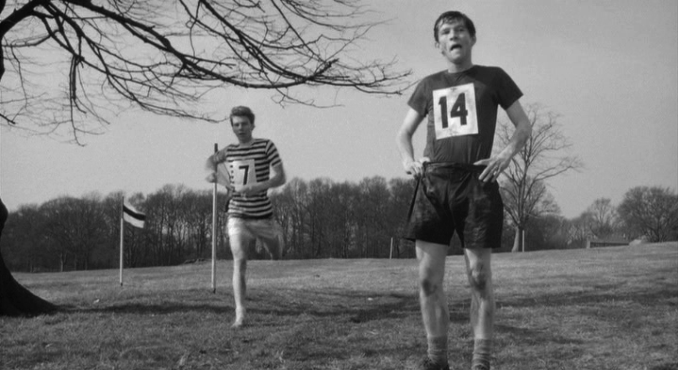
The Loneliness of the Long Distance Runner, UK, 1962, dir. Tony Richardson, starring Tom Courtenay, Michael Redgrave

Story: Colin has been sent up for robbing a bakery, but to his surprise he finds himself being handed advantages and privileges at the reform school. As it turns out, he’s a talented runner and the school director hopes he will help defeat a prestigious public school in an upcoming race.

First things first, the timing of this entry is no accident. This morning the New York Marathon kicks off – so good luck to all the runners, particularly my friends Patrick and Morgan. Secondly, tributes aside, it should be noted that this is in many respects an anti-sports film, both in the sense that it thumbs its nose at “sports film” conventions, and because it views competitive athleticism itself with severe antipathy. But more on that by the by. When we are introduced to Colin, he’s pulling double duty, running and narrating just like Fabrizio at the start of last week’s entry, Before the Revolution. There the similarities more or less end. Whereas Fabrizio was politicized in theory but distanced from any sense of class struggle, Colin – without necessarily articulating it in explicitly political terms (save for a few somewhat clumsy “consciousness-raising” lines of dialogue) – views his entire life as one long struggle against authorities and class constrictions. “Running’s always been a big thing in our family,” he tells us in the opening narration (during which, unlike Fabrizio, he runs away from the camera rather than towards it). “Especially running away from the police. It’s hard to understand. All I know is that you’ve got to run. Run without knowing why, through fields and woods, and the winning post’s no end even though barmy crowds might be cheering themselves daft. That’s what the loneliness of the long distance runner feels like.”

Remembering the Movies, Nov. 5 - 11

Every Friday, we look back at films released 10-100 years ago this week.

Halloween's over (with one exception), time for...Christmas? Shopping malls aren't the only ones to receive their holiday spirit a little early; this week Remembering the Movies features two Yuletide films right up front, plus a film set in wintry Alaska, just to get you yearning for those chestnuts round an open fire. Several great directors make an appearance below - Luis Bunuel, Tex Avery, David Lean, the ever ubiquitous D.W. Griffith, among others. Yet amongst the classic contenders I chose to highlight Home Alone above. And why not? Though I can't say it "holds up" (based on the reputation established when I was 7) it still fuels my nostalgia for a time when I was just starting to juice my now-defunct moviegoing jones. For more on that era, visit "They Once Were Coming Attractions...", my tribute to childhood cinematic excursions. For the rest, pack up your sleigh, and push it over the precipice (jump) below...

In Praise of Love (Best of the 21st Century?)


#95 in Best of the 21st Century?, a series in which I view, for the first time, some of the most critically acclaimed films of the previous decade.

Let me take a moment to clear up some misunderstandings about the “Best of the 21st Century?” title. The question mark is there for a reason; this is not my canon for the decade, but rather the collective critical canon as compiled by the website They Shoot Pictures Don’t They?. A talented critic named Kevin B. Lee started an exercise years ago in which he moved through the website’s all-time canon, watching and discussing the films he had not yet seen. His imaginative approach is to create video commentaries for each film – while my own work here is nowhere near as ambitious, I’m taking a similar approach, writing about each film on the 21st Century list that I haven’t seen. Key point: that I haven’t seen, so I have no way of knowing, going into a viewing right before a review, if I’ll like the movie in question. I’ve seen a few responses in the past saying something to the effect of “Can’t wait to see your other favorites” or “Do you really think this is one of the best of the whole decade?” Hopefully this introduction clarifies my approach.

I bring this up because otherwise some of you might be confused by what follows. So far in this series, I’ve been generally positive about the films discussed even if dissenting from the acclaim in some regards (which was already too much for some). This time I have to dissent from the apparent consensus altogether; by and large, I didn’t care for In Praise of Love, so for me that response to the question mark of my series title would have to be a “No.” It’s ironic that this film would be the one to warrant that response, since Jean-Luc Godard is one of my favorite directors of all time. Yet even in his prime, I think he could be hit-and-miss, often within the same film. We take the lows of Godard because the highs are so exhilarating; unfortunately in Praise, the latter are scarce and the former all too abundant. Though some have seen it in exact opposite fashion, I find the movie gets much better as it goes along, leading finally to a rapturous conclusion, but it’s too little too late to save the movie as a whole. The meta-questions on Godard’s old work vs. his new are most creatively addressed by Bob Clark in his “the-best-way-to-criticize-a-film-is-to-make-another-film a-video-game” response to Film Socialisme last week. As for In Praise of Love, I come not to praise but to bury. So proceed below the fold…

The Wind in the Willows - Dulce Domum


Part 8 of a microseries devoted to Kenneth Grahame's The Wind in the Willows and its film and television adaptations.
"Home! That was what they meant, those caressing appeals, those soft touches wafted through the air, those invisible little hands pulling and tugging, all one way! Why, it must be quite close by him at that moment, his old home that he had hurriedly forsaken and never sought again, that day when he first found the river! And now it was sending out its scouts and its messengers to capture him and bring him in. Since his escape on that bright morning he had hardly given it a thought, so absorbed had he been in his new life, in all its pleasures, its surprises, its fresh and captivating experiences. Now, with a rush of old memories, how clearly it stood up before him, in the darkness! Shabby indeed, and small and poorly furnished, and yet his, the home he had made for himself, the home he had been so happy to get back to after his day's work. And the home had been happy with him, too, evidently, and was missing him, and wanted him back, and was telling him so, through his nose, sorrowfully, reproachfully, but with no bitterness or anger; only with plaintive reminder that it was there, and wanted him." 
-from Dulce Domum
Mole and Rat are trekking back from a winter excursion. It is late in the evening - "the shades of the short winter day were closing in on them, and they had still some distance to go." For one reason or another, they find their path winding through a village and there they stand on the outside looking in, observing scenes of domesticity idealized all the more for being somewhat hidden. Briefly comforted by these visions of half-dreamt coziness (like the boy given visions of Christmas in Lois Lowry's The Giver) their minds quickly return to their bodies, cold and tired in the snowy dusk. Their own home calls - Ratty's cottage by the river with its fireplace and furniture and view of the icy bank out its windows. Yet in truth, this is not their own home, however welcome Mole has been made to feel within its walls. Rat hurries on but Mole freezes when this revelation hits him, with the force of a physical blow, but one tenderly applied, and all the more aching for it.

"[Mole] stopped dead in his tracks, his nose searching hither and thither in its efforts to recapture the fine filament, the telegraphic current, that had so strongly moved him. A moment, and he had caught it again; and with it this time came recollection in fullest flood." Rat insensitively impels his friend on and when they stop to rest further down the trail, Mole begins to weep; with a little prodding he reveals how homesick he has become, how suddenly and painfully he has been overpowered by the desire for his simple little hole in the ground. A sympathetic Rat tracks down Mole End - in this the animals, returned to their natural instincts, are guided by scent. Together Rat and Mole restore the shabby little apartment to a tidy and appealing state, then invite a group of carolling field mice inside, and lay out a Christmas feast on the table, with singing, and merriment, and camaraderie filling the air. Finally they turn in for the night, and as Mole drifts off to sleep, he pleasantly contemplates the rich fulfillment he can find in his own home:
"He saw clearly how plain and simple--how narrow, even--it all was; but clearly, too, how much it all meant to him, and the special value of some such anchorage in one's existence. He did not at all want to abandon the new life and its splendid spaces, to turn his back on sun and air and all they offered him and creep home and stay there; the upper world was all too strong, it called to him still, even down there, and he knew he must return to the larger stage. But it was good to think he had this to come back to; this place which was all his own, these things which were so glad to see him again and could always be counted upon for the same simple welcome."


My #1 horror film: The Shining


Just in time for Halloween (wait, it's over?), this is a response to the Wonders in the Dark Horror Countdown, which just wrapped up yesterday (The Shining also appeared on their list at #15, generating some comments almost as long as their post). A few films could have taken this spot for me - Rosemary's Baby and Pyscho were other close contenders, but ultimately this was the one I wanted to re-watch and explore in this short and informal piece. Check out the countdown, by the way, if you haven't already. And the genres keep coming - an animation countdown will launch Tuesday on the website; once it's over, I'll offer my #1 pick for that as well. For now, the Overlook Hotel...

How do you pick a #1 horror film? Well, of course, there are two parts to that question - why #1, and what's a horror film? Let's take the second part first. One great aspect of the recently concluded countdown was that it opened my eyes to viewing a whole slew of movies through this genre's framework - films with cross-genres, plots, and styles wildly divergent. Considered in the process were the sci-fi Alien, the adventure-suspense Jaws, the "realistic" serial killer movie Henry: Portrait of a Serial Killer, the surrealistic, noiresque, perhaps just purely Lynchian Blue Velvet, even the Italian "rebellious youth" 60s classic Fists in the Pocket (which unfortunately did not make the top 100, but was mentioned in the offing). These were included alongside black-and-white monster movies, ubiquitous slashers, grotesque giallos, and other usual suspects. The approach broadened my own horizons, made me see both the genre and the films in question in a new light, and made for a fun list because you never knew what would show up! Still, when going for #1, all-time, top horror, it feels right to return to the roots of the genre, its core values.

Search This Blog